


There is a question every child eventually asks. It is about the family dog, the one who was just a puppy when they were born. The dog who snuggled them to sleep, the one who let them paint his nails, pull his tail, and who '“helped” open their Christmas presents. When that dog passes, the seven-year-old will look up through tears and a snotty nose and ask their parents: “Will I see Ollie again?”
Mike Tyson said, “Everyone has a plan, until they get punched in the face.” As a parent that’s how this question hits you. As you look into those tearful eyes, suddenly you freeze, and mumble something about heaven being a wonderful place, that has no pain, and then you try and change the subject or realistically you offer a distraction: “Wanna go get ice cream?”
But maybe there are some answers to the question. I want to make the case that the Bible leaves us some clues, and that serious minds from Thomas Aquinas to John Wesley to C. S. Lewis have argued about it for centuries, and the answer is better than the distraction of a cone of cookies & cream.

This is a question that reached the highest level of religious authority. In December 2014, headlines worldwide announced that Pope Francis had comforted a boy whose dog died by promising, “One day we will see our animals in the eternity of Christ.”1 The story ran everywhere, including the front page of the New York Times. But there was a teensy weensy problem: Pope Francis never said it. The quote was actually decades old, loosely attributed to Pope Paul VI, and then in one of the more memorable correction in it’s history, the Times had to recant what they said (I couldn’t help myself with that one).
So, let’s do this properly. Sources open, footnotes on, and pour some coffee in your favorite mug2 and lets look together at what the Bible says about the question: do our pets go to heaven?
First, the Word We Need to Translate
Genesis 2:7 says God breathed into the man and Adam became “a living soul,” the Hebrew phrase is “nephesh chayyah.” Take a guess where that exact phrase appeared first? The answer is Genesis 1. Before Adam took his first breath the phrase was used for creatures of the sea, then for the animals on land, then for the birds and everything that creeps. Every one of them called a “nephesh chayyah.”3
So, why don’t English Bibles read it this way? The answer is that William Tyndale made the translation change in 1530, he gave Adam a “lyvynge soule” and the fish “creatures that move and have lyfe.”4 The Coverdale Bible (1535), the Geneva Bible (1560), and the Bishops’ Bible (1568)5 all followed Tyndale’s translation. Which leads to how it got to us. When the King James companies met in 1604, they were under a rule to follow the Bishops’ Bible wherever the original text permitted.6 The King James Bible became the dominant English translation for the next few centuries and maintained Tyndale’s translation decision, which was subsequently passed down to us.
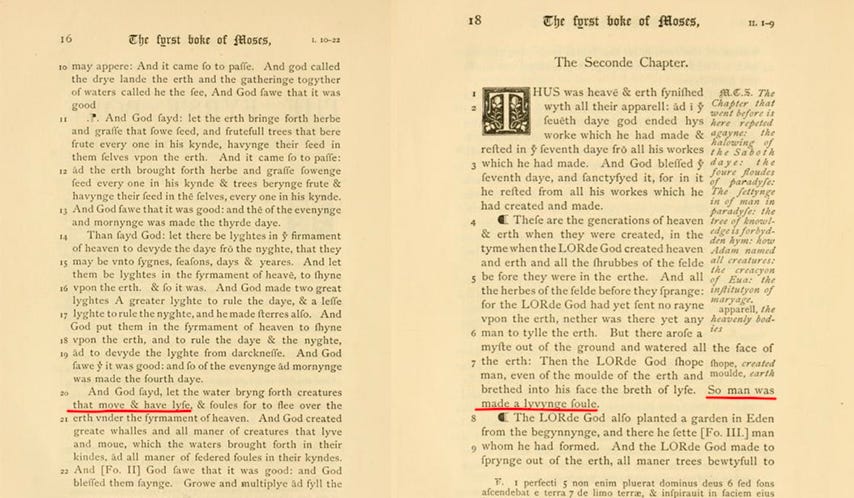
However, the Bible says no such thing. In Hebrew thought, animals are ensouled; they are breathing, feeling, living beings, that God blesses in Eden.7 After the flood, God makes His covenant with his people and He specifies animals five separate times: “with every living creature.”8 In the book of Jonah, the final verse ends with God defending His compassion for Nineveh, including, the last line, its many animals.9 The psalmist says: “LORD, you preserve both man and beast.”10 And Jesus, asked to measure the Father’s attention, went and pulled the cheapest animal off the shelf. Five sparrows for two pennies, “and not one of them is forgotten before God.”11
None of this settles what happens in eternity, and as one Old Testament sage explained it like he was Gandalf blowing smoke rings with his churchwarden. “Who knows,” shrugs Qoheleth, “whether the spirit of man goes upward and the spirit of the beast goes down into the earth?”12 Fair enough, however, this is also not a simple case closed decision. So, here are three answers the church has given to the question.
View One: The Classical No
The traditional answer, argued most carefully by Thomas Aquinas, is a no, your dog is not in heaven; but it is a pastoral no. Aquinas taught that animals possess real souls, but they are mortal ones. A dog’s soul is sensitive: it perceives, feels, remembers, and loves. What it lacks, in this view, is the rational, self-transcending dimension that survives death; an animal’s soul is so woven into its body that when the body dies, the whole creature dies.13 Which means your dog was fully real and fully loved by God, but when his body gave way, his soul followed.
Two thoughts on the classical position. First comes the modern, harsher view: animals are soulless machines, and their yelps are little more than mechanical noise. That perspective comes from René Descartes, whom I think therefore nobody should confuse with the Bible.14 Second, Rome’s approach today, which still maintains the nuances from Aquinas; Pope Francis (in words he actually wrote) envisioned eternal life as a shared experience in which “each creature, resplendently transfigured, will take its place.”15 And if you are thinking, yeah, but what about Protestants? Hold your grape juice, we will lean more Protestant in the next two views.
The strength of the classical view is its clean philosophy. It maintains the dignity of animals while also holding the theological distinction between animals and humans, the latter being made in the image of God. Its weakness is the Bible’s actual ending, which is where we find the second view.
View Two: A New Earth Full of Animals
Ask a lot of folks what they imagine heaven to be like and they may say; beautiful clouds, coffee with grandpa, and golfing the back nine of St. Andrews with the Apostle Paul. The Bible itself pictures a renewed earth, and its earth is full of all types of creatures.
Isaiah’s vision of the world reads like a animal inventory for a zoo: the wolf lodging with the lamb, the leopard with the goat, the lion eating straw like the ox, a toddler playing safely near the cobra’s den (sounds a lot like Florida).16 Paul says creation itself, “will be set free from its bondage to decay and brought into the freedom of the glory of the children of God.”17 The Bible points towards a new creation set free from the bondage of the past. In John vision he looks up and this is what he hears.18
Even the fish get a verse. You hear that Flounder?
This is why theologians like N. T. Wright insist that Christian hope is about resurrection and renewal.19 The endgame of the Bible is Eden restored. The first Eden was not a people-only garden, but a land where humans and animals flourished together. On this view the new creation includes animals, whole ecosystems of them, gloriously beyond what we’ve seen.
Let’s also not forget what Revelation tells us; when heaven opens, Jesus and His armies come back on horses.20 This means somebody up there has a stable. “Away now, Shadowfax! Run, greatheart, new creation is coming!”21
What this view doesn’t promise—on its own—is your dog will be there. Animals, yes, but your specific pet? We don’t know. Which brings us to the boldest answer in the yard.
View Three: Wesley’s Wager, Lewis’s Doorway
Published in the Arminian Magazine in 1782 was a work from John Wesley entitled “The Great Deliverance.”22 In it Wesley makes the argument that animals suffered under a curse they did not cause. If the Bible points towards restoration in Romans 8, then the promise of the liberation of creation applies to the creatures found within creation as well. Wesley went further, and carefully speculated that God might even raise animals higher than they were.
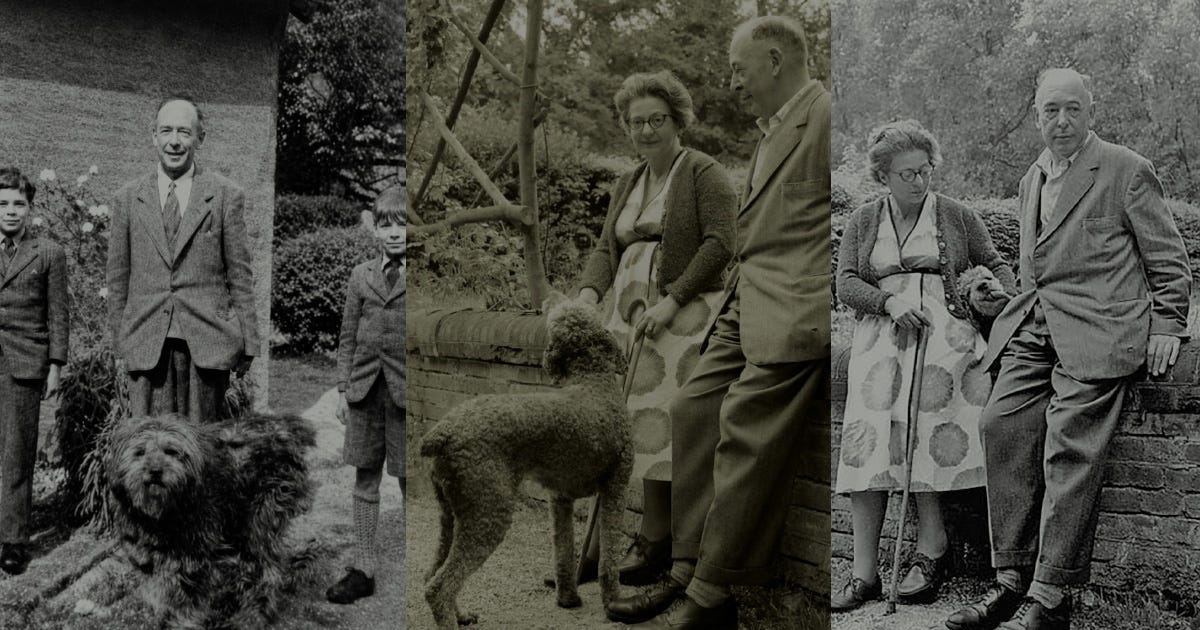
Through C.S. Lewis we find more definition to what Wesley ponders. In The Problem of Pain, he suggested that tame animals acquire a real selfhood ‘through relationship’. The dog becomes most fully itself in its bond with its people, and since the people are in Christ, the animal may be carried into eternity inside that bond, the way a note lives inside a chord.23 Lewis also painted a picture of this in The Great Divorce. A woman of no earthly importance walks through heaven trailed by a parade of birds and beasts, and the narrator says that every animal she ever showed kindness to had become more alive, more itself; in her love, because her love came from somewhere.24 Billy Graham, was asked this question and in typical Graham fashion his response was: “If it takes your dog to complete your happiness in heaven, then your dog will be there.”25
The strength of this view is that it takes the hope of Romans 8 with faithful seriousness. The weakness as you have probably recognized is that Scripture nowhere promises the resurrection of particular animals. Both Wesley and Lewis see their proposals as hopeful anticipation.
The Bible itself doesn’t say yes, but it also doesn’t say no. The difference for this view is that it speculates upwards, looking to a God who is full of wonderful surprises.
What I Tell the Seven-Year-Old
Three answers: a pastoral no, general animals, yes, and a hopeful, “maybe even yours.”
Where does that leave the child in tears?
The Bible never trivializes this grief. The God of Scripture blesses animals, covenants with them, feeds them, numbers them in Nineveh’s headcount, and notices the funeral of every two-penny sparrow. Grieving a pet is normal, Romans 8 says the whole creation is groaning for repair, and to lose a pet is to feel one small tear in it up close.
The Bible’s last page belongs to renewal on a scale we tend to underestimate. The voice on the throne says, “Behold, I am making all things new.”26 Mark how the text is worded: all “things” made new, instead of all new things. The promise is pointing towards restoration, to the healing of what was, and “all things” is an enormously large statement to find a dog in.
Can I promise you’ll see him again? No; we have seen the Bible doesn’t say yes, but it also doesn’t rule it out. What I can show you is the direction we are headed. The story ends with a garden-city on a renewed earth, lions in the straw, horses in the sky, every creature in the sea finding its voice, and a God whose mercy, Wesley reminded us, is over all His works. If, somewhere in that world, a familiar shape comes bounding across the grass toward you, it will surprise nobody who read the ending carefully.
The sparrows are not forgotten. It’s hard to believe less of the dog who loves you—isn’t that right Walter?


Enjoy the Bible’s “wait… what?” moments?
Here are three more puzzles to put together:
“Dogs in Heaven? Pope Francis Leaves Pearly Gates Open,” New York Times, December 11, 2014, with the paper's subsequent correction retracting the quote's attribution.

Genesis 1:20–21, 24; Genesis 2:7.
William Tyndale, The First Boke of Moses called Genesis (Antwerp, 1530), Gen. 1:20, 2:7. Modern edition: David Daniell, ed., Tyndale’s Old Testament (Yale University Press, 1992).
Myles Coverdale, Biblia: The Bible (1535), Gen. 2:7; The Bible and Holy Scriptures (Geneva, 1560), Gen. 2:7; The Holie Bible (Bishops’, 1568), Gen. 2:7.
Rules 1 and 14 of the fifteen instructions to the translators, 1604. Text in Alfred W. Pollard, Records of the English Bible (Oxford, 1911), 53–55. Also in David Norton, A Textual History of the King James Bible (Cambridge, 2005
Genesis 1:22.
Genesis 9:9–17.
Jonah 4:11.
Psalm 36:6.
Luke 12:6; cf. Matthew 10:29.
Ecclesiastes 3:21.
Thomas Aquinas, Summa Theologiae I, q. 75, a. 3; cf. Summa Contra Gentiles II.82.
René Descartes, Discourse on Method, part V.
Pope Francis, Laudato Si' (2015), §243.
Isaiah 11:6–9; cf. Isaiah 65:25.
Romans 8:19–22.
Revelation 5:13.
N. T. Wright, Surprised by Hope: Rethinking Heaven, the Resurrection, and the Mission of the Church (New York: HarperOne, 2008).
Revelation 19:11, 14.
No, Tolkien doesn’t quite say it like that in Two Towers.
John Wesley, “The General Deliverance,” in The Works of John Wesley, vol. 2, Sermons II: 34–70, ed. Albert C. Outler, Bicentennial ed. (Nashville: Abingdon, 1985), first published in the Arminian Magazine 5 (1782).
C. S. Lewis, The Problem of Pain (London: Geoffrey Bles, 1940).
C. S. Lewis, The Great Divorce (London: Geoffrey Bles, 1945).
This is widely attributed to Graham, you can find it here, but I don’t see any footnote related to where the author found it, Cathleen Falsani, "Do All Dogs Go to Heaven? Pretty Sure This One Did," HuffPost, July 20, 2010.
Revelation 21:5.
My kid wanted to know if there would be dinosaurs in heaven.
He also asked if there will be playgrounds and toys, which made me wonder if kids grown up in heaven.