
Why We Forge St. Augustine’s Signature

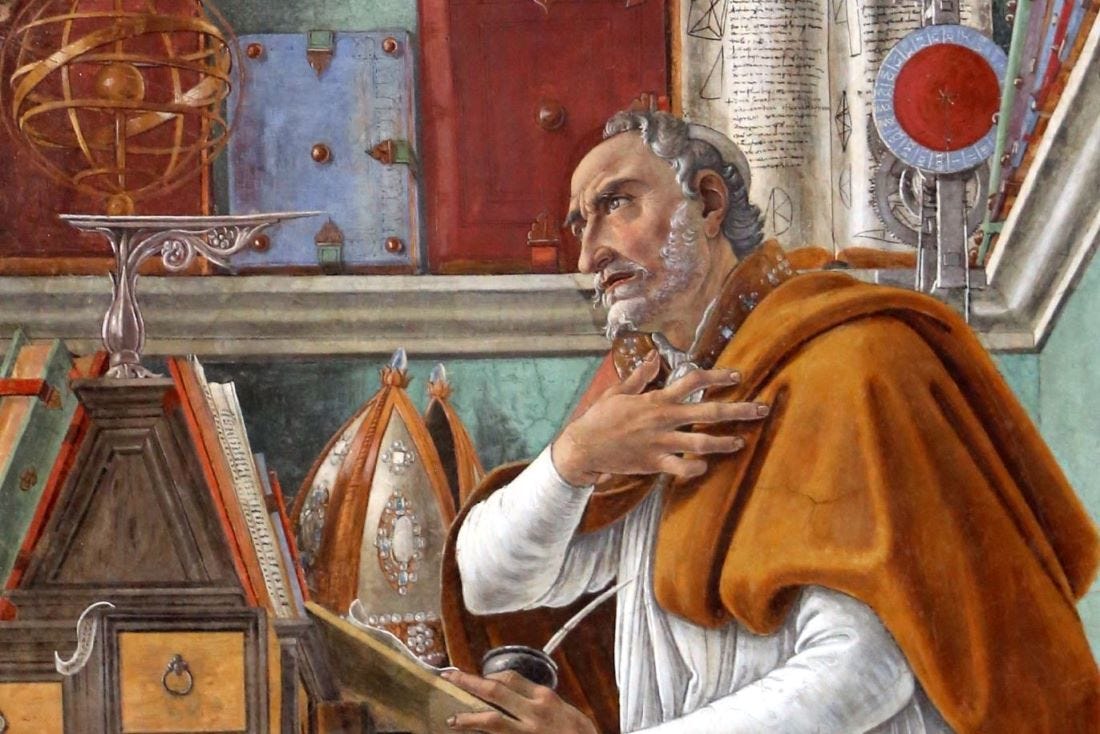
The church is a hospital for sinners, not a museum for saints.
God loves each of us as if there were only one of us.
Love God and do what you will.
In essentials unity, in non-essentials liberty, in all things charity.
Resentment is like drinking poison and then hoping it will kill your enemies.
All of these are quotes often attributed to St. Augustine1. There is just one problem. He never said them. They sound Augustinian, pithy, rhythmic, theological as if pulled right from Confessions.
But the real confession is they are not his. This is not a knock on those who have posted one of these quotes on Substack, Instagram, or any other social media platform. I know I’ve done it before. I’ve even quoted some of these in sermons and attributed them to the Doctor of Grace.
Somewhere along the line in history, quotes like these and many others became identified as the words of St. Augustine, though he has no connection. Let’s explore why we forge Saint Augustine‘s signature and the biases that got us here.
Authority Bias
Take the quote, “preach the gospel and if necessary, use words.”
Sometimes attributed to St. Augustine, but more often misattributed to St. Francis of Assisi. Now imagine the quote was never attributed to either one of them, it didn’t exist and I proudly posted it for the first time as a Substack note today. Within an hour the comments on that note would tell me, I am being illogical. The gospel is a message, you have to use words. That is the equivalent of saying, “give me your phone number if necessary use digits.” They would say, your good works won’t save someone, it was Jesus' good work that does. On and on it would go, until I deleted the note, and sat by myself in my truck drowning my sorrow by turning up Creed.
At a psychological level our tendency is to give more weight to statements when they come from someone of authority. That same quote coming from me, would be critiqued and ultimately ignored. But attach it to St. Francis of Assisi or St. Augustine and suddenly it is transformed.
The words become timeless, weighty, and most significantly—credible.
In his pioneering work Stanley Milgram2 found that ordinary people would obey instructions from an authority (a man in a lab coat) even when it meant delivering what they believed were painful electric shocks to others.
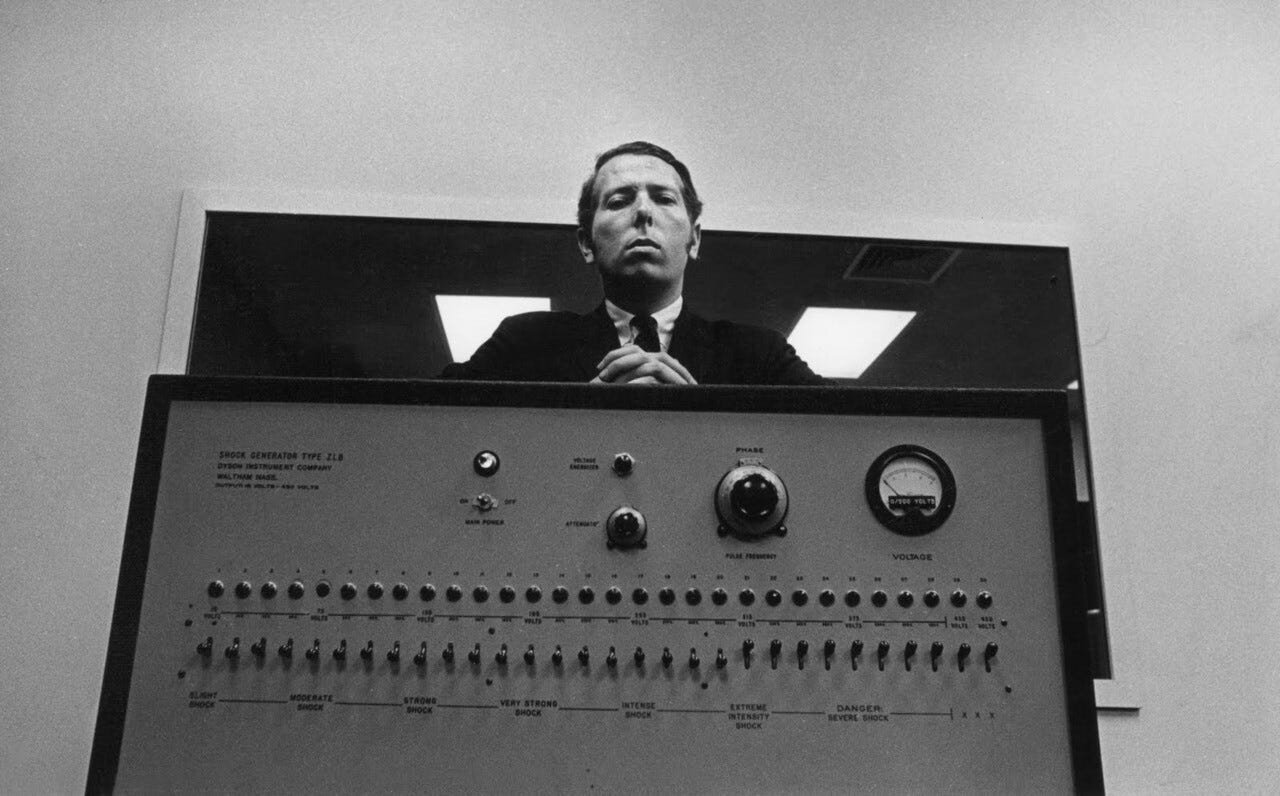
This is called authority bias: our tendency to assume something is true if it’s linked to an authority figure.
Intentional or unintentional a quote tied to St. Augustine becomes inked with the Doctor of Grace's signature. The perceived value turns from the merit of the words to the merit of the name attached.
Halo Effect
In 1920, an American psychologist by the name of Edward Thorndike published a paper, called A Consistent Error in Psychological Ratings3. His study involved large corporations. He noticed that if an employee was rated high on one trait, say physical appearance, they tended to be rated high on all traits, even when there was no evidence for it. The halo effect is one that runs rampant through churches. It is why some people uncritically accept a pastor's teaching because of that preacher's charisma and authority. This is one of the reasons why manipulative or domineering pastors are not fired earlier in their tenure, the authority they possess creates a facade around their character.
Of course, both Milgram’s obedience studies and Thorndike’s work on the halo effect have been critiqued and refined over time. Still, they remain classic illustrations of how easily we defer to authority and allow reputation to color judgment.
And few halos cast as bright of a light as St. Augustine. He is also in a unique space in that all the major streams of Christianity, claim him4. You will find Confessions, in the office of a Presbyterian pastor, the study of a Catholic nun, and in the library of an Orthodox priest. St. Augustine's name evokes depth and theological brilliance. So, when you read something stirring and his signature is at the bottom, the words glow brighter because they are refracting the halo of his reputation.
In other words, the wisdom of the quote is amplified by who we think said it.
The Desire for Continuity with Tradition
For Christians, in particular, we desire to be connected to what the book of Hebrews calls, “the great cloud of witnesses.” The quotes that inspire us today, we want to align with the great books in the halls of Christian history. We tend to have an aversion to novelty. Which is understandable, if you come up with a new doctrine that has no roots in the past 2000 years, there’s a good chance it’s wrong. So, when a modern sounding insight is connected to St. Augustine, it feels like it belongs in the hall and is not easily discarded.
To be fair, many misattributed quotes to Augustine sound like Augustine. They have that rhetorical rhythm and weighty theological depth. At a neurological level our brains are wired for cognitive fluency, meaning, if something feels familiar in style we are more likely to accept it as genuine. This is why so much music on Spotify or Apple sounds the same. It’s the familiarity we are drawn to. So, when a quote feels Augustinian, the benefit of the doubt is given that it is.
Conclusion
On a deeper level, many don’t trust the power of beauty or truth on its own merit. We think it requires a signature, a seal of approval, to justify its worth. This is true whether it’s a Monet painting, Buffett’s stock advice, or a novel by Dostoevsky. It’s as if the idea itself isn’t quite enough (or we don’t know if we can trust our own intuition), we want to anchor it to a giant like St. Augustine to validate its worth.
In short, we forge St. Augustine’s “signature” on these quotes because we crave the weight of authority, the proof of tradition, and the safety of validation. The quotes may be moving on their own, but when signed with St. Augustine’s name, they become eternal.
This is not just about St. Augustine. It’s about why we attribute pithy wisdom to Einstein, Lincoln, Twain, and St. Francis of Assisi too. It’s why there are a plethora of quotes attributed to Tolkien and Lewis floating online, though they came from neither the Wardrobe nor the Shire.
But maybe your own words are enough.
They don't need to be connected to a Doctor of the church to have value. That the value is for them to be wise, true, and beautiful, to see if time allows them to stand on their own.
Perhaps, it’s worth reflecting on our own biases and the way we elevate ideas and thoughts when they carry the perceived weight of authority. And maybe we don’t need St. Augustine’s forged signature to know the truth when we hear it.
“Love God and do what you will” is often cited as Augustinian. While it is not a direct quotation, it is a paraphrase of a longer section from his homily on 1 John 4:7–8. To be fair quite a few of the quotes attributed to him are paraphrases of things he has written.
Milgram, S. (1974). Obedience to authority. New York: Harper & Row.
Thorndike, E. L. (1920). A constant error in psychological ratings. Journal of Applied Psychology, 4(1), 25–29.
Now, while St. Augustine is widely read and cited across Catholic, Protestant, and even Orthodox traditions, each emphasizes different aspects of his thought and sometimes critique him sharply. As an example, I realize an Orthodox reader of this would point out that while Augustine is read, he’s sharply critiqued on issues like original sin and the filioque.