
Why Listening Might Be the Most Subversive Thing You Do

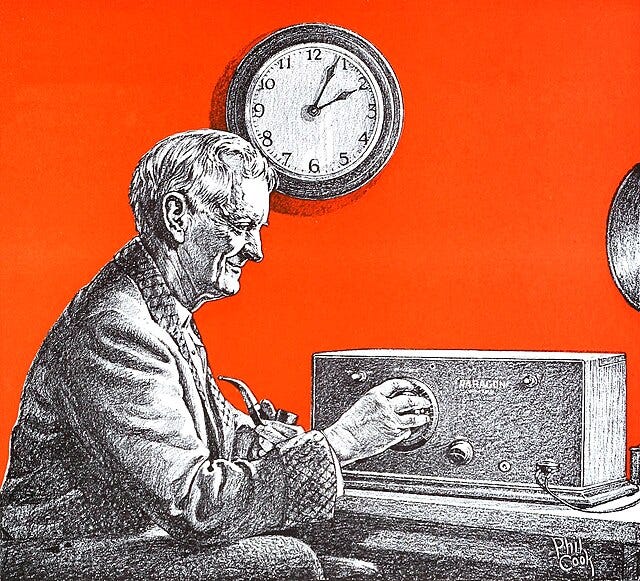
The Problem of Noise
You and I share a common problem. We live in a noisy world. Today we'll be exposed to 5,000 ads1, in 1970 it was 500. The most finite resource on planet earth is your attention.
Has this ever happened to you? You go online to read something simple, but one click leads to another, first a funny video, then Wikipedia, then Instagram, and suddenly you’re late for work. After years in digital spaces, our minds now default to hurry and distraction. We are trying to conduct multiple tasks all at once (probably even right now).
In the 70s, a study was done with two classrooms in New York2. One class was close to the noise of a subway, the other was not. The results? The noisy classroom was a whole reading level behind the others. The difference vanished once the room was sound proofed.
Years back when I was in seminary at RTS, we were sharing our experiences in church. One of my fellow students said his pastor was a good preacher and known as a strong leader. However, he had one flaw. He never listened to you. Tears began welling in my friend's eyes.
The pastor was an able preacher, but he never listened—and that silence was the only sermon my friend ever heard. You can be brilliant at your work. But if you are a poor listener, that is what those closest will remember you for. That’s why James writes: My dear brothers and sisters, understand this: Everyone should be quick to listen, slow to speak3.
A few years back I was sitting with my counselor and asked, “How do you do it? Sitting across from someone and you see where they need to go, where the healing is, and you listen and wait.”
He sighed, “It’s one of the more challenging parts of being a counselor.”
What If You Simply Listened
What if you really listened in your marriage?
The place we should feel the most heard is at home. One of the hardest things is to be in a relationship and to not be heard by the other person. But when we listen well, it begins to soften conflict, James even tells us it melts away anger. Listening creates intimacy in a way flowers and chocolate never could.
What if you really listened to your kids?
I have two young girls—talkative, expressive, and chatty girls. They love to tell me stories. To come up with a tale about a mermaid and her pet unicorn and how they flew in the clouds and went to a pink, no purple castle and had the best time. And when they do, I try (though I am not always great at it) to get down on their level, and be fully engaged in their stories. Because hopefully if I listen when they are seven, they will pick up the call when I am seventy.
What if you really listened at work?
You would simultaneously become one of the most valuable people and the one who values the most people at your work. Just sit back in your next meeting and look around and watch how often people are interrupted. You could eliminate much of the conflict at work, simply by listening.
Listening Positions
Here are a few practical tools to become a better listener.
Not all talking is the same, so wouldn’t that imply not all listening is the same as well? When it comes to listening, here are three questions to ask about which listening positions to hold in any conversation.4
Should my listening be active or passive?
Active: Engaged, eye contact, not interrupting, nodding, asking questions and paraphrasing, and resisting the internal dialogue (meaning not formulating our response while they talk). You can tell if someone is an active listener if they pause after you talk and before they respond.
Passive: When a person is practicing passive listening, they are quiet without responding to what is being said; classroom, church, or reading a Substack article.
2. Does this require reductive or expansive listening?
Reductive: Reducing everything down to what's relevant. What is the bottom line, what is the point I need to hear? What do I need to do? What do I need to leave this conversation with?
Expansive: Listening itself is the journey. It is the point. There is nothing you need to leave with, rather simply be present in the moment.
3. Is there a need for critical or empathetic listening?
Critical: Listening to evaluate and analyze.
Empathetic: Listening to understand the feelings and emotions.
In any given conversation, there is a type of listening position needed. One of the first steps to being a good listener is to maintain the right listening positions.
And here is something wonderful about listening. You can become a better listener, it is not a fixed trait. Here are three ways that you can put this into practice. Small things you can practice every day.
Listening Practices
Silence: This may seem counterintuitive, but by practicing silence, even for 30 seconds a day, can have a lasting effect. When we pause, close our eyes, breathe in deep, the silence makes us aware of how many different thoughts we have going on. When we stop and pause, we reorient ourselves to the present moment and not the past or future we tend to drift towards5.
To quote Alfred Brendel: "The word 'listen' contains the same letters as the word 'silent'."
Mixer: A mixer is when you stop and listen to all the sounds around you and begin to see how many individual sounds you can identify. Say right now you are in a coffee shop, how many different sounds can you hear? What this does: (1) increases our concentration, (2) notice what’s in front of us.
Savoring: Learn to enjoy everyday sounds anew—lighting a match, coffee percolating, or rain. Our brains naturally tune out common sounds (a process called auditory habituation). This helps us survive the noise of daily life, but it has a downside: we can start tuning out the voices we love most. Savoring helps remind us, don’t miss the sound of your kid’s laughter (but you can keep tuning out your spouse’s snoring).
The God Who Listens
In the final book of the New Testament, Revelation 8:1 says, when he opened the seventh seal, there was silence in heaven for about half an hour.
Heaven pauses, everything is stopped, and for 30 minutes–complete silence.
We live in a noisy world. Everyone has an urgent message for us. Do this, buy that, go there. All day long we are inundated by voices, the world is a crowd, everyone is talking, and so few are willing to listen.
But God listens.
A few verses later in the same chapter of Revelation6, we are told God listens to the prayers of his people.
It is rare to find someone who will intently listen and give you their full attention for long periods of time. A gift when you find someone like this.
But it is not rare with God. He is not waiting for you to share something important in order for him to listen. Nor waiting for you to be incredibly articulate; to talk to Him in some deep way. Oh no, He wants to hear every groan, every mumble, every time we stammer through prayer not knowing what to speak, God listens intently.
He quiets all of heaven down, the voices of angels, He says, “not now,” the piercing sound of trumpets pause for a moment, the thundering roar of the songs around the throne are quieted because He wants to listen to the prayers of his people.
And God looks down and says I hear you. You may live in a noisy world, but I am listening. I am not distracted, I am not lacking in attention, but I’m focused on the prayers of My children.
You and I are most like God when we listen too.
If my work has encouraged or challenged you, you can fuel the next post (and my caffeine habit) right here.
the 5,000 number was a study done in 2007, Yankelovich, Inc. Some estimate that in 2025 the average person sees 4,000-10,000 ads a day.
Bronzaft, A. L., & McCarthy, D. P. (1975). The effect of elevated train noise on reading ability. Environment and Behavior, 7(4), 517–527.
James 1:19
You can hear more about this here: Treasure, J. (2011, July). 5 ways to listen better [Video]. TED Conferences.
These also come from Treasure’s work.
Another angel, who had a golden censer, came and stood at the altar. He was given much incense to offer, with the prayers of all God’s people, on the golden altar in front of the throne. (Revelation 8:3)
I love all you’ve provided, in every scenario, it makes a difference!
Amazing how relationships change when we really listen (I honestly need the reminder 😆).