
Why Did Touching the Ark of the Covenant Kill You?

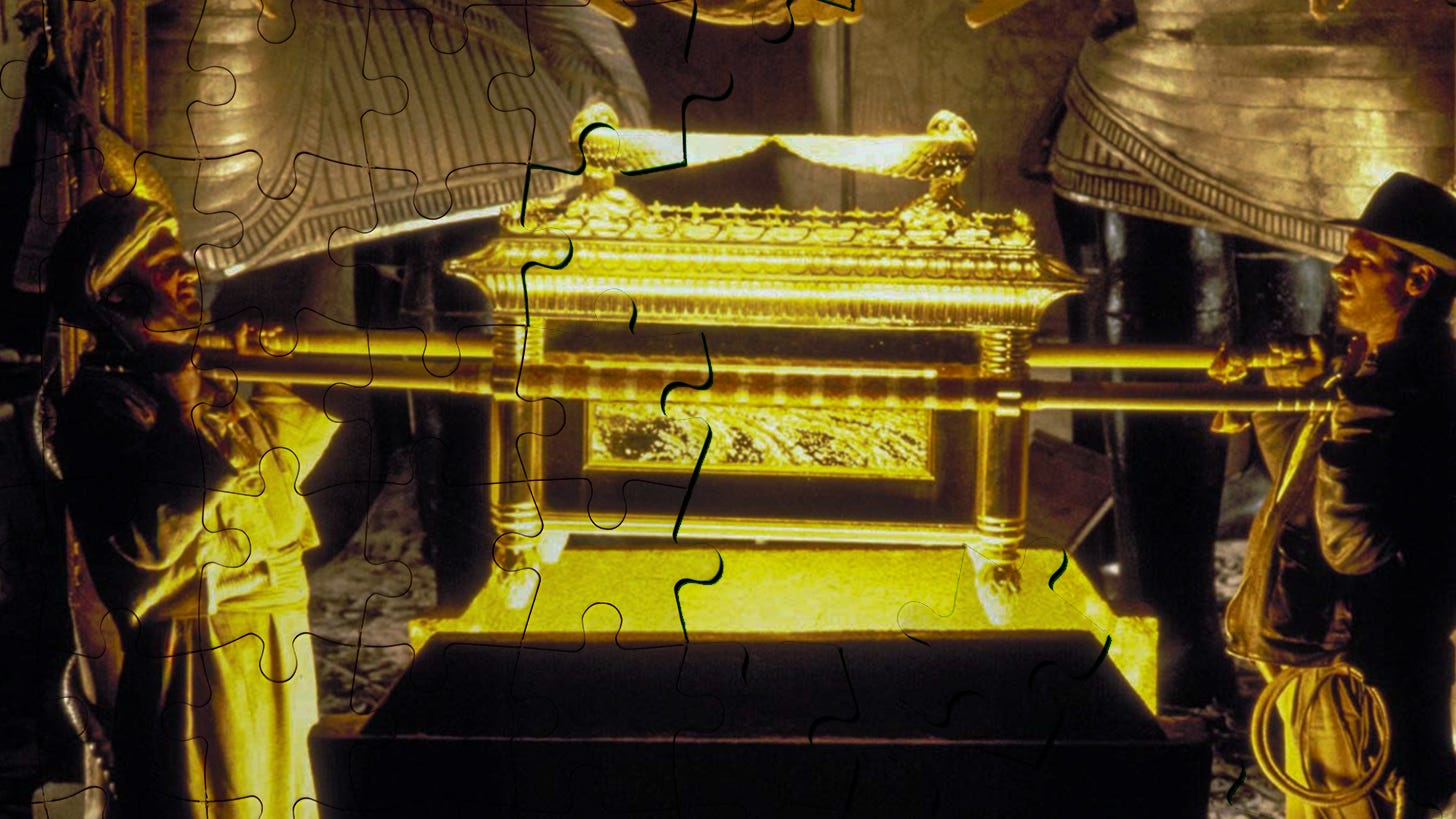
In the Book of Exodus, God gives Moses curiously specific blueprints for a chest made of acacia wood, overlaid with pure gold, and topped with two golden Cherubim. But once the chest was built, it started behaving less like a sacred object and more like a weaponized reactor. The puzzle of the Ark of the Covenant stems from the peculiar safety protocols surrounding it. Priests had to wear special bells, carry it with long poles so they wouldn’t touch the box, and if a layman like Uzzah reached out to steady it during a bumpy cart ride? He was struck dead instantly by what the text describes as an outbreak of divine anger.
What exactly was the Ark? A symbolic throne, a sophisticated piece of ancient technology, or forensic evidence for holiness?
1. The “Mercy Seat” View (The Symbolic Throne)
This is the classic theological perspective that focuses on the Presence of God. The Ark wasn’t meant to be touched because it was the footstool of God’s throne on Earth. In the book of Exodus, God speaks to Moses and says, And there I will meet with you, and I will speak with you from above the mercy seat, from between the two cherubim which are on the ark of the Testimony, about everything which I will give you in commandment to the children of Israel.1 God was establishing with His people how He would rule and lead.
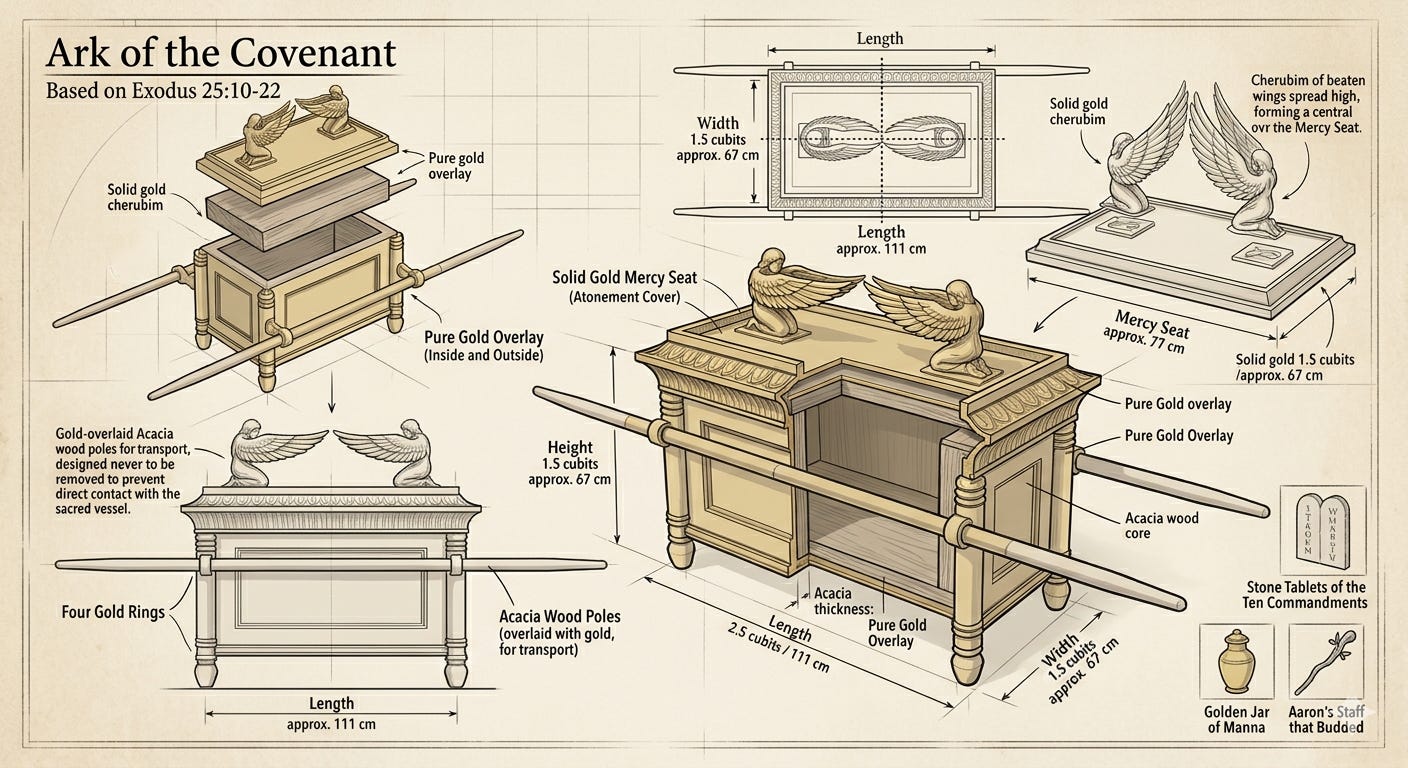
Culturally in the Ancient Near East, you didn’t touch a king’s throne or his footstool without permission; this was a matter of royal protocol and honor.2 A king sat in a throne with his feet resting on a footstool. The footstool was the lowest extension of the throne where Heaven met earth. By touching God’s footstool, Uzzah became the patron saint of “I was just trying to help,” while getting hit with enough voltage to power a Cybertruck. From the Mercy Seat view, the outbreak that killed Uzzah wasn’t a mechanical failure on the part of the ark or that it had electrical power; but a supernatural boundary violation of what God had set.
Through the Ark, God was revealing to a new nation that holiness wasn’t a suggestion; but the standard. The Ark was a physical reminder that the Creator of the universe was dwelling among them, and you don’t treat the Infinite with casual familiarity, bruh.
2. The “Electrical” View (The Great Capacitor)
Here is the preferred theory of ancient tech enthusiasts and Reddit engineers. They look at the blueprints of the Ark and see a super-capacitor. Gold is one of the most efficient electrical conductors, it is highly resistant to corrosion and excellent at carrying a charge across its surface. Acacia wood, is a natural insulator: it resists the flow of electricity and can help maintain a separation of charge. When you sandwich an insulating material between conductive layers, you’re creating the basic structure of a capacitor (a system that can store electrical energy in an electric field). That’s the principle behind a Leyden Jar; an early device designed to store high-voltage static electricity. In 1746 the physicist Musschenbroek, working in the Dutch city of Leiden (where the invention gets its name) reportedly got such a violent shock during the experiment that he said he would not repeat it “for all the kingdom of France.”3 The only more violent shock than that in France would be mispronouncing croissant.
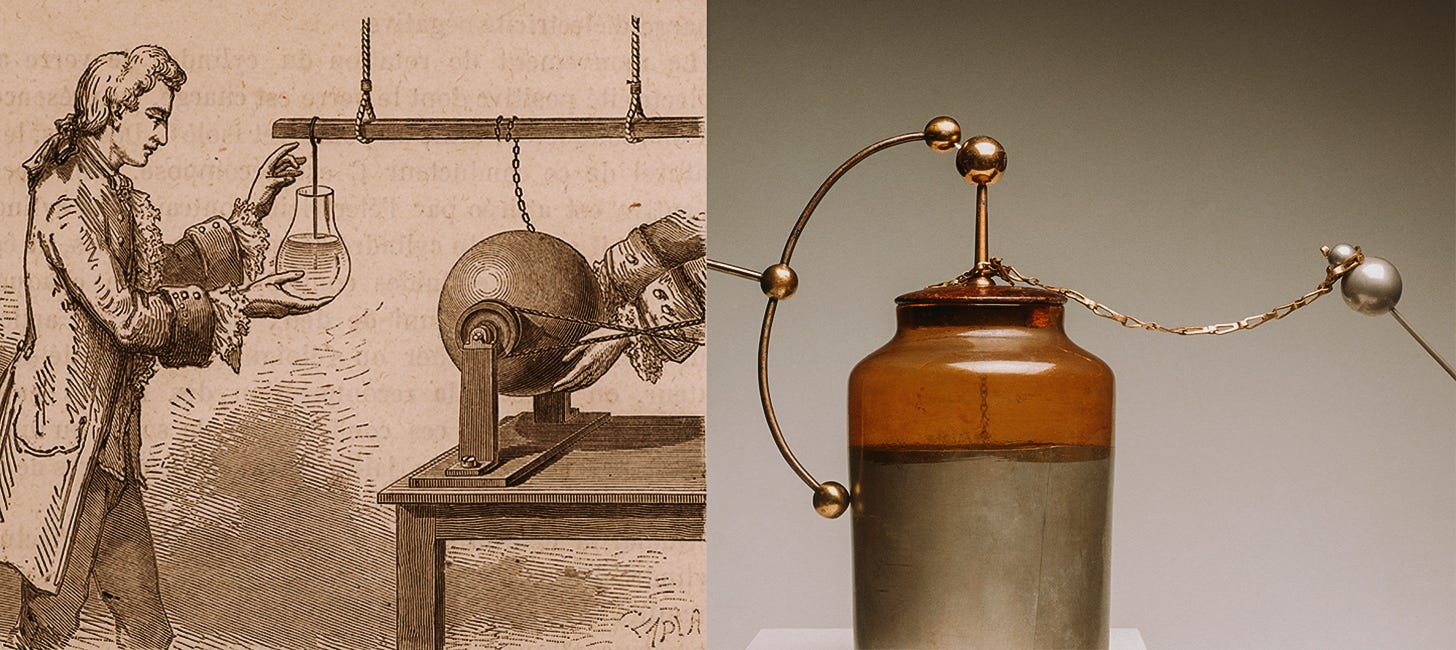
But, let’s be precise (thank you Google search and scientists who make their work simple)4, a true capacitor, like a Leyden jar requires: two conductive layers that are electrically separated, a conductive material between them and a way to introduce and maintain charge (a voltage source). Without an external charge source, you don’t automatically get stored electricity and without proper electrical separation and connections, it doesn’t function as an actual device.
Now, whether intentional or unintentional the Arks design at some level reflects principles of electrical storage that wouldn’t be formally understood until thousands of years later. Steven Spielberg seems to lean into this idea in Raiders of the Lost Ark. In the film (an American classic, IMO) the Ark is packed in sand, which is a natural electrical insulator. It’s exactly the kind of material you’d use to isolate something carrying charge. And when it’s opened (spoiler alert ) the Ark becomes a conduit; something between a transmitter and a lightning rod. Not quite a machine, not quite a miracle, but something blurring the line.
As the Israelites carried the Ark through the dry, static-heavy desert air, surrounded by sand, the gold plates could naturally accumulate a massive electrical charge. The long carrying poles then acted as a safety gap. Therefore touching the box without being grounded would result in a lethal discharge of thousands of volts. In this view, the laws of holiness coincided with the laws of physics.
3. The “Covenantal Map” View (The Forensic Relic)
This view ignores how it worked and focuses on what was inside. The Ark contained three items: the Ten Commandments, a jar of Manna, and Aaron’s staff that budded. All three items were evidence of rebellion. The tablets were given after the Golden Calf; the Manna was given after they complained of hunger; the staff was given after they challenged leadership. In this perspective the Ark was like an attorneys briefcase, and Uzzah, well:

The Ark contained the evidence of human failure, but was covered by the Mercy Seat where blood was sprinkled once a year. The core idea from this perspective is that God’s presence can only dwell with flawed people if their evidence of guilt is covered by an act of mercy. Thus making the Ark a legal puzzle solved by a sacrifice that foreshadowed a once and for all sacrifice to come.
Conclusion
The Ark of the Covenant remains the most dangerous object in the Bible. Whether it was a capacitor storing static electricity, a spiritual portal for the glory of God, forensic evidence, or a bit of all three, the central message was the same: God is not to be trifled with.
The Ark was a place where the rules of the physical world met the holiness of the spiritual world. It teaches us that approaching the Divine requires more than a map; we need a mediator. The Ark was a warning that Truth, in its purest form, is too heavy for human hands to carry alone.

Enjoy the Bible’s “wait… what?” moments?
Here are three more puzzles to put together:
Exodus 25:22
Walton, John H. Ancient Near Eastern Thought and the Old Testament: Introducing the Conceptual World of the Hebrew Bible. Grand Rapids, MI: Baker Academic, 2006.
Musschenbroek, Pieter van. Letter describing the Leyden jar experiment, 1746, in Jean-Antoine Nollet, Lettres sur l’électricité (Paris, 1753).
Rhett Allain, “The Physics of Leyden Jars,” Wired, January 27, 2017.
I tend to be an “all three” gal here.
Legends tell important truths and can warn people of making terrible mishaps.
I could be wrong but it seems to me there could be a connection to the killing of Uzzah to Egyptian legends for example.
There are several different Egyptian legends that warned people of not touching sacred items, particularly profaning the dead and funerals could lead to immediate death by the gods.
This may be a disturbing story to some but as a legend, gives wise wisdom on how to handle holy things and dire warnings when we take the sacred for granted, get too familiar with sacred objects or simply disobey God’s instructions for various situations.
Do we treat Christ with disrespect or take objects in communion in precarious ways that lead to possible death as Paul warns?
Looking at this text through the lens of Christ and as ancient literature may shed more spiritual light than simply a surface reading of the text.