

Why Did God Harden Pharaoh’s Heart?

Pharaoh and the Freedom
Exodus has a problem.
Actually, it has the same problem playing on repeat.
Cue up Val Kilmer, “Let my people go.”
God tells Moses to go to Pharaoh and demand the release of the Israelites. Moses goes and Pharaoh refuses. A plague comes and Pharaoh promises to let the people go. The plague lifts and then before Moses is barely across the palace courtyard Pharaoh changes his mind; this happens repeatedly. And at least half of those times, the Bible doesn’t say Pharaoh was stubborn by nature or that he was a hard man to convince. It says God hardened Pharaoh’s heart and then punished him for it.
Exodus 4:21 is where this begins. Before the plagues have started, before Moses has arrived in Egypt, God says to him, “When you go back to Egypt, see that you perform before Pharaoh all the wonders I have given you the power to do. But I will harden his heart so that he will not let the people go.” The apostle Paul picks this up in Romans 9:17. He quotes God saying to Pharaoh: “I raised you up for this very purpose, that I might display my power in you and that my name might be proclaimed in all the earth.” Then Paul writes: “Therefore God has mercy on whom he wants to have mercy, and he hardens whom he wants to harden.”
Thud.
If God hardened Pharaoh’s heart so that Pharaoh would refuse to release the Israelites, how is Pharaoh responsible for refusing? And if Pharaoh is not truly responsible, how is it just that Egypt suffered ten catastrophic plagues as a consequence? Here are three answers that take the question seriously.
The Reformed or Compatibilist View
One of the consistent answers in church history runs like this: God genuinely hardened Pharaoh’s heart, and Pharaoh is fully guilty, and those two things are not in contradiction. This position is called compatibilism. The argument is that human freedom doesn’t mean freedom from your own nature. You do what you want to do. The problem is that sinners desire to do sinful things. God doesn’t force Pharaoh to choose against his own desires. He governs the desires of a man whose proclivity was already bent toward cruelty.
John Calvin argued this view. His reading of Exodus was that Pharaoh was not an innocent man who got unlucky. He was a ruler who had enslaved a people group who had been enslaved for four hundred years and had ordered the murder of their infant sons. God’s hardening was not the installation of wickedness into a good man. It was a judicial act; directing existing wickedness already in that man toward a particular end. Calvin was careful to show God is not the author of sin, but He governs all things, including the consequences of sin.1 R.C. Sproul made the same argument, drawing a distinction between God hardening someone and God creating the hardness. The hardening of Pharaoh, Sproul argued, was a form of judgment, the removal of restraining grace from a man who had already chosen his path.2 John Piper developed it further, his exegesis of Romans 9 is that Paul is not embarrassed by the hardening. He is using it as evidence that God’s purposes in history cannot be frustrated by human refusal. The hardening is proof of sovereignty.3
The most common objection: If the outcome was settled before Moses walked into the throne room, what was the point of the confrontation? The compatibilist answer is that the point was exactly what Romans 9 says: the display of God’s power and the proclamation of His name throughout the earth. The hardening produced a story that became the defining event of the Old Testament. A heart left to its own devices does not turn to God, a heart changes when something outside makes new what is inside. The story foreshadows the redemption arc to be fulfilled in the New Testament.
The Arminian or Free Will View
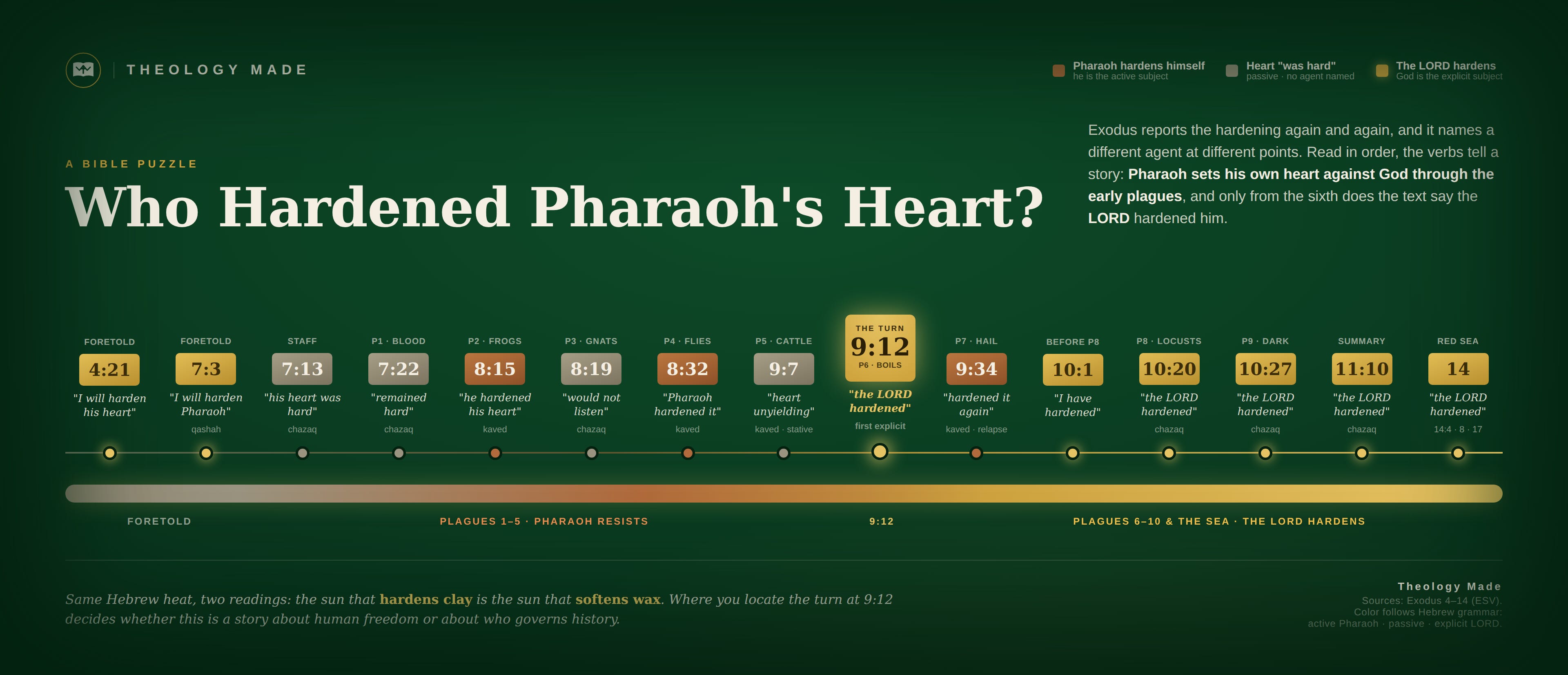
In this perspective, it’s believed that if you look at the particular sequence in the text a different picture forms. The first several occurrences in Exodus do not say God hardened Pharaoh’s heart. They say Pharaoh hardened his own heart. Exodus 8:15, after the plague of frogs lifts: “when Pharaoh saw that there was relief, he hardened his heart.” Exodus 8:32, after the flies: “Pharaoh hardened his heart at this time also.” Exodus 9:7, after the cattle plague: “the heart of Pharaoh was hardened.” God’s hardening appears explicitly beginning around Exodus 9:12, after the sixth plague. Pharaoh makes choices first, repeatedly and freely. God’s response then was judicial. He confirmed and intensified what Pharaoh had already set in motion.
John Wesley read it this way in his sermons and notes on the New Testament.4 Roger Olson pressed the same argument in Against Calvinism (2011), and Craig Keener takes a similar line in his commentary on Romans.5 The case made here is that God does not create the stubbornness from nothing and plant it in Pharaoh’s heart. He ratified what had already developed; meaning he allowed it to become fixed. The hardening was a response to human rebellion. There is also a linguistic argument to be made. The Hebrew word used for hardening in several of the early plague narratives is חָזַק, which means to strengthen or firm up. Some scholars read this as God strengthening what is already present, in the same way that sunlight hardens clay and softens wax using the same heat. The same divine patience that gives Pharaoh repeated opportunities and lifts the plagues each time Pharaoh pleads for relief is the patience that eventually, in its withdrawal, becomes a hardening.6
Where do the Reformed and Arminian readings agree?
Both traditions agree that by the later plagues, God’s hardening of Pharaoh’s heart is a judicial act. The dispute is whether Pharaoh ever had a genuine, unencumbered moment of real choice that he threw away, or whether the outcome was fixed before Moses was born. The Arminian says yes, Pharaoh made real choices badly. The Calvinist says yes but with a caveat, Pharaoh’s choices were real, but they were never outside the scope of what God had ordained.
The Ancient Near Eastern or Narrative View
There is a third reading that reframes the question entirely by asking what the Hebrew words actually meant in their original world and to their original audience. John Walton, in The Lost World of the Old Testament (2020) and his earlier work The Lost World of Adam and Eve (2015), argues that modern readers consistently import philosophical categories onto ancient texts that were doing something different.7 The ancient Near Eastern world did not organize its thinking around free will in the way post-Enlightenment readers do. When the biblical narrator says God hardened Pharaoh’s heart, this was less about an argument around human psychology and more about history.
In Egyptian royal theology, Pharaoh’s heart was the seat of wisdom and cosmic order. His decisions were, in some sense seen as divine decisions. When the Exodus narrator says God hardened that heart, he is speaking the language of Egyptian royal ideology and turning it around. The God of Israel, not the gods of Egypt, is controlling what happens in Pharaoh’s throne room. The hardening language is a sovereignty claim, written in a way the surrounding culture would recognize immediately.
Peter Enns makes a related point in his Exodus commentary.8 The function of the hardening is to establish, for ancient readers, that the contest between Moses and Pharaoh was never really between Moses and Pharaoh. It was between the God of Israel and the gods of Egypt. Exodus 12:12 says this directly: “I will bring judgment on all the gods of Egypt.” Pharaoh is not a man being prevented from making a wise choice. He is the representative of a divine order being dismantled. The hardening is the narrator’s way of telling the reader from the opening scene: no matter what Pharaoh says, this will run its course.
Does this let Pharaoh off the hook?
Not really. The text presents Pharaoh as genuinely culpable throughout. He enslaved people. He ordered infant boys drowned in the Nile. He broke every agreement he made the moment the immediate pressure lifted and before the sweat on his brow had dried. The narrative view doesn’t eliminate his guilt. It shifts the burden of the question away from free will and towards who is running history, and to what end.
Now What
What you do with the hardening of Pharaoh’s heart depends on which question you think the text is answering. If the question is about human freedom, you end up in the Reformed or Arminian camps, working out how divine sovereignty and human accountability can coexist without one consuming the other. If the question is about divine power over history, you end up in the ancient Near Eastern camp, where the hardening is a declaration rather than a dilemma.
Regardless of which view you take, Pharaoh never stops being a real person who makes real choices with real consequences. He is not a puppet in any of them. He is a man who becomes the stage on which a larger argument is made visible. Whether that comforts you or raises harder questions probably tells you something about how you read the rest of the Bible.

Enjoy the Bible’s “wait… what?” moments?
Here are three more puzzles to put together:
John Calvin, Institutes of the Christian Religion, trans. Henry Beveridge (Grand Rapids: Eerdmans, 1989).
R.C. Sproul, Chosen by God (Wheaton: Tyndale House, 1986).
John Piper, The Justification of God: An Exegetical and Theological Study of Romans 9:1–23, 2nd ed. (Grand Rapids: Baker, 1993).
John Wesley, Explanatory Notes Upon the New Testament (London: William Bowyer, 1755).
Craig S. Keener, Romans: A New Covenant Commentary (Eugene: Cascade Books, 2009).
The observation that the same external force produces different effects depending on the material it acts upon is Origen’s, found in On First Principles. C.S. Lewis used a version of the same idea in The Problem of Pain (1940).
John H. Walton, The Lost World of the Old Testament: Twenty Controversial Questions about Creation, Humanity, and Israel’s Origins (Downers Grove: IVP Academic, 2020).
Peter Enns, Exodus, The NIV Application Commentary (Grand Rapids: Zondervan, 2000).
One thing that stands out to me is that every time Pharaoh experienced relief, he returned to the same decision. Whether you emphasize God's sovereignty, Pharaoh's free will, or the narrative purpose of Exodus, the pattern is sobering: miracles alone do not change a heart. The story reminds me that what we do after the pressure lifts often reveals what is truly within us.