
Where Do Demons Come From? Three Theories Behind the Bible’s Darkest Mystery

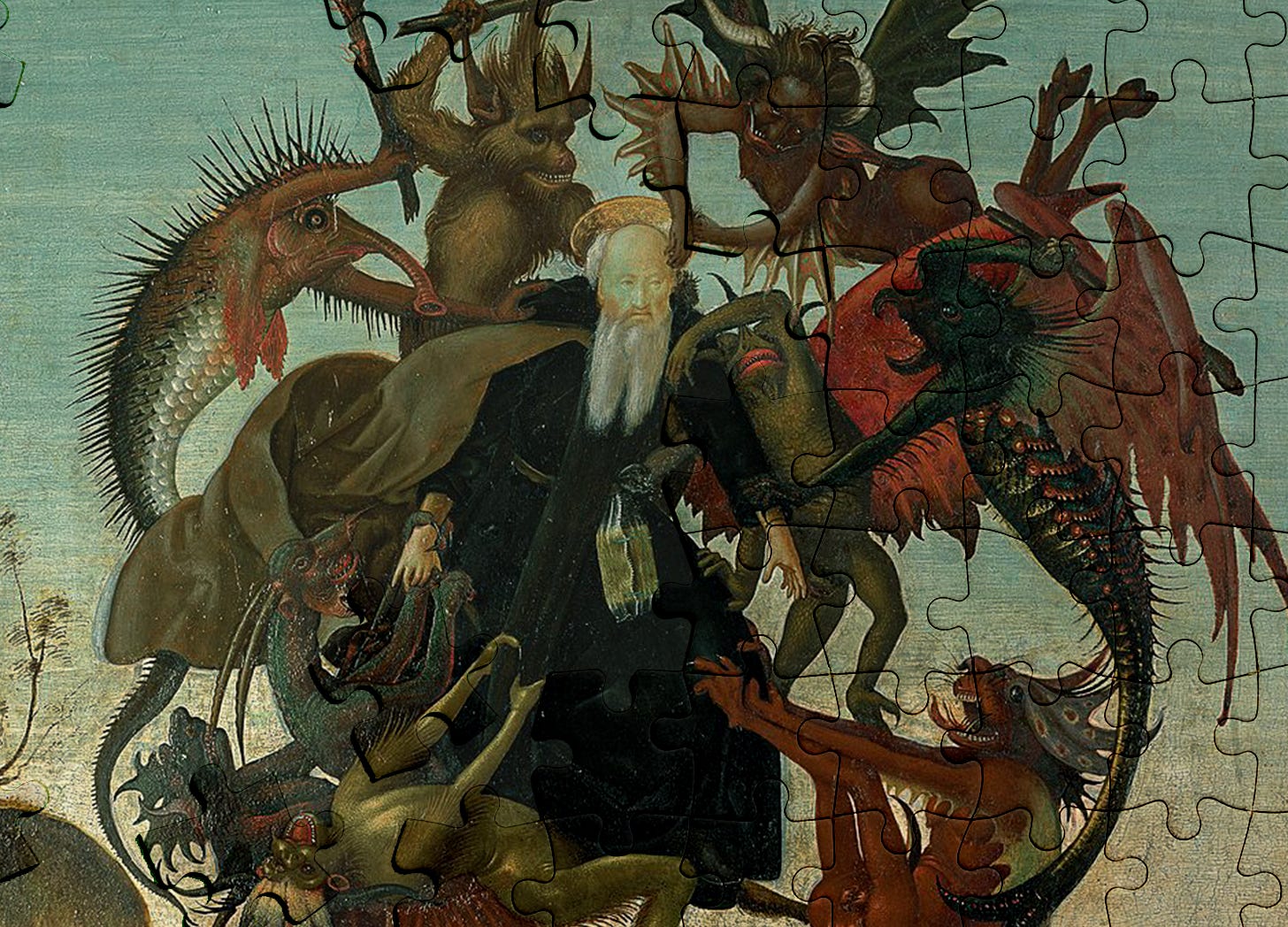
It’s 1994. Newbury Park, California. Halloween night.
My parents are downstairs “rebuking the darkness.”
Meanwhile, I’m upstairs watching Lady and the Tramp with my younger brother… wondering what exactly we’re fighting.
Demons
The New Testament talks about demons constantly, but never clearly says where they came from. In the Gospel of Mark, Jesus walks into a synagogue and when He begins teaching, a man starts screaming (only happens to me if I’m still preaching after 11:30).
A voice from inside the man shouts, “What do you want with us, Jesus of Nazareth? Have you come to destroy us?”
The demons know exactly who Jesus is. They recognize Jesus before the disciples do, before the crowd figures it out, before Peter makes his famous confession. The only characters in the Gospels who are never confused about Jesus… are the demons.
This pattern shows up again and again. Jesus heals diseases, forgives sins, raises the dead; and whenever He encounters demons, the reaction from them is immediate recognition and terror. They shout His identity and beg not to be destroyed. At one point, they even negotiate with Him, asking permission to enter a herd of pigs.1 All of which raises a question the Bible never directly answers.
Where did they come from?
For most Christians the answer is that demons are fallen angels. The Devil rebelled against God, some angels followed him, and those rebels became the demons Jesus confronts in the Gospels.
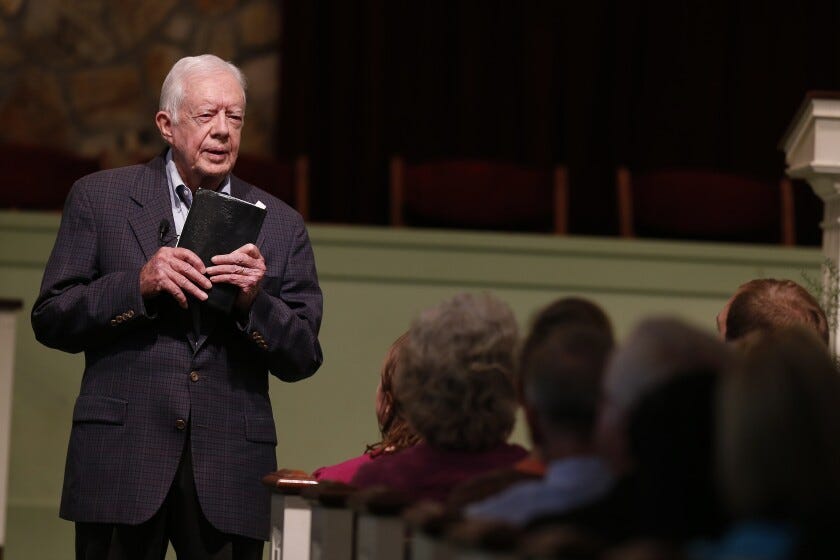
A clean, simple, Sunday School answer. The type of explanation Jimmy Carter probably taught for 40 years at Maranatha Baptist Church in Plains, GA.
However, this neat and tidy take wasn’t the only view ancient Christians held.2 Early believers proposed several different explanations for the origin of demons, each trying to make sense of the strange clues scattered throughout Scripture. Here are the three most influential attempts to solve the demon puzzle.
1. The Fallen Angel Theory
The explanation Christians are most familiar with today begins at a supernatural rebellion. At some point before human history, the Devil and a group of angels turned against God. The Book of Revelation describes a war in heaven in which a dragon sweeps a third of the stars down from the sky.3 Early theologians like Victorinus of Pettau4 in the 3rd century recognized the ‘stars’ cast down in Revelation 12:4 to symbolize angels who joined the Devil’s5 rebellion.
Other passages seem to reinforce this framework. The Second Epistle of Peter speaks of angels who sinned and were cast into darkness. The Epistle of Jude refers to angels who abandoned their proper dwelling. Taken together, these texts suggest that part of the angelic world became corrupted. Those fallen angels, according to this theory, are the demons encountered throughout the New Testament.
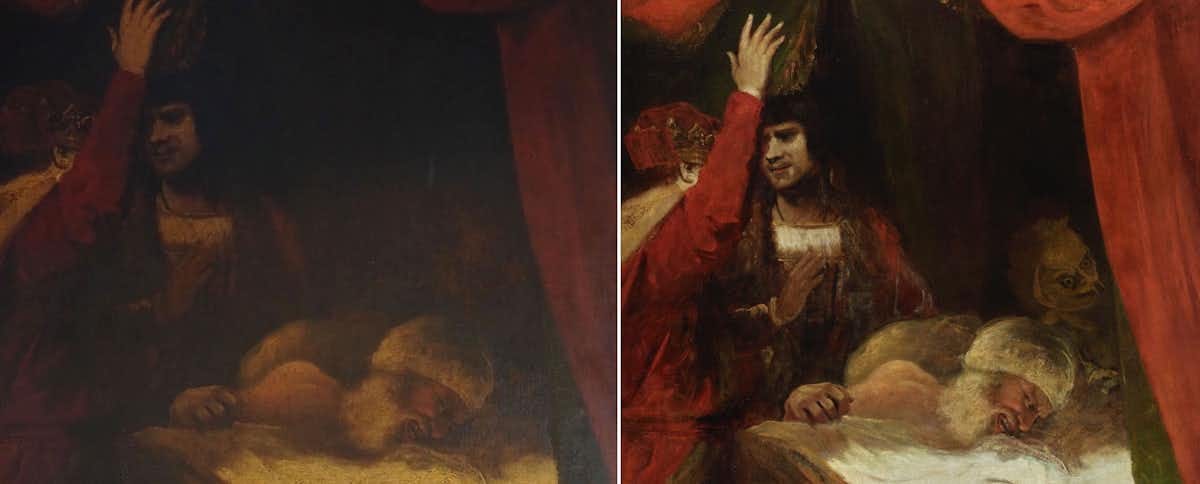
Theologians like Augustine6 and later Aquinas,7 solidified this view as it became the dominant approach within Western Christianity. It is simple, coherent, and fits naturally within the broader story of the Devil’s rebellion.
But there’s one detail that doesn’t quite fit.
In the Gospels, demons behave in a way that angels never do.
They seem desperate for bodies. When Jesus casts them out, they plead for somewhere to go. They wander through “waterless places”8 searching for rest. When given the option, they choose to inhabit animals rather than remain disembodied.
Why would angels (who are spiritual beings) need a body at all?
To answer that, some interpreters offer a stranger explanation.
2. The Nephilim Spirit Theory
The second theory begins with one of the most mysterious passages in the entire Bible. Genesis chapter six briefly describes a time when the “Sons of God” took human wives and produced offspring known as the Nephilim. The text gives almost no explanation, but it hints at a world that had become deeply corrupted before the Flood.9
In the centuries before the time of Jesus, Jewish writers expanded this story from Genesis six. Texts like the Book of Enoch10 describe a group of rebellious angels called the Watchers who descended to earth and taught humanity forbidden knowledge. Their union with human women produced giant offspring who filled the earth with violence.
When the Flood came, those giants died. But according to this interpretation, their spirits did not. Those restless spirits, stripped of their physical bodies, became the demons that roam the world. In this view, the peculiar behavior exhibited by the demons in the Gospels makes a lot more sense.
Demons wander because they are disembodied spirits. They seek human hosts because they once possessed physical form. Their desperate search for bodies reflects a lost state they can never fully recover.
This explanation was widely known in the ancient world. Several early Christian writers—including Justin Martyr,11 Tertullian, and Irenaeus12—appear to have accepted some version of it. Over time, however, this interpretation gradually faded in Western theology as the more straightforward fallen-angel explanation took precedence. Still, the Nephilim theory shows that early believers did not assume the answer to where demons came from was obvious.
3. The Corrupted Spirit Theory
A third approach takes the question in an entirely different direction.
While many traditions often focused on the origin of demons (linking them to fallen angels or the Nephilim) writers like Evagrius Ponticus did not reject this framework, but shifted the focus. For Evagrius, demons were real spiritual beings whose primary arena was the human mind; influencing thoughts, desires, and emotions rather than acting through physical corruption.13
Theologians like Evagrius cataloged the patterns of temptation they believed demons exploited: pride, anger, lust, envy, despair, and vanity. Spiritual warfare, in this framework, was less about dramatic possession stories and more about the subtle shaping of human desires. The real danger of demons was not their power to control a person, but their ability to distort what a person loves.
Within this view, the question of where demons come from mattered less than understanding how they worked. Evil did not merely appear in supernatural encounters. It appeared in ordinary human life, like illustrated in C.S. Lewis’ Screwtape Letters. Their work found in the slow twisting of motives, ambitions, and fears.

For this third perspective I began with Evagrius Ponticus because his approach marks a shift. While he never denied the existence of demons, his focus fell almost entirely on temptation, and what he famously called the logismoi, the intrusive ideas that shape behavior.
That move doesn’t erase the question of where demons come from, but over time, that interior focus allowed space for reinterpretation. By the modern period, thinkers like Sigmund Freud14 began explaining what earlier Christians called “temptation” in psychological terms; unconscious drives, repression, internal conflict. Figures like Carl Jung15 went further, treating spiritual realities as symbols of the psyche; archetypes rather than agents.
What were once understood as personal spiritual beings with an origin became in many modern frameworks; internal psychological dynamics at work within an individual (taken in a direction Evagrius would have never embraced). The question of the origin of demons, ceased to be relevant. The temptations remained, but the tempters vanished. Functionally, this is unfortunately where a lot of Christians tend to live.
The Puzzle That Remains
When Christians ask where demons come from, they often expect a single clear answer. But historical theology present a more nuanced approach. Some believers understood demons as fallen angels who joined Satan’s rebellion. Others saw them as the wandering spirits of the Nephilim, remnants of a violent world destroyed by the Flood. And more modern interpretations deleted the question entirely.
Each theory attempts to make sense of the same biblical clues. And maybe that uncertainty is ignificant. The Bible spends less time explaining demons than it does showing their defeat. Again and again in the Gospels, demons see Jesus and are terrified.
They recognize instantly and fear Him immediately. They never, not once, think they’re going to win.

Enjoy the Bible’s “wait… what?” moments?
Here are three more puzzles to put together:
Matthew 8:28-34
1 Enoch 15:8–12; Jubilees 10:1–14; cf. Amar Annus, “On the Origin of Watchers,” JSP 19, no. 4 (2010). Also see this, a 14 page read on the Watchers and the influence of Mesopotamian culture; Ida Fröhlich, “Mesopotamian Elements and the Watchers Traditions,” in The Watchers in Jewish and Christian Traditions, ed. Angela Kim Harkins, Kelley Coblentz Bautch, and John C. Endres (Minneapolis: Fortress Press, 2014)
His tail swept down a third of the stars of heaven and cast them to the earth. And the dragon stood before the woman who was about to give birth, so that when she bore her child he might devour it (Revelation 12:4 ESV).
Victorinus of Pettau et al., Latin Commentaries on Revelation, trans. William C. Weinrich (Downers Grove, IL: IVP Academic, 2011).
I am purposely referring to the Devil as the Devil in this article and not as Satan. As Satan is a title and is not always attributed to the Devil in the Bible.
In City of God, Augustine in books 11 & 12 argues some angels fell through pride And that these fallen angels are identified with the devil and his angels. He treats them as what we call demons. In book 15:23 he gives further rationale when he says, “But that those angels were not angels in the sense of not being men, as some suppose, Scripture itself decides, which unambiguously declares that they were men. For when it had first been stated that the angels of God saw the daughters of men that they were fair, and they took them wives of all which they chose, it was immediately added, And the Lord God said, My Spirit shall not always strive with these men, for that they also are flesh.”
Summa Theologiae I, q.63
When an unclean spirit comes out of a person, it roams through waterless places looking for rest but doesn’t find any. (Matthew 12:43 CSB)
For further rationale, see Michael S. Heiser, especially The Unseen Realm, Reversing Hermon, and Demons: What the Bible Really Says About the Powers of Darkness, which argue that Genesis 6 reflects an ancient Jewish view of divine beings (“sons of God”) transgressing into the human realm and contributing to pre-Flood corruption.
The Book of Enoch is not Scripture in the canon, however it is a valuable ancient Jewish text that reflects how many people in the time of Jesus understood passages like Genesis 6. Its themes appear in places like Jude and 2 Peter, showing that its ideas were part of the theological world of the New Testament. It doesn’t carry the authority of the Bible, but it provides historical context that helps us see how early readers interpreted difficult passages.
This is found in Justin Martyr’s Second Apology, chapter 5, “But the angels transgressed this appointment, and were captivated by love of women, and begot children who are those that are called demons”
This view appears in early Christian writers such as Justin Martyr (Second Apology 5) as shown in the previous footnote, Athenagoras (A Plea for the Christians 24–25), Irenaeus (Against Heresies), and Tertullian (Apology 22), who connect Genesis six’s angelic rebellion and the Nephilim with the origin of demonic spirits.
Evagrius Ponticus. Praktikos and Chapters on Prayer. Translated by John Eudes Bamberger. Kalamazoo, MI: Cistercian Publications, 1970,; Ponticus. Talking Back: A Monastic Handbook for Combating Demons. Translated by David Brakke. Collegeville, MN: Liturgical Press, 2009.
Sigmund Freud, The Future of an Illusion, trans. James Strachey (New York: W. W. Norton, 1961).
Carl G. Jung, Aion: Researches into the Phenomenology of the Self, trans. R. F. C. Hull (Princeton, NJ: Princeton University Press, 1979).
This was fascinating! Thank you. I recently started watching Michael Heiser lectures on YouTube which has opened my eyes to some of these theories (the Lord of Spirits podcast does as well) but it’s interesting seeing these other ones. I’ve never noticed the fact that demons desire to be embodied. I don’t know what the significance of that is, but it’s very interesting.
Great overview. Thank you!