
Where Did Cain Get His Wife? The Bible’s Most Awkward Question
Three Theories Explained

I am not normally a fan of puzzles, an admission that feels like trudging in dangerous waters here on Substack. That said, there is one type I enjoy: Bible logic puzzles.
If Adam and Eve were the first two people on Earth, and had two sons, Cain and Abel, then Cain kills Abel, where on earth did Cain’s wife come from? Cue up the crickets.
Did Cain marry his sister? Did God create a second tribe of people? Or is there a massive plot hole in the Book of Genesis?
The Literal or Sister Theory View
Literalist scholars point to Genesis 5:4, “After Seth was born, Adam lived 800 years and had other sons and daughters.” Here the answer is awkward, but simple: Cain married his sister or his niece1. While strange to modern ears, it’s more mathematically and biologically sound than it first appears.
The mistake is thinking of Adam and Eve as a family of four, yes that’s how it looks in your kids coloring sheet from church, but it’s not reality. According to Jewish tradition, Adam and Eve had as many as 33 sons and 23 daughters2. Even if the number wasn’t that high, if the average family had 10 children, and those children had 10 children, the population would explode over a few generations. By the time Cain was in his 100s (Seth wasn’t born until Adam was 1303, Adam was in his Pacino and De Niro era), there could have been many people on Earth.
What about the biological objection?
The #1 comment I get in my theology courses is, “Isn’t that incest? Wouldn’t that cause genetic deformities?” In our modern world, it would. But we carry thousands of years of genetic mutations (tiny errors in our DNA). When close relatives have children, those same errors match up, leading to birth defects. Adam and Eve were created very good, meaning they had perfect DNA, there were no mutations or genetic diseases to pass down4. In the first few generations, marrying a sibling wouldn’t have carried the biological risks it does today.
Why did the law change and later it became a sin?
For the first 2,500 years of human history, the Bible record shows no prohibition against marrying close relatives. Abraham, the father of the faith, was married to his half-sister, Sarah. The hard line wasn’t drawn until Leviticus 185 and the reason is two-fold.
Biological Protection: By the time of Moses, genetic mutations had likely accumulated to the point where it was no longer safe.
Social Protection: God was establishing a new moral code for a new nation to distinguish them from the surrounding cultures.
The literalist view argues that God isn’t being inconsistent; rather He issued the law in Leviticus 18, once the infection (genetic mutation) became a threat to humanity.
The Pre-Adamite or Other Tribes View
Maybe the sister theory doesn’t fit the puzzle quite right to you. Some scholars6 point to a series of strange clues in the text that suggest Adam and Eve weren’t actually alone on the planet. Here the logic starts with a question, who was Cain actually afraid of?
In Genesis 4, after Cain kills Abel, God sentences him to be a restless wanderer. Cain’s response is, “I shall be a fugitive and a wanderer on the earth, and whoever finds me will kill me.”
If the world only consisted of Adam, Eve, and Cain, who is this whoever? If Cain was only afraid of his parents, he would have said, “my father will kill me.” Instead, he describes a world populated with people who might see him as a stranger or a threat. Then the frame expands and God puts a mark on Cain to protect him from these others. Why would God need to put a physical warning sign on Cain if the only other people on Earth were his own parents?
This leads to the Two-Creation theory7. Some theologians argue that the Bible describes two separate creations8.
Genesis 1: Describes God creating mankind in a general sense, essentially populating the Earth with biological humans.
Genesis 2: Zooms in on God creating a specific man, Adam, in a specific garden.
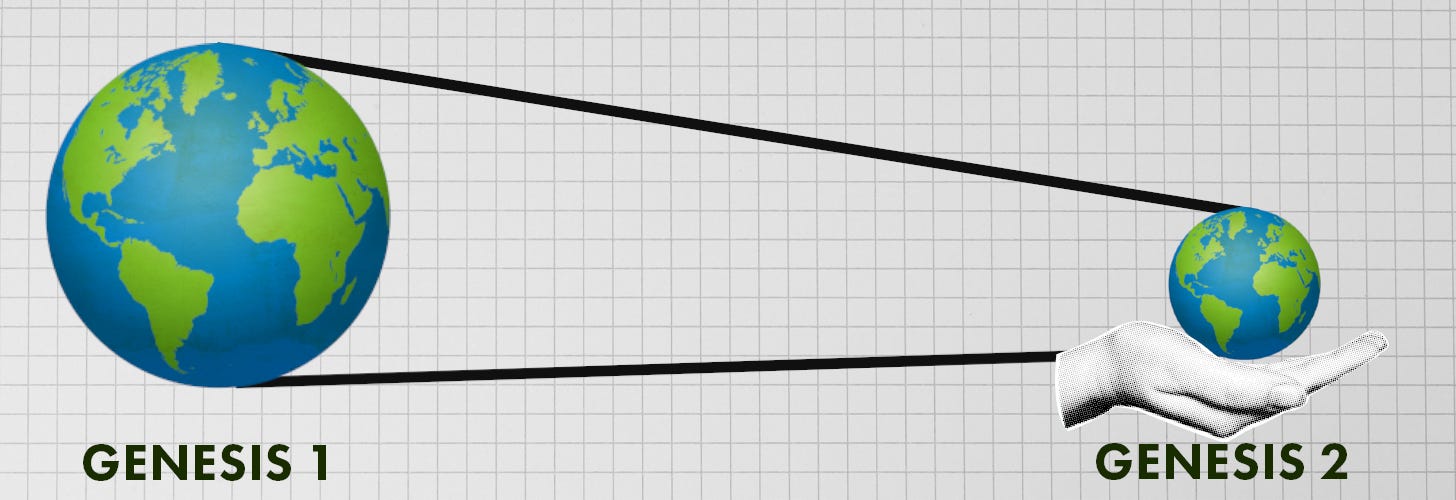
Adam and Eve were chosen to be Covenant representatives, the first humans to be the placed under God’s Law. However, they lived alongside a larger population of biological humans who had been created previously. Under this theory, Cain didn’t marry a relative; he married into one of these neighboring tribes.
What about Genesis 3:20, which says Eve was the mother of all living? Those who follow this view see this as a title of honor or spiritual significance, similar to how Abraham is called the ‘Father of many nations’ even though he isn’t the biological ancestor of every person on Earth. In this sense Eve was the mother of the chosen line that would eventually lead to the rest of the Biblical story.
This view is not the majority position in historic Christianity, but it has been proposed to account for specific textual tensions.
The Allegorical & Evolutionary View
This perspective is held by many modern theologians and scientists, often called Evolutionary Creationism or Theistic Evolution. Here the question, “where did Cain get his wife?” isn’t a problem because the story isn’t a literal history of the first family. Instead, it’s a theological archetype; a story using symbolic characters to explain the human condition9.
The first clue this might be an allegory is found in the names themselves. In Hebrew, ‘Adam’ is a pun on אדמה, which means ground or dust. He is literally ‘Earth-Man,’ Doesn’t make for a great superhero (unless there’s an Eternals 2). Eve is חָוָה which comes from the root for life. Proponents of this view argue the author of Genesis was using these figures to represent all of mankind and life. The story of Cain and Abel isn’t about the first two siblings in history, but the universal human tendency toward jealousy, violence, and the rejection of God. If the story is a parable about the human soul, asking where the wife came from is like asking what brand of oil the Good Samaritan had in his lamp.
There is also a cultural layer to examine here, Cain is a farmer and Abel is a shepherd. In history the transition from nomadic herding (Abel) to settled agriculture (Cain) is known as the Neolithic age. By placing Cain and Abel in these roles, the Bible may be using a historical backdrop that ancient readers would have recognized. In this context, Cain’s wife isn’t a plot hole because the story assumes a world already full of people experiencing this cultural shift from the wilderness to the city.
Many who hold this view such as Francis Collins believe the genetic evidence shows that the human population never dipped down to just two individuals10. Instead, they suggest that God worked through the process of evolution, and at a certain point in history revealed Himself to a group of early humans represented by Adam and Eve and gave them a moral conscience and a soul. If Adam and Eve represent a group or a specific tribe chosen by God, then Cain simply married someone from the larger population of humans that had evolved alongside them.
The City Evidence
One final puzzle piece, Genesis 4:17, “Cain was then building a city.”
You can’t build a city with just a wife and a toddler, unless it consists of Legos. The word city is a clue that by the time these events were recorded, the world was already becoming populated and complex. A city implied infrastructure. It required a workforce for construction, a system for food distribution, and a reason to group together for protection. This suggests that whether they were Adam’s rapidly multiplying descendants or other tribes of people, there were enough humans on the planet to require an urban center.
This passage also mentions that Cain’s descendants were the first to master metalworking, musical instruments, and livestock herding. The Bible isn’t describing a couple of people in the woods; it’s describing the dawn of civilization. The presence of a city shows that the question of who was Cain’s wife, is solved by the text itself. The Bible assumes a world already moving forward. Whether through hundreds of years of Adam’s genealogy or a larger created population, by the time Cain picks up a brick, he isn’t alone with Adam and Eve.
The point isn’t that one of these views “solves” the story and the others fail. It’s that Genesis isn’t embarrassed by the question, in the way a modern thinker may be. The text assumes a populated, developing world, whether through rapid genealogy, or neighboring peoples.
The question of “where did Cain get his wife?” is more than a logic puzzle, it’s a mirror, revealing what we expect the Bible to be. Is it a lab report? A family record? Or a theological map of the human condition?
Next question:
Was Noah’s Flood global or local?
Read the deep dive here → How Did the Animals Fit on the Ark?

Mathews, K. A. (1996). Genesis 1–11:26 (Vol. 1A). Broadman & Holman Publishers.
Josephus, F. (1987). The antiquities of the Jews (W. Whiston, Trans.). Hendrickson.
When Adam had lived 130 years, he had a son in his own likeness, in his own image; and he named him Seth. (Genesis 5:3 NIV)
Purdom, G. (2014, July 1). Where did Cain get his wife? Answers Magazine. https://answersingenesis.org/bible-characters/cain/creation-basics/
No one is to approach any close relative to have sexual relations. I am the Lord. (Lev. 18:6 NIV)
For a detailed exploration of the population existing outside the Garden, see S. Joshua Swamidass, The Genealogical Adam and Eve: The Surprising Science of Universal Ancestry (Downers Grove: IVP Academic, 2019); John H. Walton, The Lost World of Adam and Eve: Genesis 2–3 and the Human Origins Debate (Downers Grove: IVP Academic, 2015); and Michael S. Heiser, The Unseen Realm: Recovering the Supernatural Worldview of the Bible (Bellingham, WA: Lexham Press, 2015).
Proponents of this view note, the Hebrew grammar of Genesis 1 uses the generic adam (humankind), while Genesis 2 uses ha-adam (the specific man, Adam).
One of the earliest proponents of this view was a french calvinist from the 17th century named Isaac La Peyrère. He claimed Genesis 1 describes the creation of the Gentiles (the nations), and Genesis 2 describes the creation of Adam (the father of the Jewish people).
Enns, P. (2012). The evolution of Adam: What the Bible does and doesn’t say about human origins. Brazos Press.
Collins, F. S. (2006). The language of God: A scientist presents evidence for belief. Free Press.
This is a solid breakdown of a question that has tripped up many a skeptic. As a Pastor and a Psychologist, I find that how we answer the "Cain’s Wife" puzzle reveals more about our hermeneutic, our lens for seeing God, than it does about the "missing" inhabitants of the Land of Nod.
From my seat at the outpost, here is how I process these three views:
The Biological Reality (The Literal View)
I lean heavily into the literal-historical view. We often forget the sheer scale of time and the vitality of the early human genome. If we believe God created Adam and Eve with "very good" DNA, then the genetic load (the accumulation of mutations) wasn't an issue yet.
You mentioned the "Pacino era" for Adam, but remember, these men were living nearly a millennium. In a world before the Flood, the command to "be fruitful and multiply" wasn't just a suggestion; it was a biological mandate. By the time Cain killed Abel, we weren't looking at a family of four; we were looking at a growing clan. The "incest" objection is a modern moral category projected onto a pre-fallen biological necessity. God’s prohibition in Leviticus 18 was a protective boundary set after the "infection" of mutation and social decay made it necessary.
The "Whoever" Factor (The Two-Creation/Heiser Influence)
As a student of the late Dr. Michael S. Heiser, I find the "other tribes" or Pre-Adamite view fascinating. While I hold to Adam and Eve as the literal ancestors of all humanity, the "Deuteronomy 32 Worldview" reminds us that the Bible is often more concerned with Covenant than it is with a pure biological census.
When Cain fears "whoever finds me," he is acknowledging a world that is already expanding. Whether those people were his own siblings and nieces, or as some suggest, a broader population of "hominids" not yet under the Covenant, the text is clear: Cain was entering a world that was no longer empty. However, we must be careful not to let "evolutionary" theories strip Adam of his role as the Federal Head of the human race. If Adam isn't the first man, the theology of the "Last Adam" (Christ) in Romans 5 begins to fray.
The City and the "Sinker"
You hit the nail on the head regarding the city. You don't build a city for a wife and a toddler. Cain’s city-building represents the "spirit of the world"—an attempt to find security in walls and metalworking rather than in the Presence of God from which he was banished.
Whether the population came from the literal loins of Adam over 130 years or another means, the theological map is the same: Man, separated from God, immediately tries to build his own kingdom to protect himself from his own brothers.
Final Thought
At the end of the day, the Bible isn't a "lab report," but it is a Truth report. It doesn’t tell us everything we want to know, but it tells us everything we need to know for salvation. Cain found a wife, but he lost his soul. That’s the puzzle we should be worried about solving.
Stand Fast Brother. Speak Truth. Shepherd Boldly.
Dr. Michael Napier
This is a helpful overview.
When I teach on this and related subjects there's one element that I consider critically important to remind ourselves of.
Genesis was written by Moses. That's a long time after the actual events he recorded. Moses purpose for writing these books per internal references was basically to introduce three questions to the Israelites coming out of slavery in Egypt:. Who are you? Where did you come from? What is your connection to this God who calls you out of Egypt.
With that framing, the critical observation pops out. The question you write about, along with questions like the age of the earth or the length of days of creation, while interesting, were not questions the text ever intended to answer.
Now that works from the Mosaic perspective, what from a hermeneutical perspective "the original author".
What about the ultimate author (God)?
From the NT perspective, God didn't answer those questions for us because they aren't necessary for His purposes in providing the Bible which is to reveal that which is sufficient for "faith and practice" (as the confessions say).
Bottom line - we should not be surprised that the bible doesn't answer questions - even valid ones - that the author(s) didn't intend to answer.