
The Witch of Endor: Did Saul Really Speak to Samuel’s Ghost?

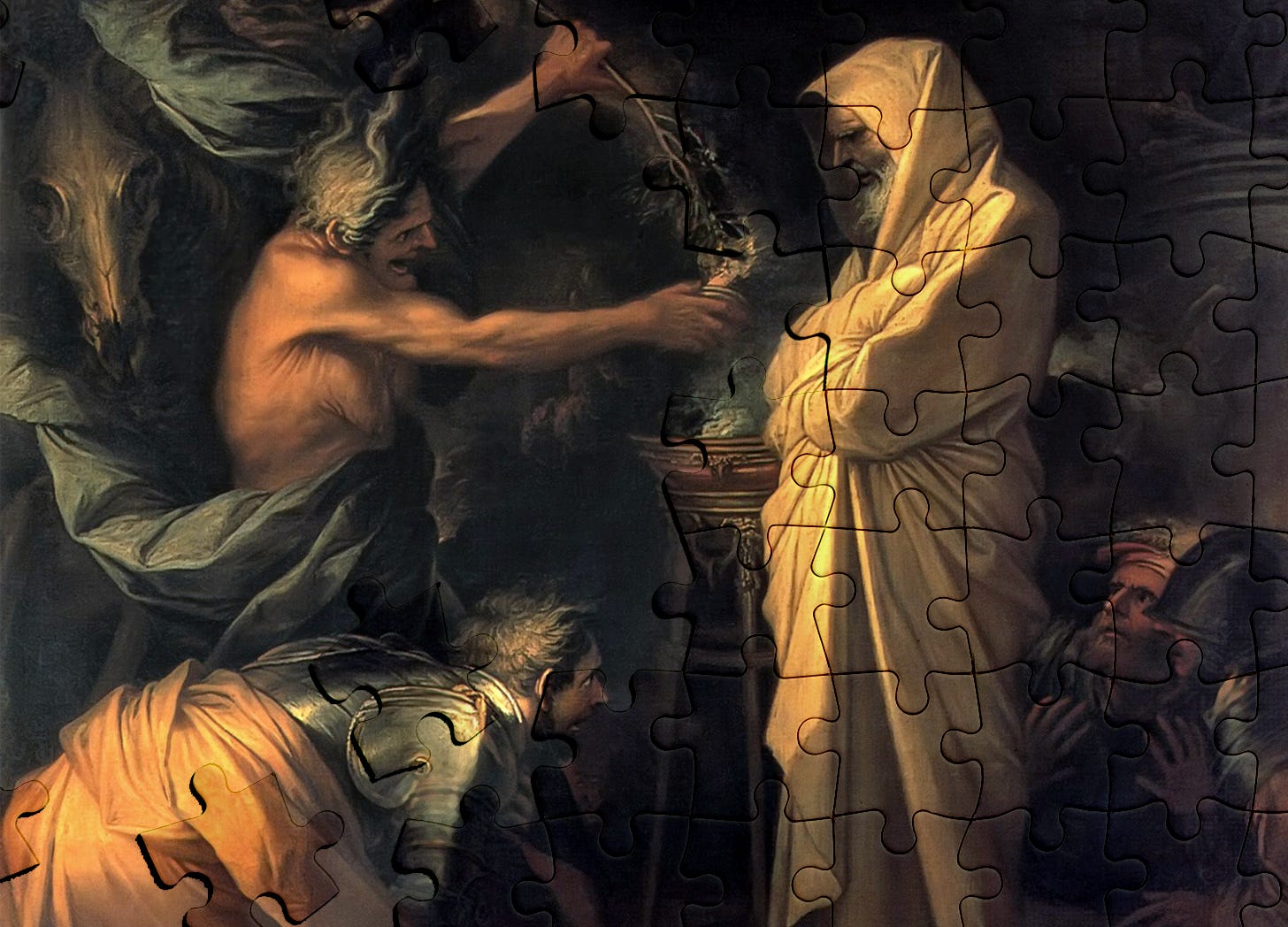
Ghost Stories
King Saul thinks he is backed into a corner. The Philistine army is closing in, God has gone silent, and the prophet Samuel is dead. In desperation, Saul does the unthinkable. The king who outlawed witchcraft goes on the hunt for a witch.
Saul disguises himself and travels by night to the village of Endor. The king of Israel once anointed by the prophet Samuel, chosen by God, meant to stand in the light, is now sneaking through the darkness to consult a forbidden medium. The king himself had driven necromancers out of the land earlier in his reign. Yet on this night, that same man knocked on a witch’s door.
So, what did Saul encounter? Was this a demon in a Samuel mask? A psychological breakdown? Or did the witch conjure up the prophet? Here are the three theories for the Bible’s only ghost story.
1. The “Divine Interruption” View (The Real Samuel)
This is the straightforward—yet most perplexing—literal reading of the text. The verse specifically says, “When the woman saw Samuel, she cried out with a loud voice.”1 It doesn’t say she saw a spirit or a demon. Furthermore, the figure gives a 100% accurate prophecy of Saul’s death, which is something usually reserved for God’s true prophets.
The message itself also sounds exactly like Samuel. The prophet rebukes Saul for disturbing him and repeats the judgment Saul had already heard before: “The Lord has torn the kingdom out of your hand and given it to David.”2 If this was a demon or spirit, it’s unlikely it would say that the kingdom would go to David. Then there is Samuel’s crushing final line: “Tomorrow you and your sons will be with me.”3 Within a day Saul and his sons would die on Mount Gilboa, just as the voice predicted.
In this view, the witch didn’t actually summon Samuel; God interrupted her ritual. It’s as if someone performing a stage trick suddenly finds themselves standing in front of the real person they were pretending to summon. The witch is terrified because she expected a parlor trick, but instead, God allowed the real Samuel to cross back over just long enough to deliver a final, crushing verdict to a king who had lost his way.
2. The “Demonic Deepfake” View (The Impersonator)
If the idea of a witch commanding a prophet feels like spiritual thin-ice, this theory suggests that Saul experienced a high-level spiritual deception. Saul never actually “sees” the figure. He asks the woman, “What is his appearance?” and she describes an “old man wrapped in a robe.” Saul assumes it is Samuel based on her description.
Supporters of this view point to the Bible’s strong condemnation of necromancy. Because Deuteronomy explicitly forbids consulting the dead, theologians such as Augustine, Thomas Aquinas,4 and John Calvin5 argued that the figure could not have been the real Samuel but was more likely a demonic impersonation permitted by God as judgment on Saul. In this perspective, the scene represents a demonic imitation exploiting Saul’s desperation.6 Proponents argue that a demon took on Samuel’s form to drive Saul into total despair. Since demons are ancient observers, they could easily mimic Samuel’s voice and repeat prophecies Saul had already heard years earlier. The views see this as a demonic “deepfake” designed to push a broken man over the edge into suicide.
3. The “Psychological Shadow” View (The Archetypal Projection)
This view looks at the psychology of guilt. Saul had spent his entire reign craving Samuel’s approval. Saul was already in the middle of a mental health crisis (the “evil spirit from the Lord” mentioned earlier in 1 Samuel). In the darkness of the cave, under extreme stress, Saul’s subconscious mind projected the one authority figure he feared most. The witch may simply have been a skilled manipulator who sensed Saul’s desperation. The prophecy wasn’t supernatural insight; but a mental breakdown. Anyone looking at Saul’s military position and mental state could have predicted he wasn’t going to survive the next day’s battle. The “ghost” was the personification of Saul’s own conscience stripping him down.
The Old Testament scholar Walter Brueggemann noted the scene ultimately highlights Saul’s tragic isolation: the king who once received God’s word through prophets now turns to a forbidden medium because he has no access to the word of Yahweh.7 Many modern scholars read the Endor episode primarily as a dramatic portrayal of Saul’s collapse rather than a report meant to explain exactly how the apparition occurred.8 By this point in the narrative Saul has already descended into paranoia, jealousy, and rage toward David. His earlier episodes of torment by an “evil spirit” suggest a leader unraveling under pressure. In this interpretation, the séance scene functions less as a supernatural event and more as the final moment when Saul’s guilt and fear take visible form.
Conclusion
The real power in the story isn’t the occult. It’s the silence of God.
Saul tried to force an answer because he could not endure heaven’s silence. Whether it was the real Samuel or a demonic mirror, the result was the same: Saul was forced to confront the reality he had been running from. The Witch of Endor teaches us that when we try to hack the afterlife, to find a shortcut to the truth, we usually end up face-to-face with the very thing we were trying to avoid.
The tragedy of Saul’s story is that he searched for answers everywhere except the place God had already provided. Earlier in his reign Saul had access to prophets, priests, and the sacred means Israel used to seek God’s guidance. But over time he rejected those voices. By the night he arrived at Endor, the silence of heaven was a consequence of a long history of disobedience.
Saul went looking for a ghost and instead found his judgment.

Enjoy the Bible’s “wait… what?” moments?
Here are three more puzzles to put together:
1st Samuel 28:12
This is found earlier in 1st Samuel 15:28
1st Samuel 28:19
This is Aquinas and the allusion to Augustine found in, Summa Theologiae, Supplement, q. 69, a. 3.: For sometimes these apparitions occur to persons whether asleep or awake by the activity of good or wicked angels in order to instruct or deceive the living. Thus sometimes even the living appear to others and tell them many things in their sleep; and yet it is clear that they are not present, as Augustine proves from many instances (De Cura pro Mort. xi, xii). (TLDR: Aquinas argued that apparitions of the dead are often demonic impersonations, though God may occasionally permit the real soul to appear.)
John Calvin, Commentaries on the First Book of Samuel, on 1 Samuel 28:11–15.
You can find this in Tertullian’s On the Soul, in chapter 57, where he writes, For, indeed, it was no less than this that was anciently permitted to the Pythonic (or ventriloquistic) spirit, even to represent the soul of Samuel, when Saul consulted the dead, after (losing the living) God.
Note of accuracy: Brueggemann does not argue explicitly that the event was a hallucination. His emphasis is that the story functions as theological tragedy, showing Saul’s alienation from God. Walter Brueggemann, First and Second Samuel, Interpretation Commentary (Louisville: Westminster John Knox, 1990).
See Robert Alter, The David Story: A Translation with Commentary of 1 and 2 Samuel (New York: W. W. Norton, 1999), commentary on 1 Sam. 28; Walter Brueggemann, First and Second Samuel, Interpretation Commentary (Louisville: Westminster John Knox, 1990); Hans Wilhelm Hertzberg, I & II Samuel: A Commentary (Philadelphia: Westminster Press, 1964).
The word elohim has a broad meaning. It can mean god, angels, judges, it can be used as superlative and more. As an example the CSB translates it as spirit form here, whereas ESV has it as gods. And it doesn’t she say she saw a spirit or demon, it says she saw an elohim.
You stated that "It doesn’t say she saw a spirit or a demon." But in 1 Samuel 28:13 she says that she saw an elohim. Was that missed or what reason would you give for making that statement in light of verse 13?