

Melchizedek Blesses Abraham, Takes His Tithe, and Vanishes

Long Road Home
Abram was coming home from a war he had not started, but was forced to finish. Four Mesopotamian kings had swept through the Jordan valley, crushed five local kings, and carried off the population of Sodom, like a thief in the night, including Abram’s nephew Lot. Abram responds by mobilizing 318 trained men from his own household, chasing the invaders north past Dan, and attacking their camp under the shade of nightfall.1 Then he gathered the captives, the goods, his pesky nephew, and began the long road home.
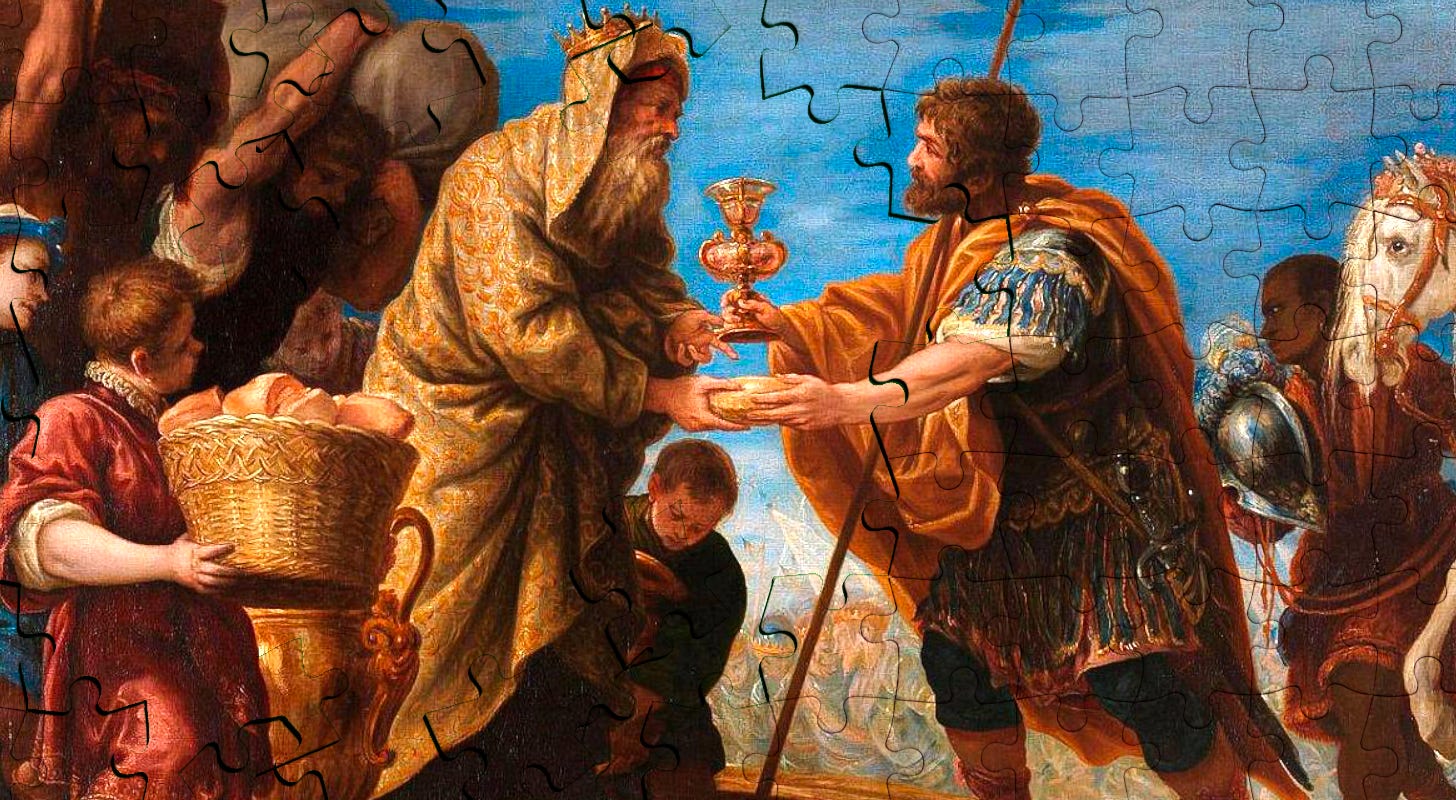
On the journey, down in the Valley of Shaveh, a stranger enters the story, “Melchizedek king of Salem brought out bread and wine. He was priest of God Most High, and he blessed Abram.”2 Abram, the man God had promised would become a great nation, responds by giving this stranger a tenth of everything. Three verses later, Melchizedek was gone, leaving behind the bread, the wine, and a question.
Who in the world is this?
We are not given an introduction or backstory; no explanation of how a priest of the true God is operating in Canaan decades before Israel exists, centuries before the priesthood enters the story, and roughly 600 years before Sinai. The narrative moves on as if there was nothing unusual to see here. But hold up, there is more to this tale.
The Boba Fett Problem

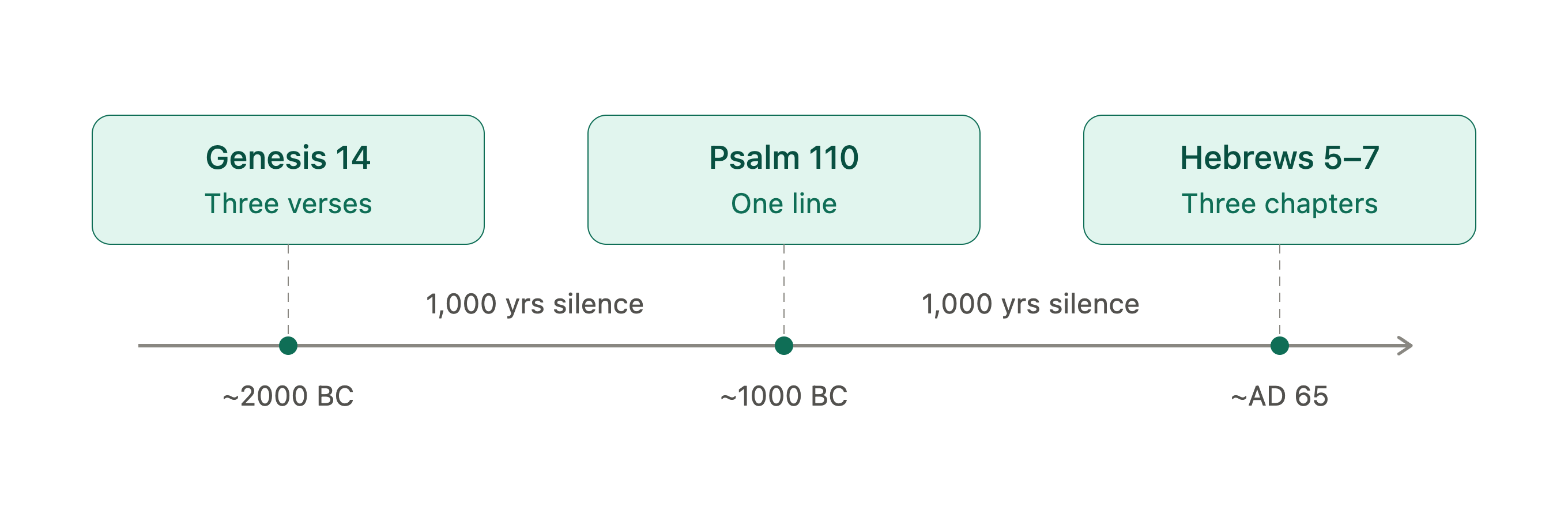
Melchizedek is the Boba Fett of the Old Testament. In the original Star Wars trilogy, Boba Fett has around six minutes of screen time and four lines of dialogue, yet he launched decades of fan theories and eventually his own Disney+ series (the mask helps, just ask Pedro Pascal). Melchizedek gets three verses in Genesis. Then the Bible goes quiet for a thousand years.
He resurfaces once in the Old Testament, in Psalm 110, where David records an oath from God to a mysterious coming king: “You are a priest forever, according to the order of Melchizedek.”3 One line and silence again for another thousand years. Then the author of Hebrews picks up Melchizedek and builds an entire theological structure around him. Hebrews spends three chapters arguing that this walk-on character from Genesis 14 holds the interpretive key to understanding who Jesus is.4
So, who exactly is this guy? Three answers have held the field for most of church history, and each one changes what he is.
View One: The Forgotten King
The first view takes the scene at face value. Melchizedek was a real, historical priest-king ruling a real city. Salem is likely an early name for Jerusalem. Psalm 76 makes this identification: “His tent is in Salem, His dwelling place in Zion.”5 Josephus, the first-century Jewish historian, treated Melchizedek as a Canaanite chieftain who ruled the city that would later become Jerusalem and who first served God as priest there.6
Genesis has been tracking one covenant family, and suddenly the text reveals that God had a witness in Canaan the whole time. Melchizedek serves “El Elyon,” God Most High, a divine title known in the wider Canaanite world.7 Abram doesn’t correct him. He identifies Melchizedek’s God as his own, swearing in the next scene by “the LORD, God Most High, Creator of heaven and earth.”8 The man whom God told the promises to, then tithes to the man with the altar.
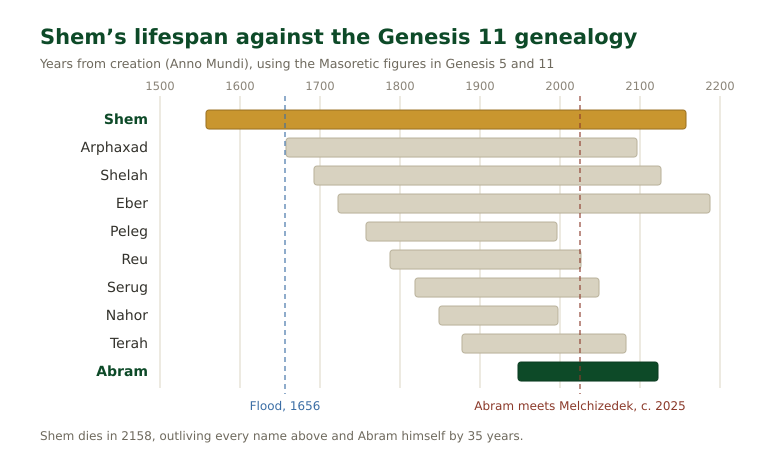
This view carries a fascinating sub-theory from Jewish tradition. The Talmud and several of the Aramaic Targums identify Melchizedek as Shem, the son of Noah.9 It sounds impossible until you add the math from the genealogies in Genesis 11. Taken at face value, the numbers have Shem surviving the Flood by 500 years, which means he would still be alive during Abram’s lifetime. (If you want to see how those lifespans work, and the three theories behind them, I put that puzzle together here.) In this reading, Abram tithes to the last living link to the world before the Flood, the man who watched the Ark doors close from the inside.
The strength of this view is that it takes a text from a historical book (Genesis) and gives an explanation for this mysterious person. A king, a city, a meal, a blessing. Its weakness is that it struggles to explain why Psalm 110 and Hebrews treat this local king as the pattern for an eternal priesthood.
View Two: The Appearance
The second view argues the reason Melchizedek seems too big for his three verses is that he was never merely human.
Hebrews describes him this way: “Without father or mother, without genealogy, without beginning of days or end of life, resembling the Son of God, he remains a priest forever.”10 That’s a résumé I’ve yet to find on LinkedIn, no parents, no birth, no death. Some Christians throughout history have concluded that Genesis 14 records a Christophany, an appearance of the pre-incarnate Son of God. Jesus stepping into history to bless Abram with bread and wine two millennia before the Upper Room.
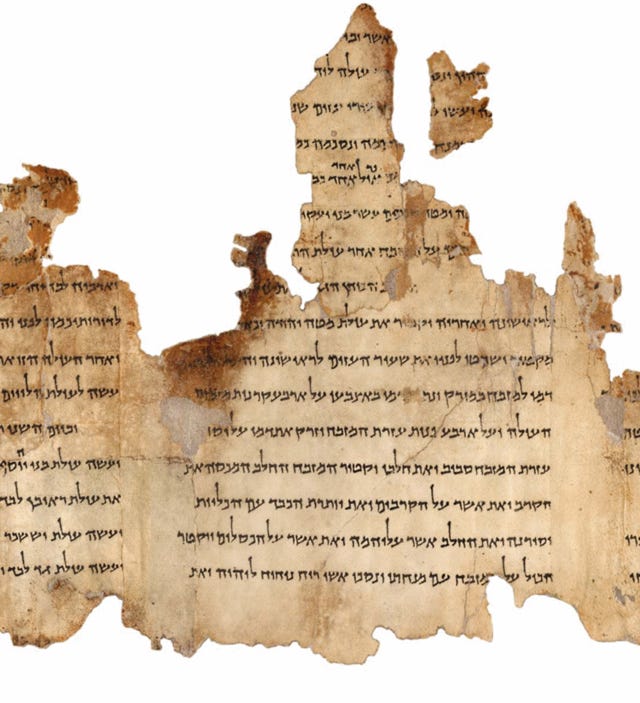
This perspective has ancient roots. Among the Dead Sea Scrolls, a fragmentary text known as 11QMelchizedek portrays him as a heavenly deliverer who executes God’s judgment and proclaims liberty to the captives in the last days.11 A community of Jews living two centuries before Jesus had already read Melchizedek as more than a man. Michael Heiser, whose work I leaned on heavy in the Nephilim puzzle, argued that texts like this show how naturally first-century readers could accept a divine figure standing alongside God.12
The early church took this view seriously. Jerome wrote an entire letter cataloging the options in circulation: some said Melchizedek was an angel, some said the Holy Spirit, some said Shem, some said the Son.13 A sect called the Melchizedekians not to be confused with the Kardashians, pushed it past the breaking point, ranking Melchizedek above Christ, which earned them a spot in Epiphanius’s famous catalog of heresies.14
The strength of this view is that it takes the theological structure presented in Hebrews with great seriousness. However, its weakness is Hebrews itself, which says Melchizedek was “resembling” the Son of God.15 A shadow reflects the object casting it. Why would a Biblical author say Melchizedek resembled Jesus, if it was Jesus?
View Three: The Deliberate Shadow
Notice what that verb is doing. Hebrews doesn’t say Melchizedek resembled the Son of God. The participle is passive. He was made to resemble him. Someone did the likening.
That is the third view, and it’s where the majority of the church, Catholic, Orthodox, and Protestant, has landed. Melchizedek was a real human king. What makes him strange isn’t the man. It’s the way the text handles him, and you can watch it happen in Genesis.
Here’s the argument; Genesis is obsessed with genealogy. The book is structured around the phrase “these are the generations of,” and it pauses constantly to tell you who fathered whom. In a book like that, introducing a priest with no father, no mother, no ancestry, no birth notice, and no death notice is a massive omission. The author of Hebrews argues from that silence: as far as the text is concerned, Melchizedek’s priesthood has no beginning and no end.16
Why does that matter? Because it solves a legal problem. Under the law of Moses, priests come exclusively from the tribe of Levi. Jesus descends from Judah, a tribe as Hebrews puts it, with no connection to the altar.17 On Levitical terms, Jesus is disqualified from the priesthood. But Genesis 14 proves a greater priesthood existed before Levi was born. Abraham, with Levi still three generations away, paid a tithe to Melchizedek and received his blessing. Hebrews draws the conclusion: the lesser is blessed by the greater.18 The order of Melchizedek outranks the order of Levi, and Psalm 110 promised the Messiah would belong to it.
Then there’s the meal. Melchizedek brings out bread and wine, and you are probably thinking what early Christians were thinking too. Cyprian of Carthage, writing around 253 AD, saw the offering as a foreshadowing of the Lord’s Supper.19 To this day, the oldest Eucharistic prayer in the Roman rite asks God to accept the offering as he accepted “that which your high priest Melchizedek offered.”20 Protestant interpreters have generally read the meal as royal hospitality, refreshment for a returning army, without a sacramental layer. Either way, the image lodged permanently in the church’s imagination: a king of righteousness (that’s what Melchizedek means) ruling a city of peace (that’s what Salem means), meeting God’s people with bread and wine.
The Riddle in the Temple Courts
Whichever view you take, the payoff runs through Psalm 110. It’s the single most quoted Old Testament chapter in the New Testament, and Jesus himself put it in play.
During His final week, teaching in the temple courts, Jesus posed a riddle to the crowd: David calls the Messiah “my Lord,” so how can the Messiah be merely David’s son?21 The question comes from the opening line of Psalm 110. And sitting three verses below the line Jesus quoted is the oath: “You are a priest forever, according to the order of Melchizedek.”
The cameo in Genesis 14 is more than a cameo with fan fiction. A priesthood older than Israel, greater than Levi, with no recorded end, held open for someone who could actually fill it. For a thousand years the position sat vacant. Hebrews’ whole argument is that it isn’t vacant anymore. Perhaps that’s why Genesis tells us so little. The mystery would be revealed at the proper time. A fully explained Melchizedek, complete with parents and a tomb, could never have carried the weight Psalm 110 placed on him. The gaps in his story were the shape of someone still to come.

Enjoy the Bible’s “wait… what?” moments?
Here are three more puzzles to put together:
Genesis 14:14–15. The number 318 is oddly specific for a legend, one reason many scholars treat the chapter as preserving genuinely ancient material. See Gordon J. Wenham, Genesis 1–15, Word Biblical Commentary 1 (Dallas: Word Books, 1987).
Genesis 14:18–19.
Psalm 110:4.
Hebrews 5:6–10; 6:20–7:28.
Psalm 76:2.
Josephus, Antiquities of the Jews 1.10.2. Josephus adds the tradition that Melchizedek was the first to build a temple at Salem and to serve God there as priest.
On El Elyon and its background in the wider Canaanite world, see Frank Moore Cross, Canaanite Myth and Hebrew Epic (Cambridge, MA: Harvard University Press, 1973).
Genesis 14:22.
b. Nedarim 32b; Targum Pseudo-Jonathan on Genesis 14:18. Jerome reports the same Jewish tradition in his day; see note 13.
Hebrews 7:3.
11QMelchizedek (11Q13). For an accessible translation, see Florentino García Martínez, The Dead Sea Scrolls Translated: The Qumran Texts in English, 2nd ed. (Leiden: Brill, 1996), 139–140.
Michael S. Heiser, The Unseen Realm: Recovering the Supernatural Worldview of the Bible (Bellingham, WA: Lexham Press, 2015).
Jerome, Epistle 73 (to Evagrius), a short treatise surveying the competing identifications of Melchizedek circulating in the late fourth century.
Epiphanius of Salamis, Panarion 55.
Hebrews 7:3. The Greek is aphōmoiōmenos, “made like” or “made to resemble” the Son of God, language of comparison rather than identity.
Hebrews 7:3, 7:8.
Hebrews 7:13–14.
Hebrews 7:7.
Cyprian of Carthage, Epistle 63.4, in The Letters of St. Cyprian of Carthage, trans. G. W. Clarke, Ancient Christian Writers (New York: Newman Press, 1984–1989).
Eucharistic Prayer I (the Roman Canon), The Roman Missal, 3rd typical ed. (2011).
Mark 12:35–37, quoting Psalm 110:1.