
The Oil, the Ice, and the Image of God

January 2026 has felt like a decade compressed into the first two weeks. We watched as U.S. forces apprehended Nicolás Maduro in what the administration called a law enforcement operation, but what much of the world and the UN Security Council is calling a violation of the very foundations of international law1. Simultaneously, the gaze of the ‘Don-roe Doctrine’ has turned north, toward the mineral-rich, sovereign expanses of Greenland.
For the politician, this is a game of Chess meets Risk. For the economist, it’s a ledger of oil barrels and rare-earth minerals. But for the Christian there are theological questions circling these headlines.
Does a nation’s hunger for security give it a divine right to another’s soil?
When we look at a map, do we see assets or do we see image-bearers?
If the Don-roe Doctrine redraws the map of the earth, does it also redraw the boundaries of our conscience?
Are we willing to sacrifice our neighbors on the altar of energy independence?
In this article, we aren’t going to talk about party lines. We’re going to talk about theology and examine the ethics of influence. We’ll explore the ancient wisdom of Just War theory, the Biblical mandate of stewardship, and why in a world of shifting borders the Kingdom of God remains the only ground that doesn’t move.
The History of “Might Makes Right”
To grasp the geopolitical tremors of 2026, the sudden annexation of Venezuelan territory and the calculated move toward Greenland, we have to look back at the tower that started it all: Babel.
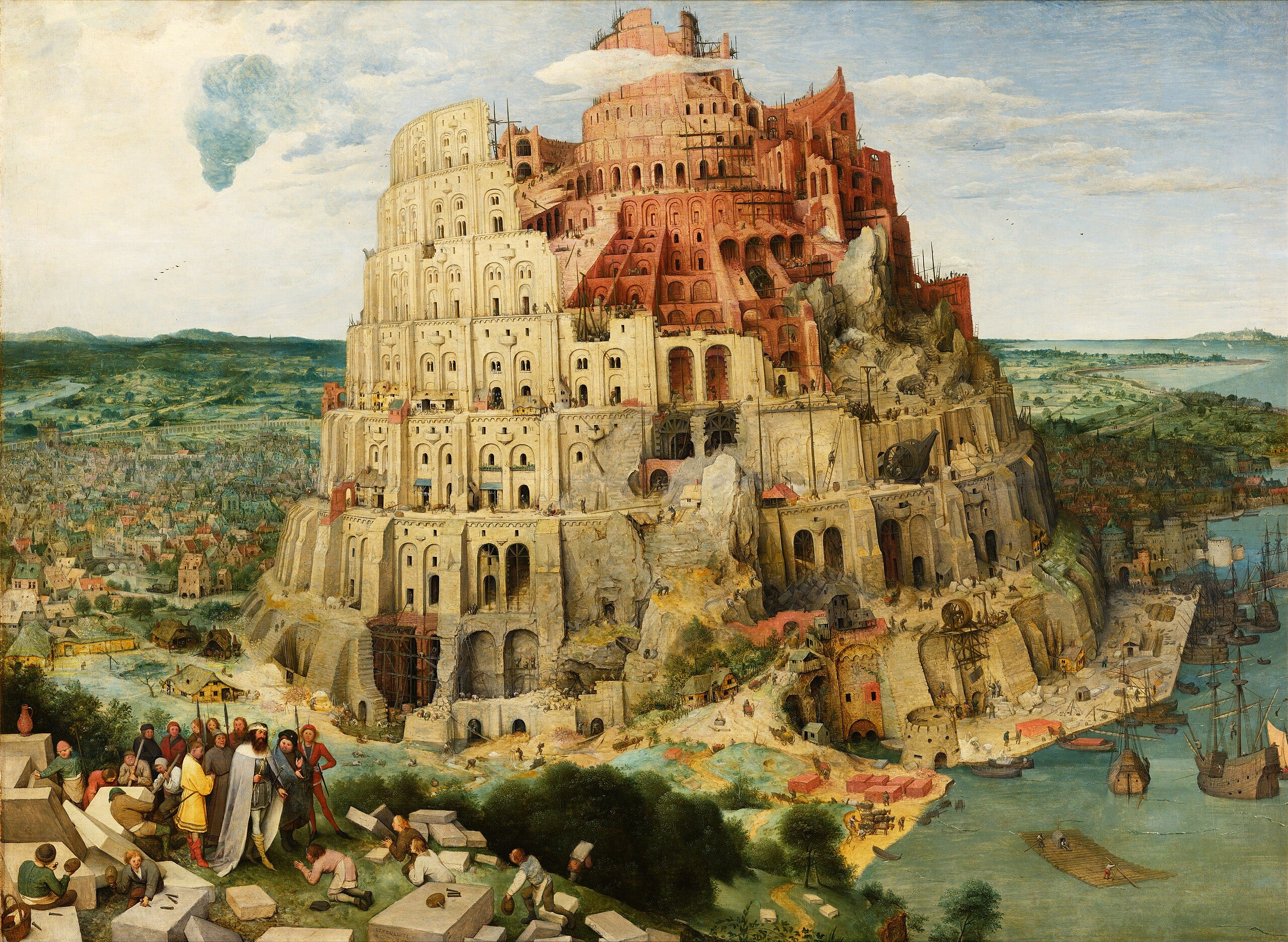
Theologically, Babel was never just about a tall building or primitive engineering. It was the birth of the superpower mindset—Nietzsche in architectural form. In Genesis 11, humanity decided to “make a name for ourselves2.” This wasn’t about the pursuit of a unified cultural identity, not the beautiful unity of Pentecost, but a forced uniformity, a totalitarianism of the spirit.
By building a tower that “reached to the heavens,” the builders of Babel were attempting to erase the distinction between the Divine and human. They were asserting that through technology, organization, and centralized power, they could define their own reality and bypass the boundaries God had set for human flourishing.
Sound familiar?
When we look at the modern Don-roe Doctrine3, it has an eerily similar bent. The belief that if a nation possesses the military might and the technological ‘tallness,’ it has the right to reach across oceans and ice sheets to claim whatever it deems necessary for its own glory.
Back to Babel. Why did God intervene?
It wasn’t because he was threatened by a brick edifice. It was because God intended for the earth to be filled with a diversity of nations and cultures, a beautiful particularity. In Acts 17:26, the Apostle Paul explains that God, “marked out the appointed times in history and the boundaries of the lands,” so that people would seek Him.
The tragedy of 2026 is that when a superpower erases the boundaries of a nation like Venezuela or Greenland, they aren’t just shifting a line on a map; they are attempting to extricate the boundary wisdom of God. They are asserting that one interest (their own) is more important than the many interests of the nations God has placed on this earth. Babel teaches us that whenever humanity tries to achieve peace or security through total dominance, God views it as a form of rebellion.
When we see the totalitarianism of interest playing out in the Arctic or South America, we have to ask:
Are we building a world that honors God’s diversity, or are we just building a new Babel with different bricks?
Babel fell because it was built on pride; the Don-roe Doctrine and all earthly expansions will eventually face the same gravity.
Throughout history, empires have used God to justify land grabs. We saw it in the Crusades, and we saw it in the original Monroe Doctrine of 1823, which essentially told Europe, ‘the Americas are our backyard, not yours, and that the United States and Europe should stay out of each other’s affairs.’ Today, critics are calling the 2026 U.S. stance the Don-roe Doctrine. An expansionist update that views the entire Western Hemisphere and the Arctic as subject to American interests.
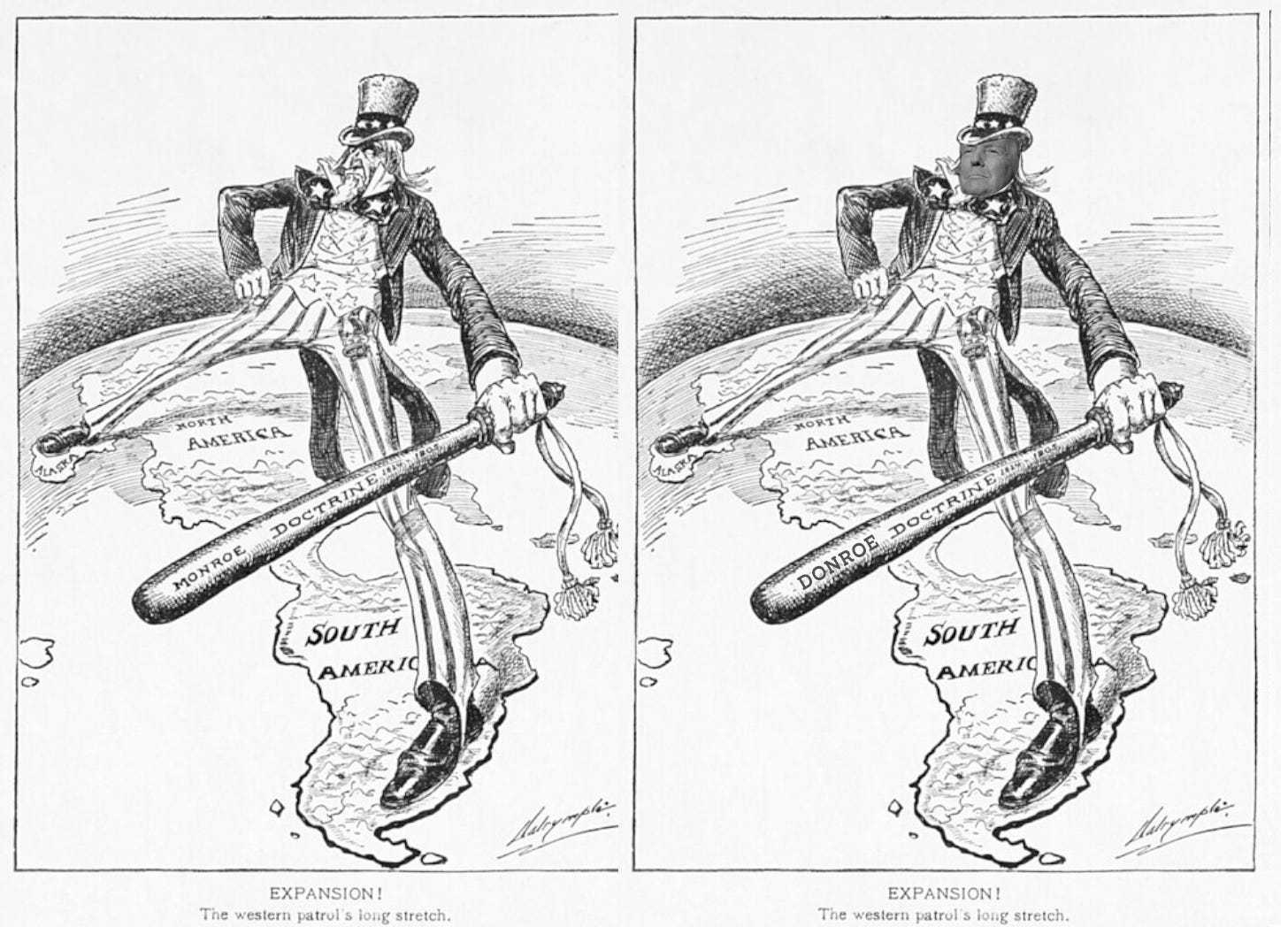
But from a biblical perspective, the National Interest is a poor substitute for the Common Good. When Israel’s kings tried to expand their borders through unholy alliances or the exploitation of neighbors, the prophets didn’t cheer them on, or give them a stamp of approval, instead they warned them, they plead with them, and they declared: woe.
Just War vs. Resource Realism
If you were to take a seminary class (grad school for pastors), you would hear and probably have to write a paper on Jus ad Bellum (the right to go to war).
Figures like Augustine and Thomas Aquinas developed Just War theory not to make war easy, but to make it nearly impossible to justify.
For St. Augustine, writing in the 4th and 5th centuries as the Roman Empire faced its own collapse, war was never something to be celebrated or used for national greatness. In his seminal work, The City of God4, Augustine argued that war is always a result of human sin. Even when a war is deemed just, such as defending the helpless, Augustine insisted that the believer should approach it with a sense of inward mourning. He believed that the primary goal of any conflict must be the restoration of the tranquility of order. By applying this to 2026, Augustine would likely challenge the Don-roe Doctrine by asking: Is this action truly seeking a lasting, peaceful order for the Venezuelan people, or is it merely the lust for domination that characterizes earthly kingdoms?
Centuries later, Thomas Aquinas codified these ideas into a formal theological framework in the Summa Theologica5. Aquinas set three strict shackles on the use of force to ensure it wasn’t used as a tool for expansion.
Proper Authority. The war cannot be started by private individuals or rogue factions.
Just Cause. Those who are attacked must deserve it because of some fault.
Right Intention. Even if you have a just cause, if your intent is to seize land, gold, or oil, the war becomes unholy and sinful.
In the context of Greenland or Venezuela, Aquinas would look past the official press releases and examine the heart: Is the intent truly to stop a threat, or is it to fill a treasury? If it’s the latter, the theory doesn’t justify the action.
Once we understand the strict restrictions placed on war by Augustine and Aquinas, we have to look at how these theories apply to the actual soil of places like Venezuela and Greenland. This brings us to a Spanish Roman Catholic theologian: Francisco de Vitoria.
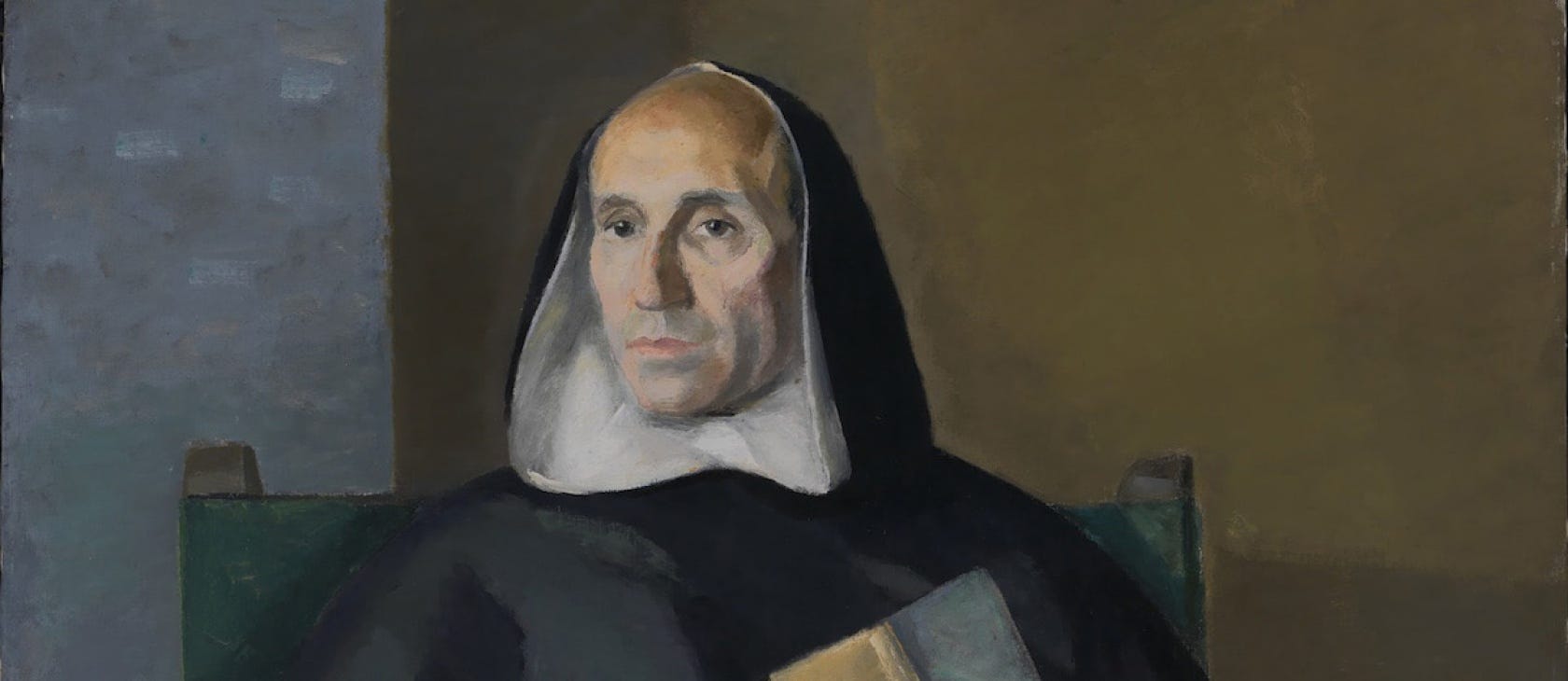
In the 16th century, as the Spanish Empire began its conquest of the Americas, Vitoria began to think about different questions. He didn’t just ask if the war was legal for the King; he asked if the people being conquered had a God-given right to say no. Vitoria argued that the inhabitants of the Americas and by extension, the people of Caracas or Nuuk today, possessed true dominion. He famously stated that neither the right of discovery nor a difference in culture gave a superpower the right to seize land, to quote two modern theologians, “You cannot discover lands already inhabited.6” To Vitoria, sovereignty was a natural right rooted in the fact that all people are created by God with the capacity for reason and self-governance7.
When we look at the Don-roe Doctrine of 2026, Vitoria’s theology reminds us that if we treat a nation like a resource to be managed rather than a neighbor to be respected, we are doing more than violating a border; we are disobeying a divine order. We are essentially saying that our need for lithium or light crude oil is more sacred than the Imago Dei present in the people who live above those resources.
What do we do when ‘Might makes Right’ seems to be winning the day?
For this, we turn from the halls of the seminary to the watchtower of the Prophet Habakkuk.
Habakkuk lived in a moment similar to our own. He watched as the Babylonians a “bitter and hasty nation8” marched across the breadth of the earth to seize dwellings not their own. This was his cry:
“Why do you make me look at injustice? Why do you tolerate wrongdoing? Destruction and violence are before me; there is strife, and conflict abounds.9”
Habakkuk was wrestling with a theology of geopolitics. He couldn’t understand why God would allow a ruthless empire to swallow up nations that were, relatively speaking, more righteous than they were. God’s answer to Habakkuk is just as timely today as it was then.
God doesn’t say the invasion is good. He pronounces a series of woes against the empire, woe to him who piles up stolen goods, woe to him who builds a city with bloodshed10.
God reminds the prophet that while the proud one (the empire) has desires that are not upright, “the righteous shall live by his faith11.” Our security does not come from the expansion of our nation’s borders or the stability of its oil reserves. Our security comes from a God who sees the movement of every tank and the suffering of every citizen, and remains the final Judge of every doctrine man dares to write.
One of the pillars that is frequently leaned into here is the concept of Just Cause. However a Just Cause is typically limited to self-defense or protecting the innocent from imminent slaughter. It specifically excludes aggrandizement or acquisition of wealth. Put in today’s vernacular: you cannot go to war for oil. You cannot threaten a nation’s sovereignty because you want their lithium.
Looking at the 2026 takeover of Venezuela, the administration argues it’s about ‘law enforcement’ against narco-terrorists. And while yes, that may play a part, the timing also happens to align perfectly with the global energy crisis. If our theology allows us to justify violence for resources, we have traded the cross for the sword.
The Arctic Soul
Now, north to Greenland. It’s a land of 56,000 people (image-bearers of God) living on an island that holds what is seen as one of the keys to the next century of technology. The United States wants its minerals for National Security. But what about the security of the Greenlanders?
In Genesis we are handed the concept of stewardship. But this is not ownership, it is a delegated responsibility. To “subdue the earth12” doesn’t mean to strip-mine it for the highest bidder; it means to care for it so that all life can flourish.
When a superpower treats Greenland as a property to be purchased against the democratic will of its people, it commits a theological error: treating humans as obstacles to profit. If our theology doesn’t protect the meek in Nuuk or the poor in Caracas, then it isn’t the theology of Jesus.
Now What?
It’s easy to feel cynical, natural to get angry. But as followers of the Prince of Peace, we are offered an alternative approach. Three practices for pursuing God’s shalom.
Intercessory Prayer. We pray for leaders, but we pray for their repentance, not just their success. We pray that they would see people, not just pixels on a strategic map.
Prophetic Hospitality. Early Christians were known for φιλοξενία (love of the stranger). What made Christian theology potent in the first century, wasn’t that it was cleverly debated, but that it was tasted. It was tactile, visceral, and undeniable. Their truth became plausible because their lives were beautiful. In a world of closed borders and security zones, we are called to be people of the open table. If your nation takes over another, your duty is to love the people of that nation as your own.
Allegiance Clarity. To remind yourself daily, your primary citizenship is not in a country that seeks to take over Greenland or Venezuela. Your citizenship is in a Kingdom that gives itself away for the sake of the world.
The maps of 2026 will likely look different than the maps of 2025. But the heart of God for the marginalized, the respect for the ancient boundary stones, and the call to be stewards of the earth remain unchanged.
Don’t let the noise of geopolitics drown out the whisper of the Spirit. God is not surprised by the movement of armies, and His justice is not delayed by the vetoes of the Security Council.
He is still on His throne.

United Nations Security Council. (2026, January 5). Security Council emergency meeting on the situation in the Bolivarian Republic of Venezuela (S/PV.9525) [Meeting record]. https://www.un.org/sg/en/content/sg/2026-01-05
And they said, “Come, let’s build ourselves a city and a tower with its top in the sky. Let’s make a name for ourselves; otherwise, we will be scattered throughout the earth.” - Genesis 11:4 (CSB)
The Don-roe Doctrine (a play on the 1823 Monroe Doctrine) is a term used to describe President Donald Trump’s 2026 foreign policy shift, which reasserts aggressive U.S. dominance over the Western Hemisphere through military intervention, resource control, and potential territorial expansion.
Augustine, S. (2003). The City of God (H. Bettenson, Trans.). Penguin Classics.
Aquinas, T. (1947). Summa Theologica (Fathers of the English Dominican Province, Trans.). Benziger Brothers.
Charles, M., & Rah, S.-C. (2019). Unsettling truths: The ongoing, dehumanizing legacy of the Doctrine of Discovery. IVP Books.
He used “natural reason” to protect Indigenous sovereignty from the Pope and the Emperor. However, he also argued that every country is bound by the Law of Nations. Meaning if a nation blocks ‘free trade’ or ‘travel’ (which he considered natural rights), it provides a ‘just cause for war.’ In the context of 2026, the Don-Roe Doctrine may acknowledge the sovereignty of Venezuela but claim ‘natural right’ to intervene if the nation is blocking American access to resources or trade.
Habakkuk 1:6
Habakkuk 1:3
These are found in Habakkuk 2
Habakkuk 2:4
Genesis 1:28