
The Nephilim: The Bible’s Most Mysterious Plot Hole

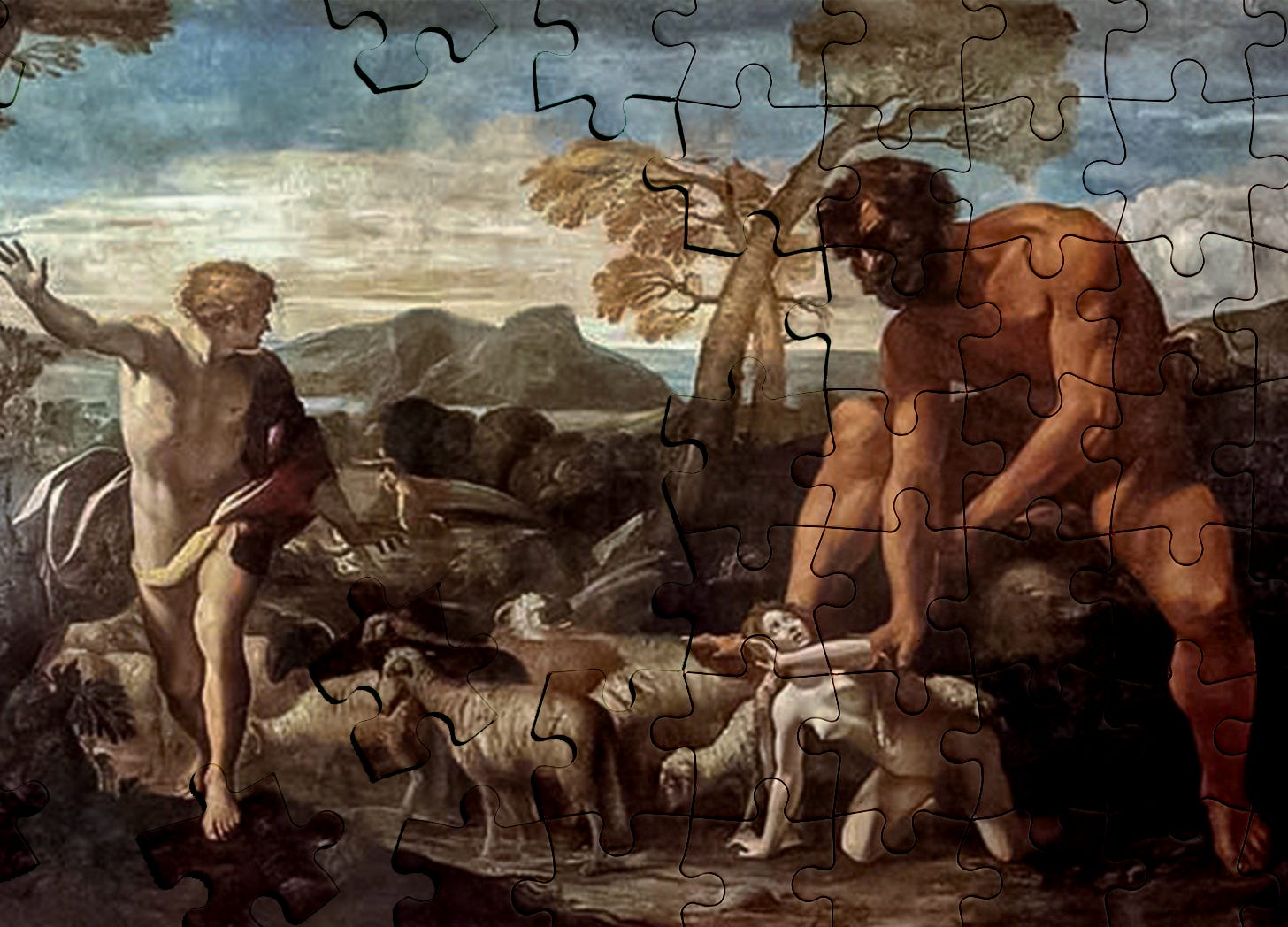
Fee-fi-fo-fum… here come the Nephilim.
Which is usually the moment readers stop and ask: Wait… what?
In Genesis, right as humanity begins to multiply and spread across the earth, the book takes a turn into what looks like a deleted scene from Lord of the Rings. The text reads, “The Nephilim were on the earth both in those days and afterward, when the sons of God came to the daughters of mankind, who bore children to them. They were the powerful men of old, the famous men.1”
In Genesis six, we are introduced to the “Sons of God,” and the “daughters of man,” and their resulting offspring: the Nephilim.
But who were the Nephilim?
Were they supernatural beings, corrupted bloodlines, or powerful rulers later remembered as legends? Depending on which framework you take, the answer changes how the puzzle fits in the Biblical story.
The Supernatural View (The Angel Theory)
This is the most dramatic interpretation and the oldest. It suggests that the “Sons of God” were fallen angels (often called The Watchers) who crossed a forbidden biological boundary to mate with human women. The late Michael Heiser, a scholar of ancient Semitic languages, argued that the Supernatural View wasn’t a fringe perspective but the original worldview of the Biblical authors. He based this on passages like Psalm 82,2 which he believed revealed a real spiritual “divine council” operating in the unseen realm.3
1. The Linguistic Smoking Gun: Sons of God vs. Sons of Seth
Heiser’s first point was that every time the phrase bene ha’elohim (Sons of God) appears in the Old Testament (like in Job 1:6 or Job 38:7), it always refers to celestial, spiritual beings and never to humans. For Heiser, calling them descendants of Seth was a modern invention used to make the Bible feel less weird. He argued that if the author meant the line of Seth, he would have used those words. By using bene ha’elohim, Genesis was signaling a supernatural event.4
2. The Biological Category Error
Heiser explained the immense size and strength of the Nephilim not as a miracle, but as a category error. In the Biblical worldview, there is a specific order to creation. Humans belong in the terrestrial realm; the elohim (spiritual beings) belong in the unseen realm. When these two realms intermingle sexually, it creates a biological transgression of that order. The Nephilim were the physical manifestation of that chaos. Beings that shouldn’t exist, possessing attributes (like massive stature or renown) that are a warped reflection of their father’s celestial nature.
3. The Divine Council Rebellion
Heiser’s biggest contribution to this perspective is his views on the Divine Council. He argued that the Sons of God were members of God’s heavenly bureaucracy who staged a mutiny. However, this wasn’t primarily about lust. We have to remove the mental models we have of how the Greek Gods were portrayed and how that shapes our reading of Genesis six. Rather this was a strategic move by these beings to corrupt the human race and prevent the Seed of the Woman (the future Messiah) from being born. If the human gene pool could be fully hybridized with the spirit realm, the legal human requirement for a Savior would be nullified.
4. The New Testament Proof Text
Heiser would often point to the New Testament to support his Genesis approach. In 2nd Peter 2:4 and Jude 1:6, the apostles speak of “angels who did not keep their proper domain” and were “chained in gloomy darkness” for their sin. What sin did they commit that was so much worse than other fallen angels? Heiser argues they left their proper dwelling (the unseen realm) to pursue human women (the human realm).
This gives further rationale for the Flood. Under this theory, God was not only wiping out bad behavior; He was dealing with a corrupted human genome. Humanity was being biologically hacked by outside forces, the Flood was a hard restart to preserve the pure human line that would eventually lead to the Messiah.
While it sounds like a treatment for a Star Wars prequel, this was the standard model of the early Church. Largely because ancient readers relied on the Book of Enoch to provide the Director’s cut of Genesis six. While the biblical text is brief, Enoch identifies these Sons of God as the Watchers; celestial beings who staged a cosmic mutiny on Mount Hermon to corrupt the human lineage and leak forbidden divine secrets.
This interpretation began to lose influence in the fourth century, when theologians like Augustine favored the Sethite view and the Church gradually distanced itself from the imaginative world of Jewish pseudepigrapha like 1st Enoch, moving instead toward interpretations that emphasized moral and theological meaning over cosmic speculation.5
Ultimately, your stance on the supernatural view depends on how you weigh the book of Enoch. Heiser famously argued that even if one doesn’t view Enoch as inspired Scripture, the New Testament authors, specifically Jude and Peter, seemed to. By quoting Enoch directly and referencing “angels who left their proper dwelling,” the apostles signaled that they shared this supernatural worldview. To understand the Nephilim through their eyes, you have to accept that the celestial and human realms collided, creating a biological and spiritual crisis that required the Flood.6
Now view two.
The Religious View (The “Sethite” Theory)
If the angel theory feels a bit too much like a Percy Jackson novel for your taste, the second option is the Sethite View. Often taught in Bible colleges and seminaries, this is not simply the comfortable alternative, it’s better understood as a deep dive into the Family Tree paradigm found in Genesis. To understand this perspective, you have to look at the Tale of Two Cities (it was the best of Genesis, it was the worst of Genesis) established in the previous chapters of the Biblical text. In Genesis four, there is the line of Cain, technologically advanced, but morally bankrupt. Towards the end of Genesis four and in Genesis five, the line of Seth, a family characterized by “calling on the name of the Lord.7” Proponents of the Sethite theory argue “Sons of God” is a covenantal title, not a biological one. Throughout the Old Testament, God refers to his chosen people as His sons.8 In this perspective, the “Sons of God” were the godly descendants of Seth, and the “daughters of men” were the rebellious descendants of Cain.9 Genesis six then wasn’t a celestial invasion; but a compromise of the line of Seth. It’s a story about what happens when the people of God prioritized physical beauty and cultural assimilation over spiritual integrity. They stopped being a set apart people and merged with a culture that had rejected God.
In this view, the Nephilim weren’t ten-foot-tall hybrids. The word Nephilim comes from the Hebrew root נָפַל (naphal) meaning to fall. These were fallen ones in a moral sense; men who fell upon others with violence. When the spiritual heritage of Seth’s line merged with the ruthless ambition of Cain’s line, it produced a generation of tyrants. They were giants of status and ego; who were “renowned” for their power and cruelty.
This view solves one of the logical hurdles: justice. If the problem was rogue angels hacking the human race, then humanity looks like a victim. But the Bible says God sent the Flood because, “the wickedness of man was great.” The Sethite view argues that the Flood was a necessary judgment because the last godly line on Earth had finally compromised its way into total corruption.
Now the final view.
The Political View (The “Divine Kings” Theory)
This theory moves the puzzle out of the Bible study and into an archaeological context. It looks at how people actually spoke and wrote in the Ancient Near East during the time of the patriarchs. In ancient Mesopotamia, Canaan, and Egypt, kings were more than sovereigns; they were frequently viewed as demigods. The Sumerian King list and Egyptian records show that rulers claimed to be Sons of [Fill in the blank with a god],10 to justify their absolute power. Under this theory, the Sons of God were not angels, but polygamous despots who claimed divine status to seize whatever and whomever they wanted.
The Genesis text says they took wives “whomever they chose.” This is ancient code for the establishment of royal harems. By seizing the daughters of men (the common people), these kings were centralizing power and bloodlines. The sin wasn’t inter-species breeding; it was the birth of tyranny. As the world became more populated, power became centralized in the hands of the mighty men. The Nephilim were the world’s first Warlords. They were men of renown because they were the first to master the art of organized warfare and monumental building.11
So, why would the Bible include this type of perspective?
In the ancient world, this reading makes sense. Across the Ancient Near East, kings routinely called themselves the “sons” of a god and claimed divine authority to take land, wealth, and women at will. Genesis six evokes that world: powerful men who took any they chose and became famous for their dominance. Rather than describing mythic giants, the text may be exposing the real source of the world’s violence, human rulers who used divine claims to justify domination. In that light, the Nephilim aren’t supernatural monsters. They’re the Bible’s earliest warning about what happens when power stops answering to God.
The Genetic Remnant: And Also Afterward
There is one final detail in the text. Genesis six says the Nephilim were on the earth in those days…and also afterward. If the Flood wiped out everyone except Noah’s family, how do we see giants like Goliath or the Anakim later in the Bible? Scholars have proposed several ways to explain this detail. The chart below summarizes the three most common approaches to how the Nephilim could appear again after the Flood.

Conclusion
Is this just a nerdy theological deep-dive into ancient mystery? Maybe.
But it also reveals a recurring theme in the human story: The boundary.
Whether they were fallen angels, compromised believers, or power-hungry kings, the story of the Nephilim is about what happens when we try to break the boundaries God set for us.
So, who were the Nephilim?
Maybe a better question isn’t who the Nephilim were, but what they represent. All three interpretations point to the same danger: when the boundaries God established are ignored—between heaven and earth, holiness and compromise, authority and domination—chaos ripples out.
Genesis doesn’t give us the Nephilim’s DNA. But it does give us something more important, a warning: when being powerful matters more than being faithful, the storm is already on the horizon.

Enjoy the Bible’s “wait… what?” moments?
Here are two more puzzles to put together:
Genesis 6:1-4
God has taken his place in the divine council; in the midst of the gods he holds judgment:
“How long will you judge unjustly and show partiality to the wicked? Selah. Give justice to the weak and the fatherless; maintain the right of the afflicted and the destitute. Rescue the weak and the needy; deliver them from the hand of the wicked.” They have neither knowledge nor understanding, they walk about in darkness; all the foundations of the earth are shaken. I said, “You are gods, sons of the Most High, all of you; nevertheless, like men you shall die, and fall like any prince.” Arise, O God, judge the earth; for you shall inherit all the nations! (Psalm 82)
Michael S. Heiser, The Unseen Realm: Recovering the Supernatural Worldview of the Bible (Bellingham, WA: Lexham Press, 2015). For a more accessible overview, see Michael S. Heiser, Supernatural: What the Bible Teaches About the Unseen World—and Why It Matters (Bellingham, WA: Lexham Press, 2015). For deeper study, see Michael S. Heiser, Angels: What the Bible Really Says About God’s Heavenly Host (Bellingham, WA: Lexham Press, 2018), and Demons: What the Bible Really Says About the Powers of Darkness (Bellingham, WA: Lexham Press, 2020).
Heiser, Unseen Realm
Augustine, The City of God, trans. Henry Bettenson (London: Penguin, 2003)
If you want to read a book that challenges some of Heiser’s assumptions, check out Brian Dempsey book The Unseen Throne.
Genesis 4:26
Hosea 1:10, Psalm 73:15
Victor P. Hamilton, The Book of Genesis: Chapters 1–17 (Grand Rapids: Eerdmans, 1990)
James B. Pritchard, ed., Ancient Near Eastern Texts Relating to the Old Testament, 3rd ed. (Princeton: Princeton University Press, 1969)
John H. Walton, Genesis (Grand Rapids: Zondervan, 2001)
I am really loving this approach with the different views represented.
As far as the post-flood Nephilim theories, I am leaning most towards A: Angelic Incursion. In Genesis 19, Lot protected the angels that were visiting him from a mob that wanted to rape them.