
The 3-Day War: What Christians Believe Happened After Jesus Died

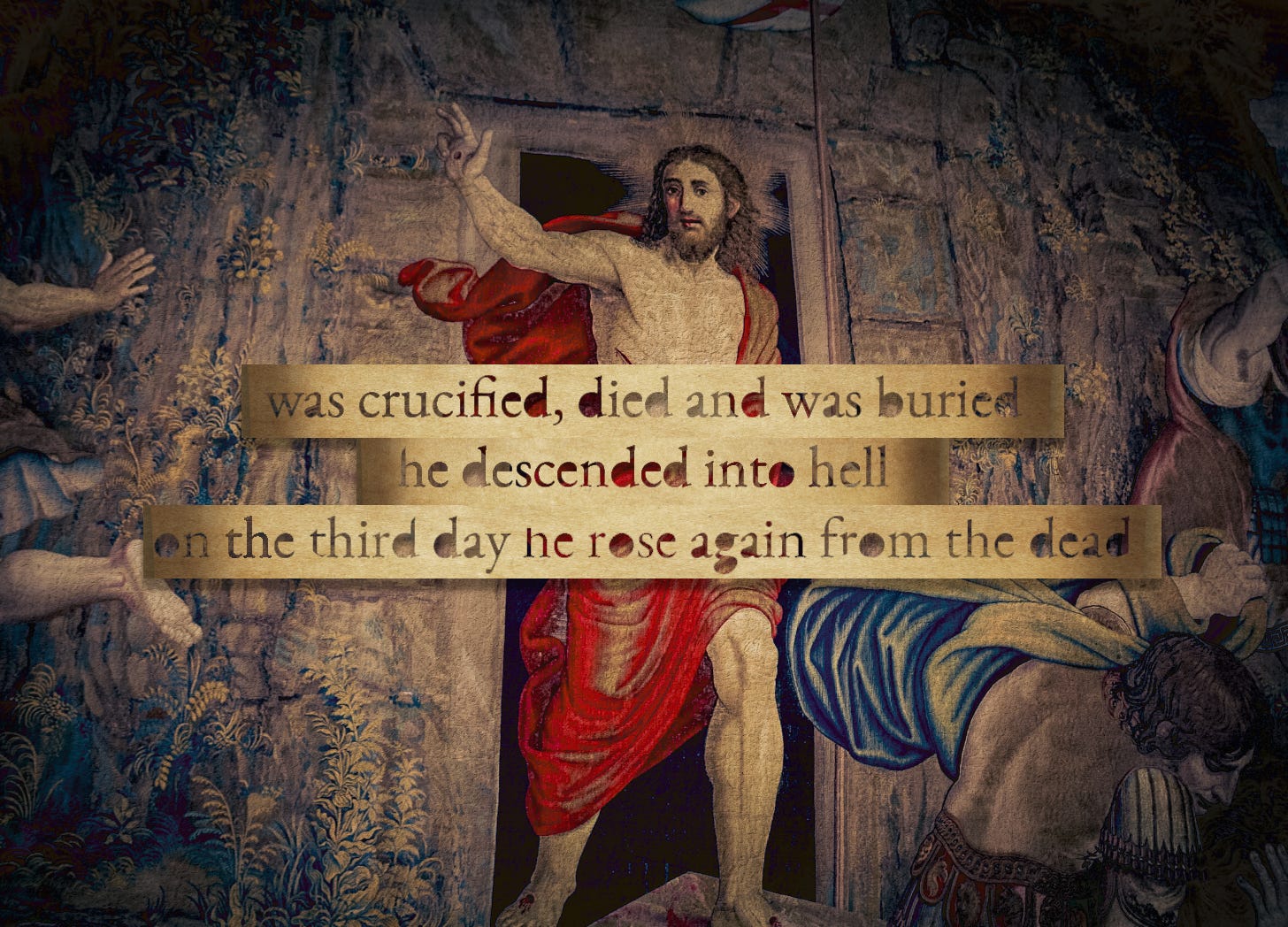
The 3-Day War
Friday, 3:00 P.M.
The most famous man in history is dead. The sky is black, the curtain is torn, and the body of a 33-year-old carpenter is wrapped in linen and sealed behind two tons of limestone. For the disciples, the story is over. For the Roman Empire, a nuisance was removed. For the Jews, a radical is gone. But for the rest of the world?
This is where the real story begins.
In the Apostles’ Creed, millions of people every Sunday recite a line, “He descended into Hell.“
In the New Testament, Peter writes that Christ was “put to death in the body but made alive in the Spirit, in which He went and proclaimed to the spirits in prison.”1 In this article, we are descending into the theological perspectives of the underworld: The Harrowing of Hell.
The Geography of the Grave
Before we can understand the war, we need to step onto the battlefield. To do that, we may have to delete some of what we think we know about Hell. Forget the pitchforks, horns, and if you grew up Baptist in the south, cool the fire and brimstone for a moment. In the ancient mind, the horror of the afterlife wasn’t that it was hot, nor was it imagined as Dante’s Inferno; rather it was simply inevitable for everyone.
Ancient Hebrews called it Sheol. Greeks called it Hades. It was the shadowy realm of the dead; a place of dust, silence, and fading memory. Every king and prophet, no matter how holy, still ended up in the same dark underworld when they died.
By the first century, some Second Temple Jewish traditions described the realm of the dead in more developed terms.2 They believed Sheol had different compartments. On one side, was the Place of Torment, language later Jewish and Christian writers connected to final judgment. On the other side, separated by an impassable chasm, was Abraham’s Bosom. Jesus presented this worldview in His story of the rich man and Lazarus, where the righteous rested in Abraham’s side, while the wicked suffered across a great chasm.3
In the theological interpretation of the early Church, these gates were seen as locked from the inside. Death was described as a Strong Man who had never lost a fight. The Bible uses similar imagery.4 Since the fall of Adam, the grave had a 100% success rate. The gates of Sheol were a one-way valve. You could check in, but you could never leave.
Which creates a crisis of justice (at least for the 21st century mind). If God is the God of the living, why is He letting His friends gather dust in the underworld? If the sacrifices of the Old Testament were supposed to work, why are the saints still behind bars?
Because the promise had yet to be fulfilled.
For years, the inhabitants of the shadow world heard nothing but the footsteps of more souls arriving. But on this specific Friday, the underworld shifted. For the first time in history, the Strong Man of death heard a knock on his door.
The Storming of the Gates
While the surface world was weeping, the underworld was panicking. To get a more vivid picture we turn to an early apocryphal writing in church history: The Gospel of Nicodemus. This is a 4th-century text detailing the trial, crucifixion, and resurrection of Jesus Christ—including His descent into Hell. Though not in the Bible, this book shaped the visual imagination of the Harrowing of Hell.
In this account, Hades (the personification of the Grave) is sitting on his throne when Satan comes rushing in, bragging. Satan says, “I did it! I stirred up the people. I got Him crucified. He’s dead, and he’s coming here to join the rest of the collection.”
Hades doesn’t celebrate with Satan. He is terrified.
He looks at Satan and says, “Who is this Jesus? A man in appearance, but mighty in power? For I heard that he raised Lazarus from the dead after he had been four days in the tomb. If he comes here, he will release all who are bound.”
Hades realizes what Satan doesn’t. You didn’t kill a man, you planted a God. They had trapped the ultimate victor and swallowed a depth charge. Hades screams to his demons, “Make fast the gates of brass. Set up the bars of iron. Fight with all your strength, if He enters here, we are undone.”5
Then, out of the silence, comes a sound the underworld had never heard. Not a scream of agony or ache of pain, but a summons. A commanding voice thunders through the abyss, the voice of the Creator shaking the vents of the universe.
The voice echoes Psalm 24 the ancient war-song: Lift up your gates, O princes, and be lifted up, you everlasting doors, and the King of glory shall enter.
The Gospel of Nicodemus described the King of Glory entering in human form, and the darkness of Hades flooded with light. The bronze gates were broken. The iron bars torn apart. This is the Harrowing. The word itself comes from the Old English hergian, meaning “to pillage” or “to plunder.” Jesus didn’t enter Hell to serve a sentence. He smashed the gates to rob the strong man’s house. He came to take back everything that had been stolen. Paul hints at this descent when he writes, “He ascended…what does it mean but that He also descended into the lower parts of the earth?”6
The Great Jailbreak
If you walk into an Orthodox church at Easter, you won’t see Jesus quietly stepping out of a tomb. You’ll see the Anastasis, Christ descending into Hades and pulling Adam and Eve from the grave. It’s one of the most enduring images in Christian history.
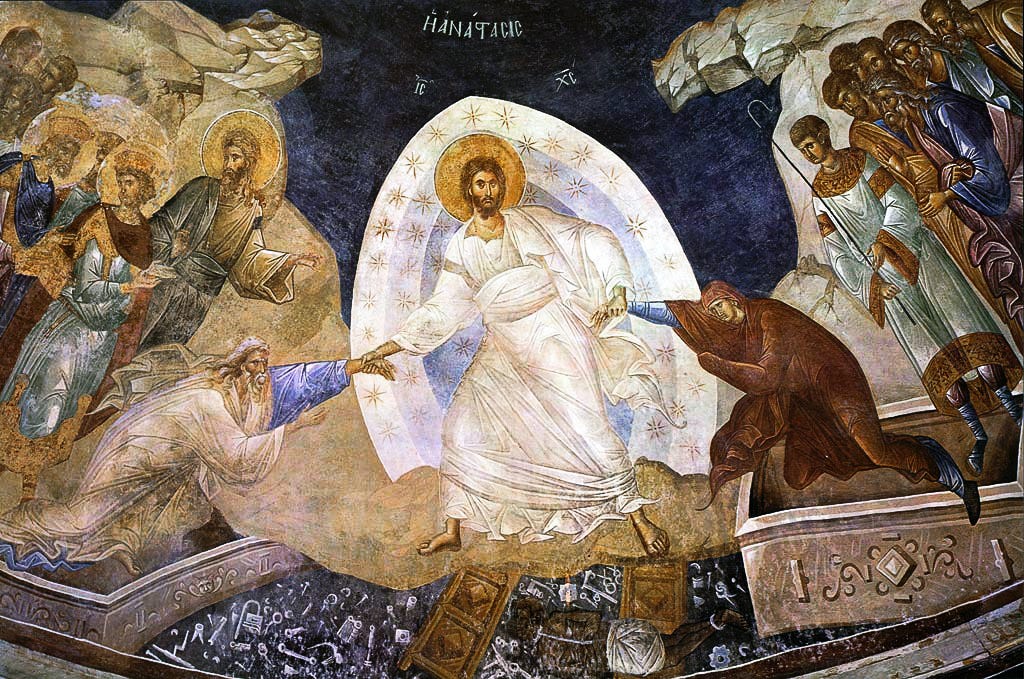
Look at the grip. In these icons, Jesus isn’t holding their hands. He is grabbing them by the wrists.
Why the wrists?
In ancient iconography, this is a rescue. Adam and Eve aren’t climbing out on their own. Christ is the one pulling them out of death. He isn’t looking for permission; He’s reclaiming what death stole.
Picture yourself as Adam. You’ve been sitting in the gray twilight of Sheol for millenniums. You are the one who lost the garden. You have watched every single one of your children from Abel, Seth, Noah, Abraham, David, and John walk through those gates and join you in the dust. You’ve had thousands of years to think about your mistake. But then, the darkness breaks.
Suddenly, the Man of Sorrows walks in, glowing with the brilliance of a thousand suns. He doesn’t look at Adam to give a lecture. He doesn’t bring a scroll of laws. He walks over, grabs the old man by the arm, and says, “Let’s go. The lease is up. I’ve paid the debt, and I’m taking the house back.”
This is the Christus Victor model of atonement.
In many modern Protestant circles, we focus on the Penal Substitutionary view of atonement. The theological concept that Jesus Christ died on the cross as a substitute for sinners, voluntarily taking upon Himself the legal penalty we deserved to satisfy the demands of divine justice. While that’s a part of the story, the Harrowing is about something much more visceral. It’s a divine rescue mission. It suggests that humanity wasn’t just guilty in a courtroom; but were hostages in a bunker. Jesus didn’t just come to sign our pardon; He came to blow the doors off Hell and carry us out on His shoulders.
Now, depending on which door of the Church you walk through on Sundays, this 3-Day War takes on a completely different flavor. Think of it like three directors providing their take to the final scene.
The Gold Lens: The Eastern Orthodox Victory
In Orthodox theology the Resurrection is understood as Christ’s victory over death and Hades. They believe that when Jesus died, His divinity remained united to His humanity even in death. He didn’t go to the underworld to visit; He entered Hades to break its power and free those held by death. St. John Chrysostom’s Easter sermon (still read every year in Orthodox churches) declares: “Hell took a body and met God face to face. It took earth and encountered heaven. It took what it saw, and fell by what it did not see.7”
The Crimson Lens: The Roman Catholic “Limbo of the Fathers”
In the Roman Catholic tradition, the descent is understood through the idea of the Limbus Patrum (Limbo of the Fathers). The righteous of the Old Testament such as Abraham, Moses, David, and others were not in torment, but in a state of peace and waiting. They could not yet enter Heaven, because the work of redemption had not yet been completed and the gates of the Beatific Vision had not yet been opened.
In this view, Christ descends to proclaim the victory of the cross and to bring the faithful into the presence of God. Think less prison break and more royal procession: the long-awaited opening of heaven.
The Plain Lens: The Protestant Struggle
Then the Protestant Reformers. For many of them, the idea of Jesus physically traveling to the underworld beneath the earth felt a bit too much like a Greek myth. Reformers like John Calvin understood the descent differently. For Calvin, “He descended into hell” did not mean that Christ traveled to the underworld after His death. Instead, the descent happened on the Cross.8 There, Jesus endured the full weight of God’s judgment against sin; the terror, the curse, and the experience of abandonment expressed in His cry, “My God, my God, why have you forsaken me?” In this view, the victory over hell was accomplished not in a hidden realm after death, but in the suffering of the Cross itself.
For many Protestants,9 the “Harrowing” happened while Jesus was still breathing. The “bars of iron” were the weight of the world’s sin crushing His spirit. The victory wasn’t about what He did in a hidden underworld; but about the fact that Death couldn’t hold Him because He had already survived the “Hell” of the Cross.
In the End
Whether you see it as a literal prison break, a priestly procession, or a theological victory over despair, the idea converges on one radical point: Death now has a hole in it. The ancient writers wanted you to understand that the one-way valve of the grave had been broken. The Strong Man had been tied up in his own house, and his goods (you and I) had been stolen back by the rightful owner.
The Harrowing of Hell tells a story where even if you are in the deepest, darkest “compartment” of life, even if you are “dead” in your mistakes or your history, there is a King who breaks down doors.
Christ did not escape death. He broke it from the inside.

If you enjoyed this look at the Harrowing of Hell, you’ll love my short workshop Faith Without Fear: Learning Theology with Confidence.
In just 40 minutes, I show you how to break down complex theological ideas without feeling overwhelmed. Right now it’s available for $19.99.
1 Peter 3:18–19
George W. E. Nickelsburg, Resurrection, Immortality, and Eternal Life in Intertestamental Judaism and Early Christianity, expanded ed. (Cambridge, MA: Harvard University Press, 2006),
Luke 16:22–26
Psalm 9:3, Job 38:17, Isaiah 24:22, Mark 3:27
Gospel of Nicodemus, Descent into Hell 4–5. (In this article I paraphrase the text)
For the fuller context, Ephesians 4:8-9: This is why it says: “When he ascended on high,
he took many captives and gave gifts to his people.” (What does “he ascended” mean except that he also descended to the lower, earthly regions? He who descended is the very one who ascended higher than all the heavens, in order to fill the whole universe.)
John Chrysostom, Paschal Homily, in The Liturgy of St. John Chrysostom
Calvin, John. Institutes of the Christian Religion. Translated by Ford Lewis Battles. Edited by John T. McNeill. 2 vols. Louisville, KY: Westminster John Knox Press, 1960.
Many Protestants follow Calvin, but others historically did affirm a descent to the realm of the dead, including: Martin Luther, who believed Christ descended as a conqueror and some Anglican and Lutheran traditions that still affirm a literal descent.
I love the Icon of the Resurrection. This was a great article. I did not know about the belief in different compartments but it does track with the Lazarus story. Thanks!
awesome! Thanks Jordan