
The Three Theories Behind the Destruction of Sodom

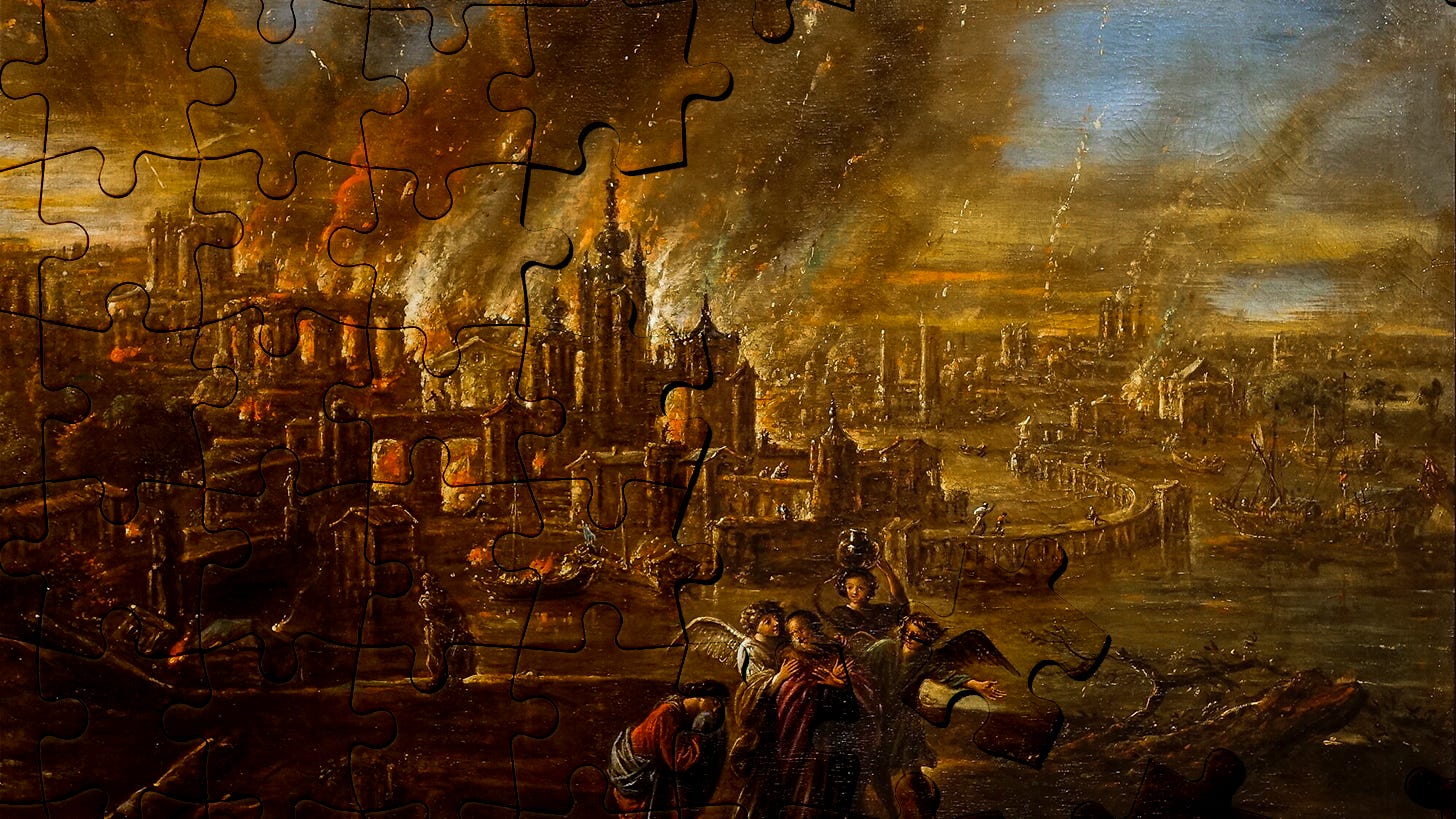
The One Where a Lady Turned to Salt
In the Book of Genesis, we find the story of Sodom and Gomorrah, these are more than just ancient cities of decay; they have served as a moral warning for 4,000 years. The text says “The Lord rained on Sodom and Gomorrah sulfur and fire... out of heaven.”1 By morning, Abraham looked toward the valley and saw “the smoke of the land went up like the smoke of a furnace.”2
For centuries, this was viewed as a purely supernatural bolt from the blue.3 In the last few decades, however, researchers have revisited the Dead Sea basin with a forensic lens; reassessing candidate sites and asking what kinds of natural catastrophes (seismic activity, fire, regional collapse) could match the scale of the biblical story.4
The question in this article, isn’t whether God acted. The question is how He acted. Was it through direct intervention, natural forces, or a combination of both? When we apply Biblical logic to the ruins, we find four unique theories to explain one of the wilder stories in Genesis.
1. The Traditional Biblical View (The “Divine Rain” Theory)
The traditional view takes the text at its literal face value: God intervened directly in time and space to execute judgment. The text specifies that the fire came “out of heaven.” This isn’t described as an earthquake from below, but a targeted strike from above. Proponents of this view argue that trying to find a natural cause misses the point.5 This event was timed to allow Lot to escape and cast judgment, suggesting a controlled application of force from God above.
In recent years, some independent explorers working in the southern Dead Sea region have pointed to small sulfur deposits found near proposed Sodom sites. They describe rounded fragments embedded in ashy soil and claim they have unusually high sulfur purity compared to typical volcanic material. These reports have circulated widely in documentaries and apologetics media.6
However, such findings have not been confirmed in the major peer-reviewed excavation reports from the region. The Dead Sea basin does contain natural bitumen, sulfur, seismic activity, and fire destruction layers documented at several Bronze Age sites.7 But whether any specific sulfur deposits can be directly connected to the Biblical destruction remains unproven. For those who read the account literally, these deposits have been seen as possible physical remnants of the “rain of sulfur” described in Genesis. However, for most proponents of this view, “proof” of the deposits are not needed to support a miraculous act of God in the text. If God chose to act in judgment from heaven, He doesn’t need to leave “miracle evidence” still visible 4,000 years later (BTW, turns out you can buy some of your own sulfur balls on Ebay).
2. The Archaeological Theory (The “Tallah el-Hammam” Airburst)
In 2021, a team of scientists published a paper in Scientific Reports analyzing the ruins of Tall el-Hamman.8 The proposal has generated significant debate. Some archaeologists question whether the site was actually Sodom, while others argue the evidence for an airburst remains inconclusive.
They analyzed the ruins of Tall el-Hammam; a massive Bronze Age city near the Dead Sea. The city was abruptly destroyed around 1650 BC. The team found a charcoal-rich destruction layer containing melted pottery, shocked quartz, and diamond-like carbon.
These materials only form under intense heat and pressure; specifically, temperatures exceeding 2,000°C (hotter than a blast furnace). The theory is that a cosmic airburst (like a meteor similar to the 1908 Tunguska event) exploded over the valley. The resulting heat wave would have flash-incinerated the cities, while the shockwave would have leveled the walls instantly. The airburst may have lofted large amounts of salt and brine into the atmosphere, which then fell back over the region. This explains why the region remained unculturable for centuries.9 This could provide a possible natural context for the Biblical description of Lot’s wife becoming a “pillar of salt.”10
3. The Geological Theory (The “Bitumen Pressure Cooker”)
This view looks at the geological context of the Dead Sea. The area sits on a massive fault line and is one of the most oil-and-gas-rich regions in the ancient world. Ancient writers like Strabo and Josephus describe the region as prone to earthquakes and burning asphalt pits.11 The Dead Sea is famous for bitumen (asphalt) that occasionally bubbles to the surface. In this perspective, a massive earthquake triggered a seismic purging of the earth.12
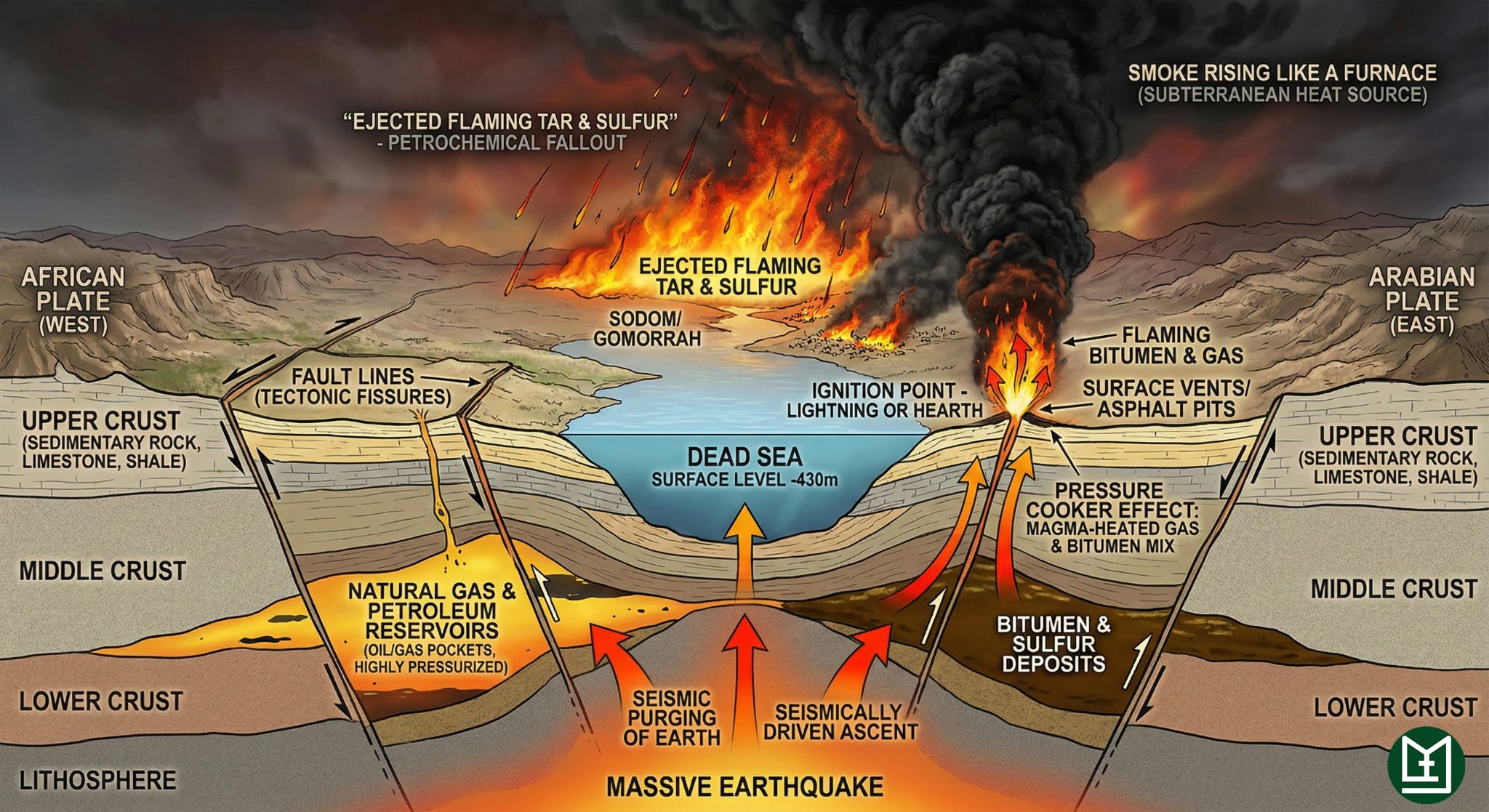
High-pressure pockets of natural gas and petroleum were forced up through the fault lines. Once ignited (perhaps by a lightning strike13) the valley became a natural pressure cooker. The rain of fire wasn’t falling from the stars; it was being ejected from the earth and falling back down as flaming tar and sulfur. This could explain why Abraham saw the smoke “rising like a furnace.” A furnace implies a subterranean heat source, consistent with a massive petrochemical fire fueled by the earth’s own reservoirs.
4. The Ezekiel Reframe
For centuries, the most contested question about Sodom wasn’t geological but, hermeneutical: what exactly was the sin?
The traditional answer has been so dominant that many readers assume it’s the only answer. But the Bible itself offers a counter-interpretation and it comes from one of its own prophets. In Ezekiel 16:49, God speaks directly about Sodom’s sin:
“Now this was the sin of your sister Sodom: She and her daughters were arrogant, overfed and unconcerned; they did not help the poor and needy.”
No sexuality mentioned, but pride. Excess. Indifference to the poor.
This isn’t a liberal revision of the text. It’s a later biblical writer looking back at the same event and naming a different center of gravity. Ezekiel doesn’t contradict the Genesis passage; instead he reframes what the text was about. The destruction wasn’t primarily a response to a particular sexual act. It was the culmination of a society that had turned inward, hoarded its resources, and had stopped seeing the people at its gates.
Which makes the story significantly more uncomfortable than its traditional reading.
Because a Sodom defined by sexual sin is easier to keep at a distance. A Sodom defined by wealth, comfort, and neglect of the vulnerable is a city that looks recognizable. It looks like cities today. It might look like your city. It might look like your church.
The four theories in this piece are all trying to answer the same question Abraham was asking from the hillside. Not just what happened, but what does it mean?
And Ezekiel’s answer is the one that has the longest reach.
Conclusion
We often treat the story of Lot’s wife as a strange moral legend; the woman who became a pillar of salt, like a bizarre footnote in the Bible’s index. But when you look at the Dead Sea basin through the lens of history, geology, archaeology, and hermeneutics the image becomes more complex.
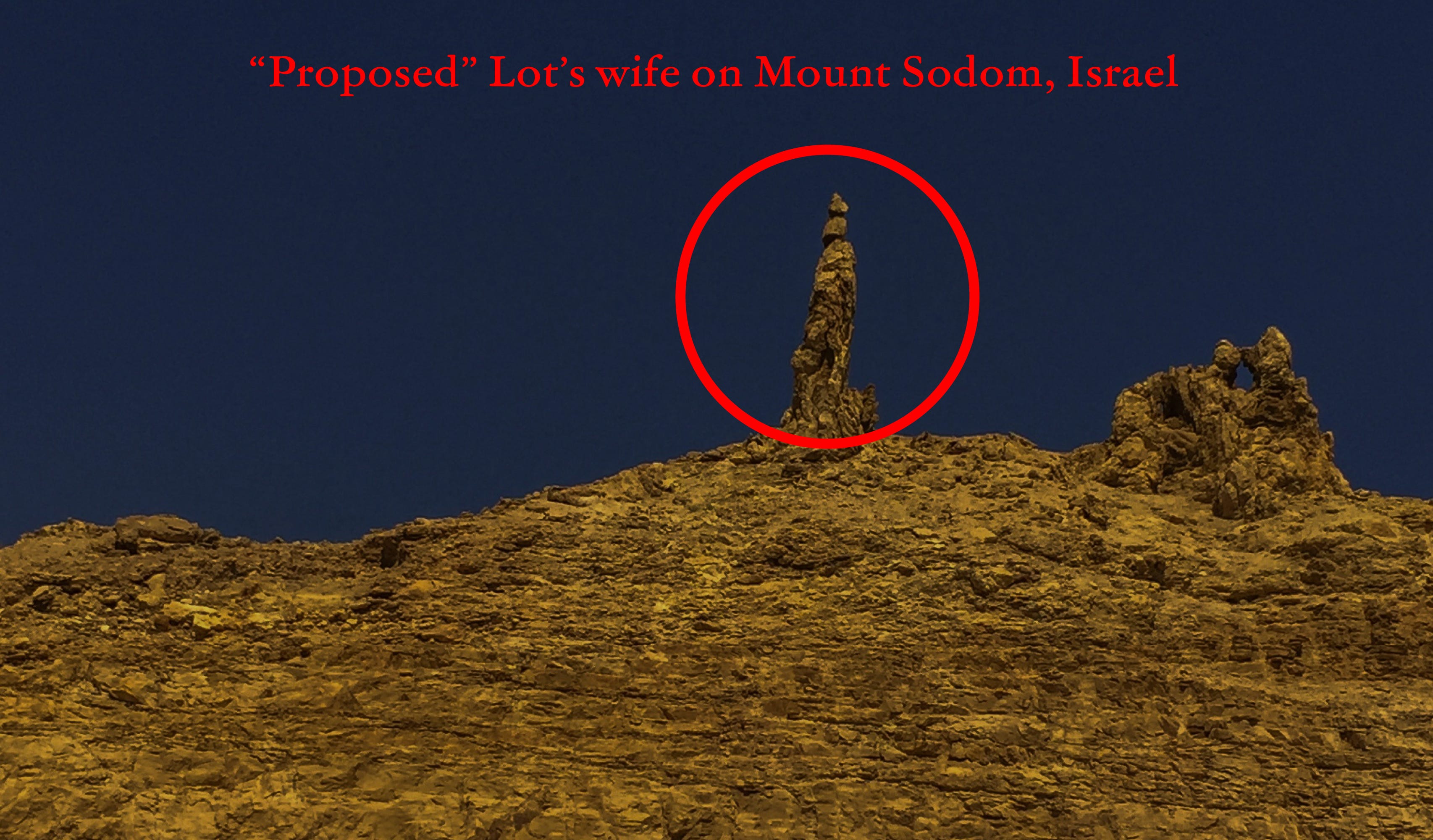
If the destruction was a direct act of divine judgment, then the pillar of salt stands as a symbol of disobedience frozen in time.
If the catastrophe was the result of earthquakes and ignited petroleum deposits, then the valley may have erupted in burning asphalt and sulfur, turning the landscape itself into a furnace.
And if the airburst theory is correct, a massive atmospheric explosion could have blasted salt and brine across the basin, encasing everything in a mineral storm.
Each explanation; miracle, geology, or cosmic catastrophe, tries to account for the same ancient history: a city destroyed so violently that what rose was “like the smoke of a furnace” and the land itself became a monument to the event.
Four thousand years later, the ruins of the Dead Sea valley still invite the same question Abraham asked as he gazed across the plain. Not just what happened, but what it means when God’s physical world and God’s moral world crash together.
Because in Genesis, judgment is never just an idea. It leaves a landscape as a reminder.

Enjoy the Bible’s “wait… what?” moments?
Here are three more puzzles to put together:
Genesis 19:24-26
Genesis 19:28
An idiom refers to a sudden, unexpected, and shocking event or piece of news that comes without warning.
Steven Collins et al., Tall el-Hammam Excavation Project publications; Ted E. Bunch et al., “A Tunguska-sized airburst destroyed Tall el-Hammam…” Scientific Reports (2021). Note for the reader the Scientific Reports issued a retraction note in 2025 regarding the initial findings.
Gordon J. Wenham, Genesis 16–50, Word Biblical Commentary 2 (Dallas: Word Books, 1994); Victor P. Hamilton, The Book of Genesis: Chapters 18–50, New International Commentary on the Old Testament (Grand Rapids: Eerdmans, 1995).
Ron Wyatt, field claims regarding sulfur deposits at proposed Sodom sites, as summarized in Lennart Möller, The Exodus Case: New Discoveries of the Historical Exodus (Copenhagen: Scandinavia Publishing House, 2002), 279–284. These claims are not documented in peer-reviewed archaeological excavation reports. BTW Ron was a Nurse Anesthetist not as an archeologist. Here is a better take Lennart Möller, The Exodus Case (Copenhagen: Scandinavia Publishing House, 2002), 279–284; cf. Walter E. Rast and R. Thomas Schaub, Bab edh-Dhra: Excavations at the Town Site (1975–1981) (Winona Lake, IN: Eisenbrauns, 2003), which do not report such sulfur findings.
Walter E. Rast and R. Thomas Schaub.
Ted E. Bunch et al., “A Tunguska-Sized Airburst Destroyed Tall el-Hammam, a Middle Bronze Age City in the Jordan Valley Near the Dead Sea,” Scientific Reports 11, no. 1 (2021)
Ted E. Bunch et al.,
See Genesis 19.
Strabo, Geography 16.2.42–44; Josephus, The Jewish War 4.8.4; Josephus, Antiquities of the Jews 1.11.4.
Ben-Avraham, “The Dead Sea Transform and Its Geological Evolution,” in The Dead Sea: The Lake and Its Setting, ed. T. M. Niemi, Z. Ben-Avraham, and J. R. Gat (Oxford: Oxford University Press, 1997).
Without denying that at some date famous cities were there burnt up by lightning, I am yet inclined to think that it is the exhalation from the lake which infects the soil and poisons the surrounding atmosphere (Tacitus, Histories 5.7.).
Another one!
Excellent synthesis of information. Thank you for the work that must have gone into this.