
Not Angels, Not Ghosts: What Really Happens When We Die

It doesn’t matter whether you’re a philosopher or a child, a scientist or a saint. When you stand graveside and watch someone you love lowered in the ground, or when you feel your own mortality pressing in, the question strikes: what happens when we die?
Cultures throughout history have tried to answer. Egyptians built elaborate tombs, the Greeks told stories of Hades, Eastern religions imagined cycles of rebirth, even modern secularism has its own eschatology, some talk about “living on” through DNA, legacies, or memories (Ubik1, anyone?).
But what about Christianity? When the Bible talks about death, what would it write on the headstone?
The Reality of Death
The Bible doesn’t romanticize death. It calls death what it is; the last enemy to be destroyed2. When Adam was created from the dust of the ground, God gave a command: “If you eat of the tree of the knowledge of good and evil, you shall surely die.3” By Genesis 3, Adam and Eve rebelled, “Dust you are, and to dust you shall return.”
Modern voices call death a part of the circle of life, something to be accepted peacefully. Scripture exposes it: an intruder. A thief. The wages of sin. And yet, paradoxically, in Christ, death becomes a doorway.
The Intermediate State in Scripture
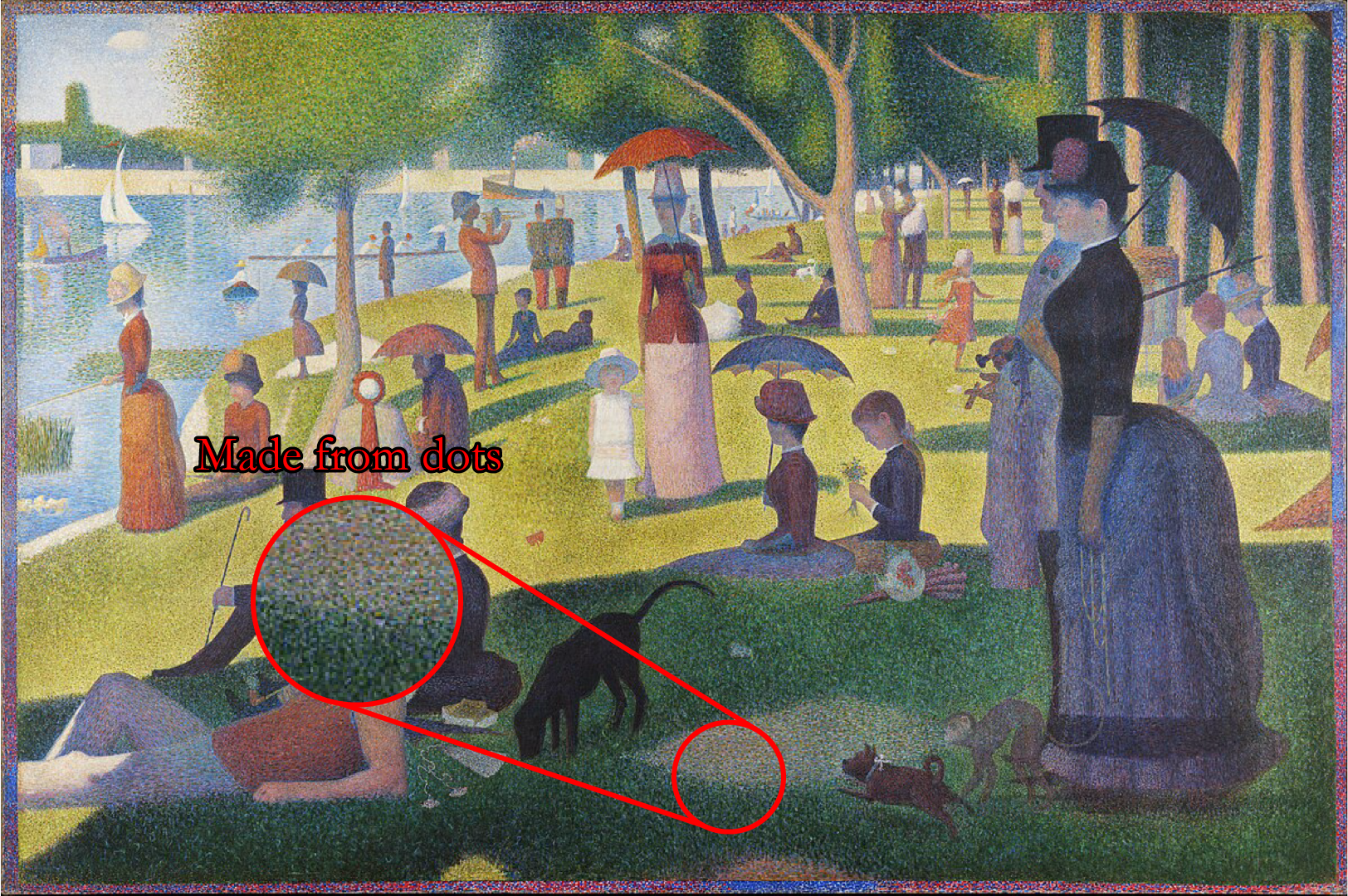
What happens in that moment after death, before the final resurrection? Theologians call this the intermediate state. The condition of the human person between physical death and the resurrection of the body at Christ’s return. Contrary to some televangelists, the Bible does not hand us a neatly organized chart of the afterlife. Instead it offers windows, glimpses, testimonies, and fragments of revelation. Alone they are like disconnected dots, but put together they become like a Pointillism4 painting displaying the full scope of Scripture.
The Old Testament rarely describes in detail what happens after death. The picture is one of finality, shadow, and silence. The most common word for the place of the dead is Sheol, appearing over 60 times in the Hebrew Bible. Sheol is not equivalent to “hell” in the New Testament sense, nor is it identical to heaven. It is simply the realm of the dead. In Genesis 37, when Jacob believes Joseph is dead, he cries, “I shall go down to Sheol, to my son, mourning.” Jacob doesn’t imagine heaven for the righteous and hell for the wicked. He sees all the dead as going to Sheol. In Job 14:13, Job longs for God to hide him in Sheol until God’s wrath has passed. In Sheol, both righteous and wicked descended.
At times, the Old Testament hints at the dead as shades or disembodied spirits. Isaiah 14 portrays the dead kings of the nations rising from their thrones in Sheol to mock the fallen king of Babylon. 1st Samuel 28 narrates the peculiar scene where Saul consults the medium of Endor, who brings up the spirit of Samuel from Sheol (don’t worry, no Ewoks were harmed). These texts do not give us systematic doctrine, but do suggest the dead continue in some diminished form.
As Israel’s faith developed, so too did its hope. By the later prophets, the portrait Scripture was painting became more defined. In Isaiah 25:8: “He will swallow up death forever, and the Lord God will wipe away tears from all faces.” Then in Daniel 12:2: “Many of those who sleep in the dust of the earth shall awake, some to everlasting life, and some to shame and everlasting contempt.” Sheol was still the default, but through the prophets’ brushstrokes, resurrection hope emerged.
By the time of Jesus, Jewish thought was divided. The Sadducees denied resurrection5. The Pharisees affirmed it. Into this tension, Jesus brought clarity. On the cross, a dying criminal turns to Jesus and says, “Remember me when you come into your kingdom.” Jesus replies, “Truly, I say to you, today you will be with me in paradise.6”
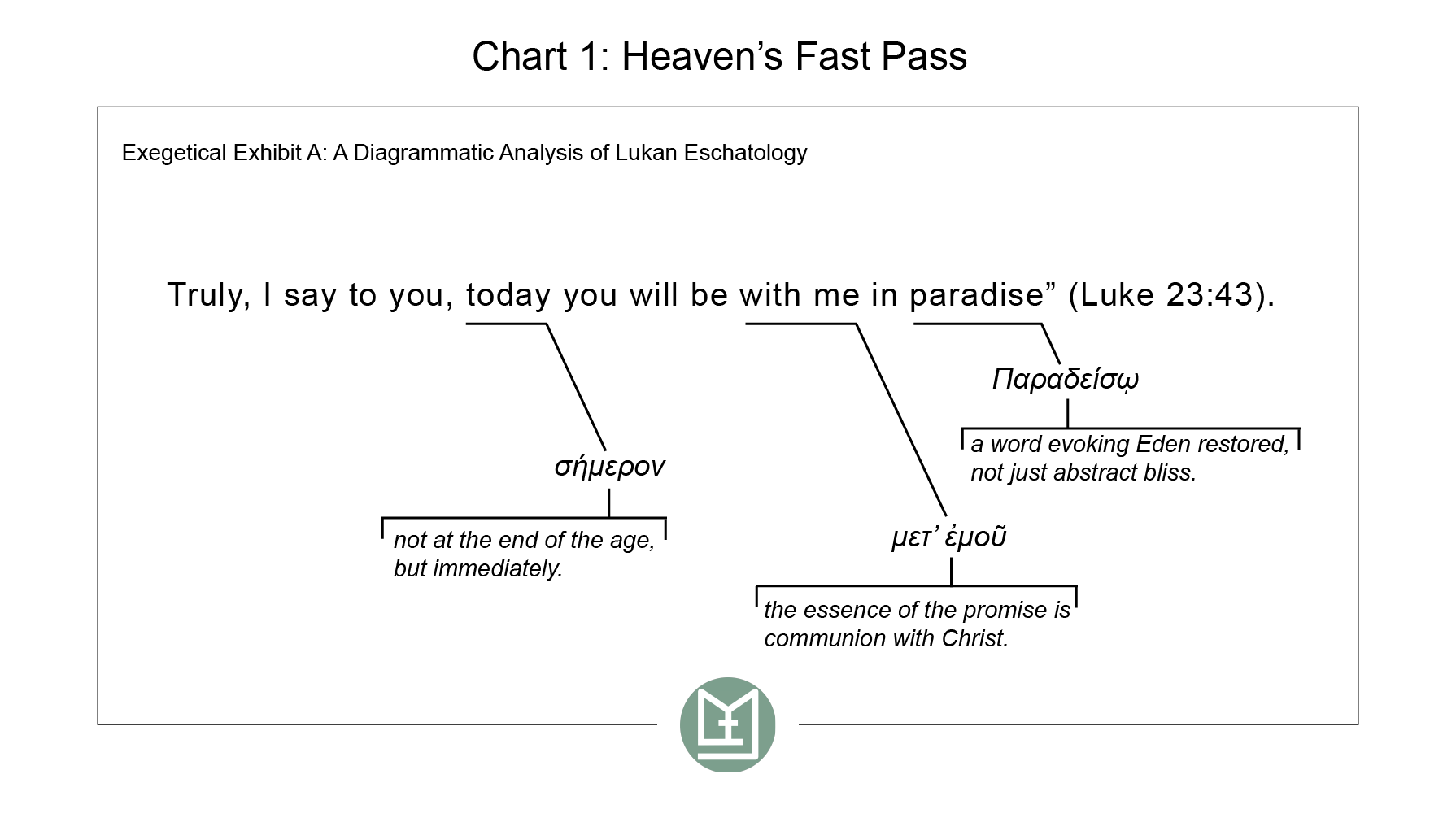
Here we are given the clearest New Testament window into the intermediate state: it is conscious, immediate fellowship with Christ.
In Luke 16, Jesus tells the parable of the rich man and Lazarus. The poor man, Lazarus, dies and is carried to “Abraham’s side.” The rich man dies and finds himself in torment. A great chasm separates them. While precarious to press a parable into systematic theology, the story does suggest conscious existence after death. A distinction is also shown between the righteous and the wicked, with comfort for the faithful and torment for the faithless.
In John 11, Jesus tells Martha, “I am the resurrection and the life. Whoever believes in me, though he die, yet shall he live.7” He is saying eternal life begins now, we are in the already/but not yet. Death does not cancel eternal life and at the trumpet sound, death will have its execution at the resurrection of all believers.
In Mark 12, when debating the Sadducees, Jesus quotes God’s words to Moses: “I am the God of Abraham, the God of Isaac, and the God of Jacob.” Jesus concludes: “He is not God of the dead, but of the living.8” The patriarchs—who were long dead—Jesus was implying were alive to God.
Paul is equally insistent that death does not sever believers from Christ. Writing from prison, Paul presents his dilemma: “My desire is to depart and be with Christ, for that is far better. But to remain in the flesh is more necessary on your account.9” He does not envision unconscious waiting, but anticipates immediate presence with Christ.
In 2nd Corinthians, this imagery is expanded: “While we are at home in the body, we are away from the Lord… we would rather be away from the body and at home with the Lord.10” Again, the intermediate state is not viewed as nothingness, but conscious fellowship with Christ. However, Paul never confuses the intermediate state with the final hope. The climax is not the soul with Christ, but the resurrection of the body: “We wait eagerly for adoption as sons, the redemption of our bodies.11” The intermediate state is blessed, but incomplete, awaiting resurrection.
The book of Revelation, filled with apocalyptic imagery, gives perhaps the most vivid glimpses of the intermediate state. John sees the souls of martyrs under the altar crying out, “How long, O Lord, holy and true, before you judge and avenge our blood?12” The martyrs are conscious, articulate, and longing. This scene confirms a few things; consciousness in the intermediate state, a sense of waiting, and a final vindication to come. From chapter four onward in Revelation, John portrays heaven as a place of worship; where elders, angels, and redeemed saints lift their voices.
So, what can we say, with confidence, from the whole sweep of Scripture?
Death is real. It is the separation of body and soul and the last enemy. The dead will continue. The Old Testament presents Sheol as the shadowy realm of the dead. The New Testament makes clear that the faithful are with Christ, the unfaithful apart from Him. The intermediate state is blessed, but incomplete. Believers are with Christ in conscious rest and joy, but are still waiting. The final hope is not escape to heaven, but resurrection and new creation.
Theological Perspectives on the Intermediate State
The New Testament makes clear Christ will return, the dead will be raised, and judgment will follow. But what about the undefined stretch of time between the grave and the trumpet blast? Over the centuries, several perspectives have emerged.
1. The Traditional View: Conscious Fellowship or Separation
The mainstream Christian view has been that after death, the faithful enter into the presence of Christ in a conscious way, while the unfaithful experience separation from him.
The Biblical support for this view comes from several texts:
Jesus’ promise to the thief on the cross: “Today you will be with me in paradise” (Luke 23:43). Implying immediate presence with Christ.
Paul’s longing to “depart and be with Christ, which is far better” (Philippians 1:23). He does not speak of a long unconscious delay, but of immediate communion.
Revelation 6:9–11, where John sees the souls of martyrs under the altar crying out, “How long, O Lord?” They are awake, aware, waiting.
Early church fathers leaned towards this view. Tertullian spoke of souls resting in a place of conscious waiting13. Augustine affirmed that the dead in Christ were alive with Him, though still awaiting resurrection14. The Reformers all emphasized that believers were “with Christ” after death, even if they differed on the details.
This view allows Christians to comfort one another at funerals with the assurance that their loved ones are not lost in unconsciousness, but are alive with Christ. While not the final hope, it is genuine hope.
2. Soul Sleep
Not everyone has agreed with the traditional view. Some groups have taught what is called psychopannychia, or “soul sleep.” According to this perspective, when a person dies, they enter into a state of unconscious rest until the resurrection.
Advocates point to the frequent biblical language of death as “sleep”:
Daniel 12:2: “Many who sleep in the dust of the earth shall awake.”
1 Thessalonians 4:13: “We do not want you to be uninformed about those who are asleep.”
John 11:11: Jesus says of Lazarus, “Our friend Lazarus has fallen asleep.”
They argue that this imagery is not just metaphorical, but descriptive: death is like falling asleep, and resurrection is like waking up.
Some Anabaptists in the 16th century adopted this view. More recently, groups such as the Seventh-Day Adventists and Christadelphians have emphasized it. This perspective does keep the spotlight on resurrection as the central hope. It also guards against overly spiritualized or Platonic views of the soul floating free from the body. However, it struggles to explain texts that imply immediate fellowship with Christ. It also risks turning death into an absolute void, which can pastorally undercut the assurance of presence with Jesus.
John Calvin wrote an entire treatise against “soul sleep.15” He insisted that the soul remains conscious after death, even while the body awaits resurrection. Luther, by contrast, occasionally used the language of “sleep” more literally, though he still affirmed communion with Christ.
3. Purgatory (Roman Catholic Tradition)
Distinctive to Roman Catholicism, is the doctrine of purgatory. According to this teaching, some believers, though saved by grace, are not yet fully purified from the effects of sin. After death, they undergo a process of purification in order to enter the presence of God fully sanctified.
The Catholic Church grounds this in passages like:
1 Corinthians 3:13–15: “The work of each will become manifest… it will be revealed by fire… if anyone’s work is burned up, he will suffer loss, though he himself will be saved, but only as through fire.”
2 Maccabees 12:44–4516 (a deuterocanonical book): Judas Maccabeus prays for the dead, implying an intermediate purification.
By the Middle Ages, purgatory had become a well-developed doctrine. It was tied to practices like indulgences and prayers for the dead. Dante’s Divine Comedy famously depicts purgatory as a mountain of purification before entering paradise.
The Reformers rejected purgatory as unbiblical and as undermining the sufficiency of Christ’s atonement. For them, Christ’s work on the cross fully accomplished salvation; nothing further was needed after death.
The Catechism of the Catholic Church still affirms purgatory, though in a purified form: not a place of torment, but a process of sanctifying grace. It is not “a second chance” for the damned, but a merciful preparation for the saved.
4. Orthodox Christianity
Eastern Orthodoxy approaches the intermediate state with more mystery and less systematization.
The Orthodox emphasis is that the soul, at death, begins its journey toward theosis17 (union with God). The righteous experience a foretaste of paradise; the unrighteous, a foretaste of separation.
Orthodox Christians resist overly detailed speculation. Where Western theology wants to define, Eastern theology wants to adore. Death is a mystery, and the soul’s journey is wrapped in prayer, liturgy, and hope.
5. Philosophical and Cultural Background
We cannot understand the Christian views of the intermediate state without noticing the philosophical context in which Christianity arose.
Greek Dualism
In the Greco-Roman world, many believed in the immortality of the soul. Plato taught that the soul was eternal and trapped in the body, which was inferior and decaying. Death, then, was liberation—escaping the prison of the flesh.
Christian Distinction
The early church affirmed something different. Yes, the person continued after death. But the ultimate hope was not in escaping the body, but resurrection of the body. This was the decisive break from Platonism. Christianity affirmed the goodness of creation and the future of embodied life.
Jewish Background
Jewish apocalyptic thought also shaped Christian hope. Books like Daniel and 2nd Maccabees already pointed to resurrection, not mere immortality of the soul. Christians inherited this hope as the seeds to the resurrection of Jesus as the firstfruits.
So where does this leave us?
The traditional view emphasizes conscious fellowship with Christ. Soul sleep highlights resurrection but risks flattening the intermediate state. Purgatory underscores purification but raises questions about grace. Orthodoxy embraces mystery and theosis.
What unites them all, however, is this: death is not the end. The story continues. And whether with greater clarity or mystery, Christians across centuries have confessed that those who die in Christ are secure in him, awaiting the day when mortality is swallowed up by life.
Common Misconceptions
Here are a few popular but misleading ideas related to the intermediate state.
“We become angels.”
Might be shared by a well meaning aunt at a graveside: “God needed another angel.” Biblically not true, humans and angels are distinct.“Heaven is our forever home.”
True in one sense, false in another. Heaven is where we are with Christ after death, but the new creation is our forever home. Revelation ends not with us going up, but with heaven coming down.“Ghosts linger on earth.”
Popular culture is filled with ghost stories. The Bible gives little room for this idea. The dead are with Christ or apart from him, not roaming the earth. Apparitions in Scripture are rare and usually deceptive.“Near-death experiences prove the afterlife.”
Books about tunnels of light or out-of-body journeys are compelling, but they’re not authoritative. They may be glimpses of something real, or simply brain phenomena. Our confidence rests not on anecdotes but on the resurrection of Jesus.
So, what happens when we die?
Biblically, the answer is simple and profound. Death is real, but in Christ, death has lost its sting. For those who belong to Jesus, death is an immediate presence with Him while we await something even greater: the resurrection of the body and the renewal of all creation.
We don’t become angels. We don’t float as ghosts. We don’t enter cycles of rebirth. We rest in Christ and wait. Like the souls under the altar in Revelation, we cry, “How long, O Lord?”
Then one glorious day, the answer will come. The trumpet will sound, the dead will be raised, and mortality will be swallowed up by everlasting life.

If this essay felt like a Fast Pass through the Bible’s teaching on death, my course Theology Made Simple is the full theme park (think Knott’s Berry Farm though, not Disney). It’s built to help you make sense of the big picture of theology without needing a dozen charts. Learn more here:
Thanks for the recommendation Michael Barros.
1st Corinthians 15:26
Genesis 2:17
Pointillism is a painting technique where artists use tiny, distinct dots of pure color placed closely together. When viewed from a distance, the dots visually blend to form an image.
Acts 23:8
Luke 23:43
John 11:25
Mark 12:27
Philippians 1:23
2nd Corinthians 5:8
Romans 8:23
Revelation 6:10
Tertullian. (1885). On the soul (P. Holmes, Trans.). In A. Roberts, J. Donaldson, & A. C. Coxe (Eds.), The Ante-Nicene Fathers: Vol. 3. Latin Christianity: Its founder, Tertullian (pp. 181–250).
Augustine. (1998). The city of God (M. Dods, Trans.). Modern Library. (Original work published ca. 426 CE)
Calvin, J. (1534/1989). Psychopannychia: Or, a refutation of the error entertained by some unskilful persons who ignorantly imagine that in the interval between death and the judgment the soul sleeps together with the body (E. W. Johnston, Trans.). Still Waters Revival Books. (Original work published 1534)
44 If he hadn’t been looking forward to the resurrection of the dead, then it would have been unnecessary and frivolous to pray for them. 45 He was looking, however, to that best reward laid up for those who die in godliness, and so this was a pious and holy thought. Thus he made an offering of reconciliation so that the dead would be forgiven of their sin.
This is a theological concept, primarily in Eastern Christianity, describing the transformative process of becoming united with God and partaking in His divine nature, not to become God, but to become perfectly like God by developing divine characteristics and fully living in His image.
“don’t worry, no Ewoks were harmed” 😂😂