
Why the Incarnation Isn’t God ‘Becoming Less’
God Wearing the Shape of Humanity


You use skeuomorphs every day, but may not know the word.
You hear them when your iPhone camera makes a shutter sound, you see them in the floppy disk icon you click to save your work, and you feel them in the light bulb shaped like a flame above your head.
A skeuomorph is a design feature that imitates an older object’s look or function even though it no longer needs to. The design finds its roots in ancient Greek architecture. After shifting from wood to stone, many Greek temples still included design elements that mimicked those found in wood, such as ceiling rafts that were only decorative or triglyphs; stone carvings made to look like wooden beam ends.1
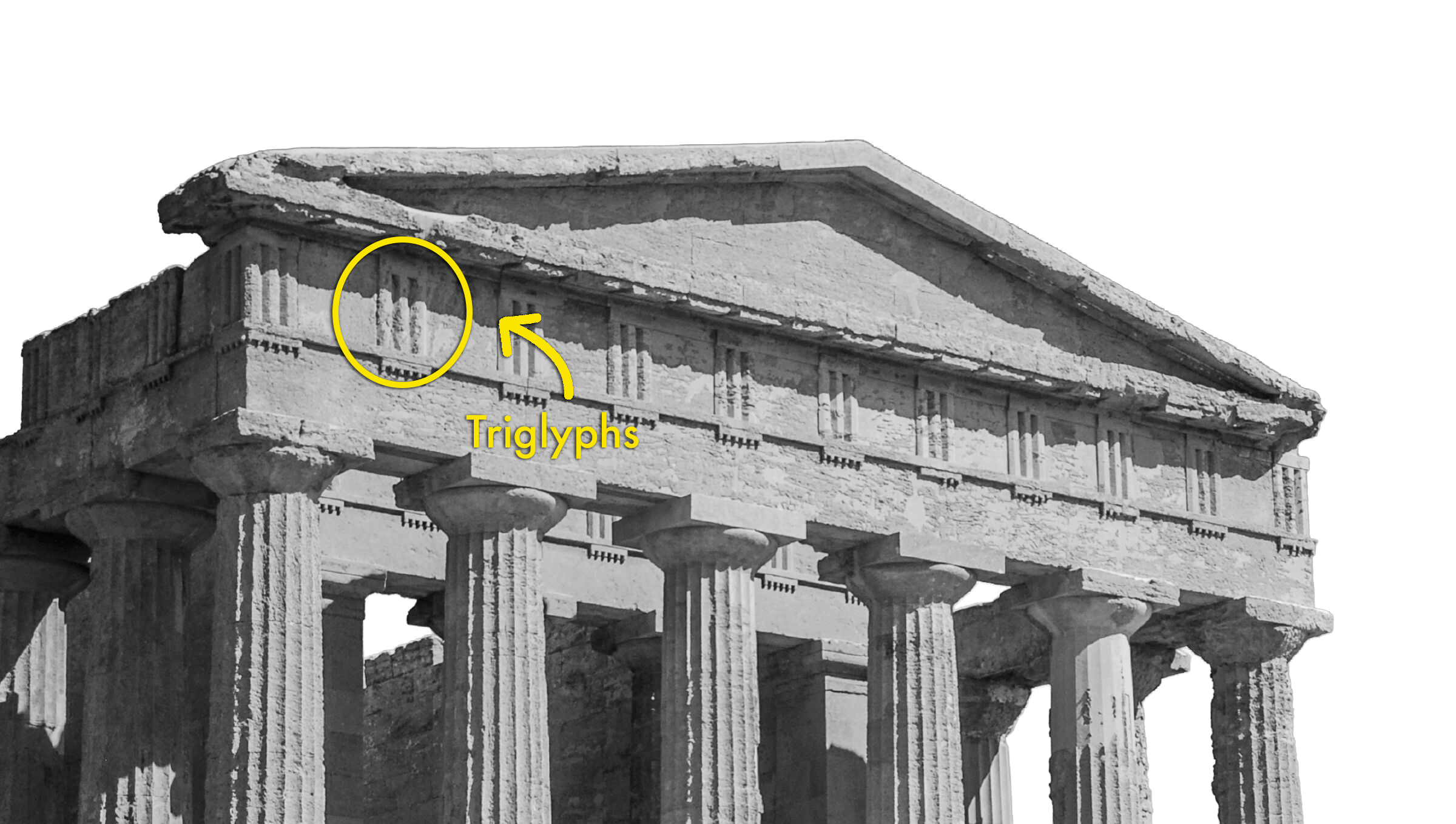
A skeuomorphism takes something new but keeps it familiar and helps us name something deeper than a design choice: the way a reality can take on a new form without ceasing to be what it truly is. That’s how Paul describes Christ in Philippians 2.
Who, existing in the form of God, did not consider equality with God as something to be exploited. Instead he emptied himself by assuming the form of a servant, taking on the likeness of humanity. And when he had come as a man…
Philippians 2:6-7 (CSB)
Existing in the form of God, Christ is God in every way Paul understood God. Form (μορφή) is referring to the essential mode of existence for Christ, not temporary or in appearance only. He’s the genuine article, the real McCoy, the real deal Holyfield, or whatever other English idiom you chose to use. Gordon Fee notes this is the clearest Pauline assertion of Jesus' preexistent divine status.2
“Equality with God” isn’t something Christ lacked and tried to seize, It is something He already possessed but refused to exploit. Christ coming was to be different than the little-g god’s the world had known, this big-g God, would not use divine strength for selfish advantage. He would lay aside self-assertion for self-giving; even to the point of death. The first Adam tried to grasp equality through the tree and failed. The second Adam would offer himself up on a tree, and win a victory not for himself only, but for the world.
Christ did not give up deity nor divest himself of divine attributes. Instead He “emptied himself” by addition, not subtraction. The “emptying” happened by taking the form of a servant, not by shedding the form of God. Moisés Silva argues the participles explain the verb.
How did this happen?
By taking the form of a servant. By being found in human likeness. Meaning the “kenosis” is self-humiliation, not self-subtraction.3
If Paul had meant: “He emptied himself by giving something up,” there would be an object of emptying or the language of loss. But Paul doesn’t say, “he emptied himself of divinity, power or attributes,” in Greek, the verb 'ἐκένωσεν' (emptied) is modified by the participles that follow it. The 'emptying' is defined by the 'taking'.
The point was not that Jesus renounced divine attributes, but that He refused divine privilege. He never stopped being God; He simply refused to exploit His divine status. The movement of the hymn found in Philippians 2 purposely cascades downward from (1) Deity, (2) refusal to exploit equality, (3) self-emptying, (4) servanthood, (5) humanity, (6) death, (7) death on a cross.
The hymn is not merely Christ being humble “toward God.” Christ is revealing the character of God. That God by his nature is self-giving, self-emptying, and loving. Christ’s humility is the revelation of the true divine identity of the Triune God.4
The incarnation gives us the ultimate skeuomorph: the invisible God taking on the visible morphē of humanity. Philippians 2 says Christ was in the “form of God” yet “took the form of a servant,” not as imitation—like the tiny handle on your maple syrup serving no functional purpose—but as embodiment.
Jesus is the skeuomorph that became real.
The purpose of a skeuomorph is a design shape borrowed from an older world to help us navigate a new one. In Jesus, God doesn’t borrow the shape of humanity as a clever interface. He enters it. He becomes it. The incarnation isn’t a simulation, it is God stepping inside the system itself. Every icon, every sacrament, is a shade of that one divine skeuomorph.
And every human face reflects the God who took one.

Institute for Archaeology and the Ancient World. (n.d.). Greek past: Skeuomorphism. Brown University. https://www.brown.edu/academics/archaeology/greek-past/skeuomorphism
Fee, G. D. (1995). Paul’s letter to the Philippians (NICNT). Eerdmans.
Silva, M. (2005). Philippians (2nd ed.). Baker Academic. (Baker Exegetical Commentary on the New Testament)
Fee. (1995).
My favorite discussion of the Incarnation is Athanasius’s On the Incarnation. Thank you for your post—it became all too frequent in the 20th century to treat kenosis as subtraction of being.