
How Did the Animals Fit on Noah’s Ark?

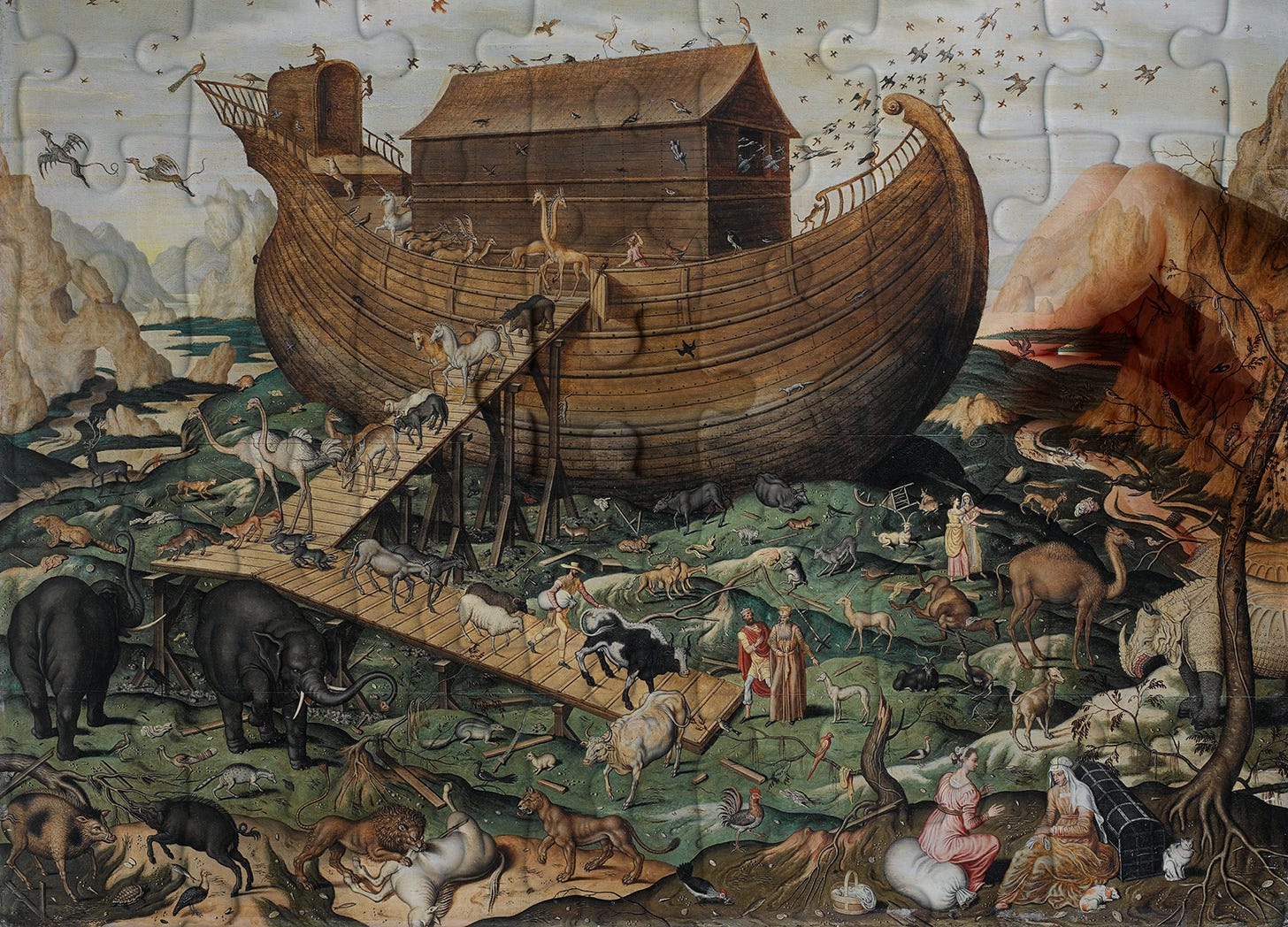
How Did the Animals Fit on Noah’s Ark?
Every species on Earth—from elephants, penguins, to tiny beetles—all tucked away on one wooden boat for a year. If you do the math on the millions of species we have today, the Ark would need to be the size of a small country or at least Rhode Island, not a boat. Is the story of Noah’s Ark a mathematical impossibility, or are we missing a piece of the puzzle?
In this article, we’re looking at three different approaches used to solve the Ark puzzle. And if you stay with me to the end (it’s only 1,500 words, roughly the same length as the Directions for Use on my wife’s shampoo), we will also answer that one question you have probably always wondered.
Approach 1: The “Kinds” vs. “Species” Framework
One of the biggest objections skeptics raise is: “There are millions of species. There’s no way they all fit.”
Touché, that’s a fair point.
If we’re talking modern biological species, the Ark isn’t a boat—it’s Rhode Island with a roof. But literalist scholars argue that we’re making a category mistake. Genesis doesn’t say Noah took two of every species. That’s a modern classification system. The text says two of every kind.
Enter baraminology1—and yes, that’s a real word, unlike brung.
Baraminology is a faith-based approach to biology that developed within young-earth creationist circles. Instead of one giant evolutionary family tree, it imagines creation more like an orchard. God created distinct groups of animals (kinds) with room for variation inside each group, but not across them2.
Think apples and oranges. An apple tree can produce Honeycrisp, Granny Smith, Fuji—go wild. But it’s never going to wake up one morning and produce a tangerine. In the same way, a baraminologist might argue that everything from our house cat Antonio Vivaldi (yes, our daughters named him that) to lions and tigers belongs to the same “cat kind.” Dogs, bears, and horses? Different trees.
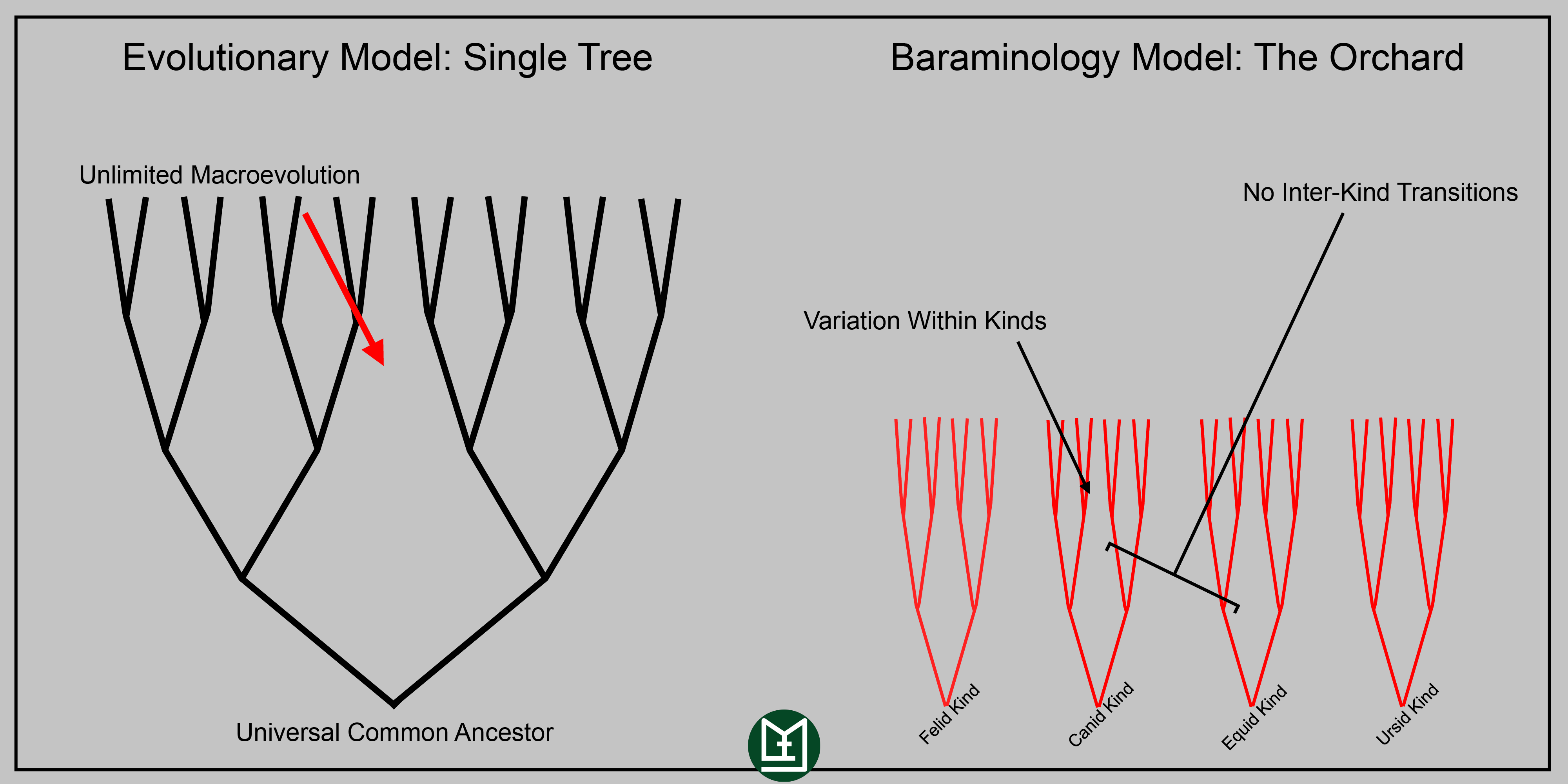
Under this framework, Noah didn’t need 30 types of dogs, 10 wolves, and a parade of coyotes. He only needed two members of the original canid kind. From there, adaptation and selective breeding could explain wolves, foxes, dingoes, and your neighbor’s anxious Labradoodle with the thunder jacket.
Before evangelicals get too excited, let’s be clear about the limits.
Baraminology is not mainstream biology. It does not accept universal common descent, and it operates with theological assumptions baked in from the start. When proponents talk about “genetic potential,” they aren’t claiming animals can morph into anything. They mean a limited but flexible range of variation already present within created kinds; not infinite biological LEGO pieces.
Groups like Answers in Genesis3, which openly operate from a young-earth, literalist framework, have used this model to estimate that Noah would have needed somewhere between 1,500 and 7,000 land-dwelling vertebrates on the Ark. Those numbers make sense inside that worldview, but they are not numbers most biologists would sign their name to.
So does this approach solve the Ark problem?
If you already accept a young-earth reading of Genesis and divine intervention: yes.
If you’re asking for a neutral scientific explanation: no.
This framework doesn’t pretend to be a consensus biology solution. It’s a theological model with biological implications, not the other way around. And it only works if you’re already comfortable with miracles being part of the equation.
Approach 2: The Regional Flood Framework
What if the puzzle isn’t about the size of the boat, but the size of the flood itself?
While the view that the whole planet was flooded is common in Christianity, many theologians and geologists argue for the Regional Flood theory. In our modern English Bibles, we see the word earth and think planet or globe. But the Hebrew word used in Genesis is eretz (ארץ) and throughout the Old Testament, it is most often translated as land, country, or region.
We see this same language elsewhere in the Bible. In Luke 2:1, a census was taken of the entire world. We know that didn’t include the Americas or Australia—it meant the Roman world. Proponents of this view argue that the whole world in Genesis refers to the Mesopotamian Valley4. The world as it was known to the inhabitants of that time.
If the flood was a massive regional event, Noah didn’t need to gather penguins from Antarctica or kangaroos from Australia. He only had to preserve the livestock and local wildlife necessary to restart that specific ecosystem. Scientists have pointed to events like the Black Sea Deluge or massive flooding in the Tigris-Euphrates basin as potential historical candidates5. These events would have been world-ending for the people living there, covering every visible horizon with water.
This view removes the global logistics problem entirely. It accounts for why we don’t see a single, uniform layer of sediment across the entire planet from the same year, while keeping the theological message of judgment and grace intact. The flood was total in its judgment of that civilization, even if it wasn’t global in its geographical scope.
Approach 3: The Theological Polemic Framework
Our final approach sees the flood as a Theological Polemic. It’s a protest story written to challenge the religions of the cultures surrounding ancient Israel6. Every major culture in the Ancient Near East had a flood story. Long before Genesis was written, the Babylonians had the Epic of Gilgamesh and the Epic of Atrahasis. In those versions, the gods decide to wipe out humanity simply because humans are ‘too noisy’ and the gods can’t sleep—with my snoring, I can’t let my wife know about this.
In this view the author of Genesis borrows the familiar cultural framework but flips the script to make a radical point about the nature of God. In the pagan stories, the gods are erratic, selfish, and terrified of the flood themselves. In the Bible, God is moved by the moral violence and corruption of the earth. He isn’t a capricious tyrant; He is a Judge who is grieved by evil. Under this lens, the specific dimensions and perfection of the Ark are symbolic of Divine Order in the midst of watery chaos. The Ark represents a New Eden or a floating Temple7.
The most important part of the story isn’t the survival of the animals, but the Rainbow Covenant. While the pagan gods were hungry and demanded sacrifices after the flood, the God of the Bible makes a promise to never destroy the earth again. If you view the story as a literary polemic, the puzzle of how the animals fit doesn’t matter. Because the story wasn’t written to satisfy a biology professor; it was written to tell suffering people that their God is a rescuer who brings order out of chaos and value to human life.
Okay, now that one question you have probably wondered.
“What about the 💩?”
If you have thousands of animals in a confined space for a year, the logistics seem a bit... messy. There are two fascinating ways to look at this.
The Biological Theory (Induced Dormancy)
Many scholars and creation scientists suggest that the animals may not have been in their normal, high-energy states8. It is possible that God induced a state of hibernation or dormancy in many of the ‘Kinds’ on board. This would dramatically reduce the need for food and water, minimize waste production, and keep the animals calm during the violent storms outside. Even today, we see animals instinctively hunker down or go dormant during natural disasters.
The Engineering theory
Regardless of your view on biology, the engineering of the Ark is shockingly advanced. The dimensions given in Genesis are 300 cubits long, 50 cubits wide, and 30 cubits high. In 1993, a ship research center in South Korea (KRISO) conducted a scientific study on these specific dimensions. They found that the Ark’s proportions were surprisingly stable to handle waves over 100 feet high. It would have been exceptionally resilient and hard to capsize. It wasn’t built for speed (it had no engine); it was built for buoyancy and survival. This doesn’t prove the Ark happened, rather it does show the design itself isn’t the cartoonish impossibility it’s often made out to be.
Genesis also mentions a window or opening finished within a cubit of the top. Engineers point out that a long opening running the perimeter of the top deck would create a natural aspiration system. As the ship rocked in the waves, it would act like a giant bellows, pumping fresh air in and pushing carbon dioxide and waste odors out.
Whether through divine intervention like hibernation or the sophisticated application of ancient naval engineering, the Ark wasn’t just a floating box. It was a highly specialized survival vessel designed to withstand a planetary or regional cataclysmic event.
Where does that leave us?
If you take the Kinds vs Species Framework, you see a God of miracles and a master engineer. If you take the Regional Flood Framework, you see a God of history working within the geography of the ancient world. And if you take the Theological Polemic Framework, you see a God of profound truth using the language of his time to reveal His character.
And maybe the real question isn’t whether Noah could fit the animals. It’s whether we’re asking an ancient story to answer a question it was never written to solve.

Where did Cain’s wife come from?
Because the answer reveals more about the early world of Genesis than most people realize.
Read it here → Where Did Cain’s Wife Come From?
The term originated from the Seventh-day Adventist biologist Frank Lewis Marsh. Marsh combined the Hebrew bara (create) and min (kind) to define the boundaries of biological variation.
Wise, K. P. (1990). “Baraminology: A Young-Earth Creation Biosystematic Method.” In R. E. Walsh (Ed.), Proceedings of the Second International Conference on Creationism (Vol. 2, pp. 345-360). Pittsburgh, PA: Creation Science Fellowship.
https://answersingenesis.org
For proponents of the regional flood view and the linguistic interpretation of “the whole world” as the known world or Mesopotamian valley, see Tremper Longman III and John H. Walton, The Lost World of the Flood: Mythology, Theology, and the Deluge Debate (Downers Grove, IL: IVP Academic, 2018), 154–57; Hugh Ross, Navigating Genesis: A Scientist’s Journey through Genesis 1–11 (Covina, CA: RTB Press, 2014), 145–49; and John H. Walton, The NIV Application Commentary: Genesis (Grand Rapids, MI: Zondervan, 2001), 312–14.
For scientific and archaeological candidates for a regional deluge, such as the Black Sea or Mesopotamian basin, see William Ryan and Walter Pitman, Noah’s Flood: The New Scientific Discoveries About the Event That Changed History (New York: Simon & Schuster, 1999); David Robert Montgomery, The Rocks Don’t Lie: A Geologist Investigates Noah’s Flood (New York: W.W. Norton & Co., 2012), 198–202; and Leonard Woolley, Excavations at Ur: A Record of Twelve Years’ Work (London: Ernest Benn, 1954), 26–35.
Enns, Peter. (2012). The Evolution of Adam: What the Bible Says Without Saying about Human Origins. Grand Rapids, MI: Brazos Press.
G. K. Beale, The Temple and the Church’s Mission: A Biblical Theology of the Dwelling Place of God (Downers Grove, IL: InterVarsity Press, 2004), 60–66.
For arguments regarding the logistical feasibility of animal care through hibernation or dormancy, see John Woodmorappe, Noah’s Ark: A Feasibility Study (Santee, CA: Institute for Creation Research, 1996), 127–35; and Henry M. Morris and John C. Whitcomb, The Genesis Flood: The Biblical Record and Its Scientific Implications (Philadelphia: Presbyterian and Reformed Publishing Co., 1961), 69–74.
I highly recommend the Ark Encounter for anyone remotely interested. It addresses all these things, and even if you do not agree with the literal interpretation, it is quite impressive.
Perhaps it's the simplest explanation.
It's just a dramatized fictional story loosely based on ancient regional flooding events. These type of "campfire stories" taught moral lessons to the tribes... they were recycled generation after generation (oral traditions) and then as the story tellers figured out how to write things down it became what many call "scripture" today.
I suspect many of those OT stories developed this way.