
Genesis and the 900-Year Lifespans: History, Science, or Symbolism?


A 900 Year Mystery (But First Sunday School)
I wonder if it’s still hanging there?
As a child, in Sunday School at Jubilee Church in Camarillo, California there was a long chart full of cartoon caricatures of famous Bible figures that stretched across the top of the wall. Under each person it listed how long they lived. There was Adam at 930 years, Seth at 912, and the undisputed heavyweight champion, the legacy of longevity, Methuselah clocking in at 969 years. To put that in perspective, he could have watched the rise and fall of the Roman Empire twice and still had enough time left over to get really good at sourdough.
Those numbers raise a question you’ve probably thought about. Did people really live that long or are we reading Genesis the wrong way?
When you see this in the Bible, it feels like a myth. Our bodies seem to come with an expiration date. Biology tells us that cells can only divide so many times before the system shuts down.
Yet, when you look across the Book of Genesis, you see these insanely high ages but then suddenly rapid decline. Right after the Flood, longevity falls off a cliff. Noah hits 950, his son Shem drops to 600, but post flood everything changes and by the time we get to Abraham, we are down to 175.
What does that mean?
Are the numbers symbolic or are they literal, and what exactly are they trying to communicate? Here are three theories that attempt to solve the longevity paradox.
1. The Biological Theory (The “Genetic Entropy” View)
If Adam and Eve were created with “very good” DNA, their cellular repair systems would have functioned with exceptional efficiency.1 Think of it like a brand-new BMW engine, it runs smoothly, until the parts begin to wear. Over time, small genetic errors in human bodies accumulate. Every time DNA replicates, tiny copying mistakes can occur.2 Most are harmless, but some damage cellular repair mechanisms, weaken immune function, or increase vulnerability to disease and cancer. Over generations, these slightly harmful mutations can reduce overall biological resilience and shorten lifespan.
Modern genetics confirms that each generation inherits dozens of new mutations that were not present in the parents.3 Population geneticists refer to this as mutation load; the gradual accumulation of genetic changes within a population.4 Most mutations are neutral; meaning they don’t significantly affect survival or reproduction.5 For example, today more people are born with fewer or no wisdom teeth than in the past. As human diets became softer, jaw sizes decreased, and variations that reduce or eliminate wisdom teeth became more common.6 This change doesn’t meaningfully improve or harm survival, it’s a neutral genetic shift that has spread over time.
Under this framework, the early generations of humanity began with exceptionally high genetic integrity. The dramatic drop in lifespans after the Flood is not a change in God’s intention, but a sudden genetic bottleneck.7 With only eight people on the Ark, the diversity of the human gene pool was drastically reduced. When populations pass through severe bottlenecks, harmful mutations can become more common. For instance, the Amish community descended from a small number of founders, which led to a higher rate of Ellis–van Creveld syndrome, a rare genetic disorder.8 Similarly, cheetahs experienced a population bottleneck that left them with low genetic diversity and increased health vulnerabilities.
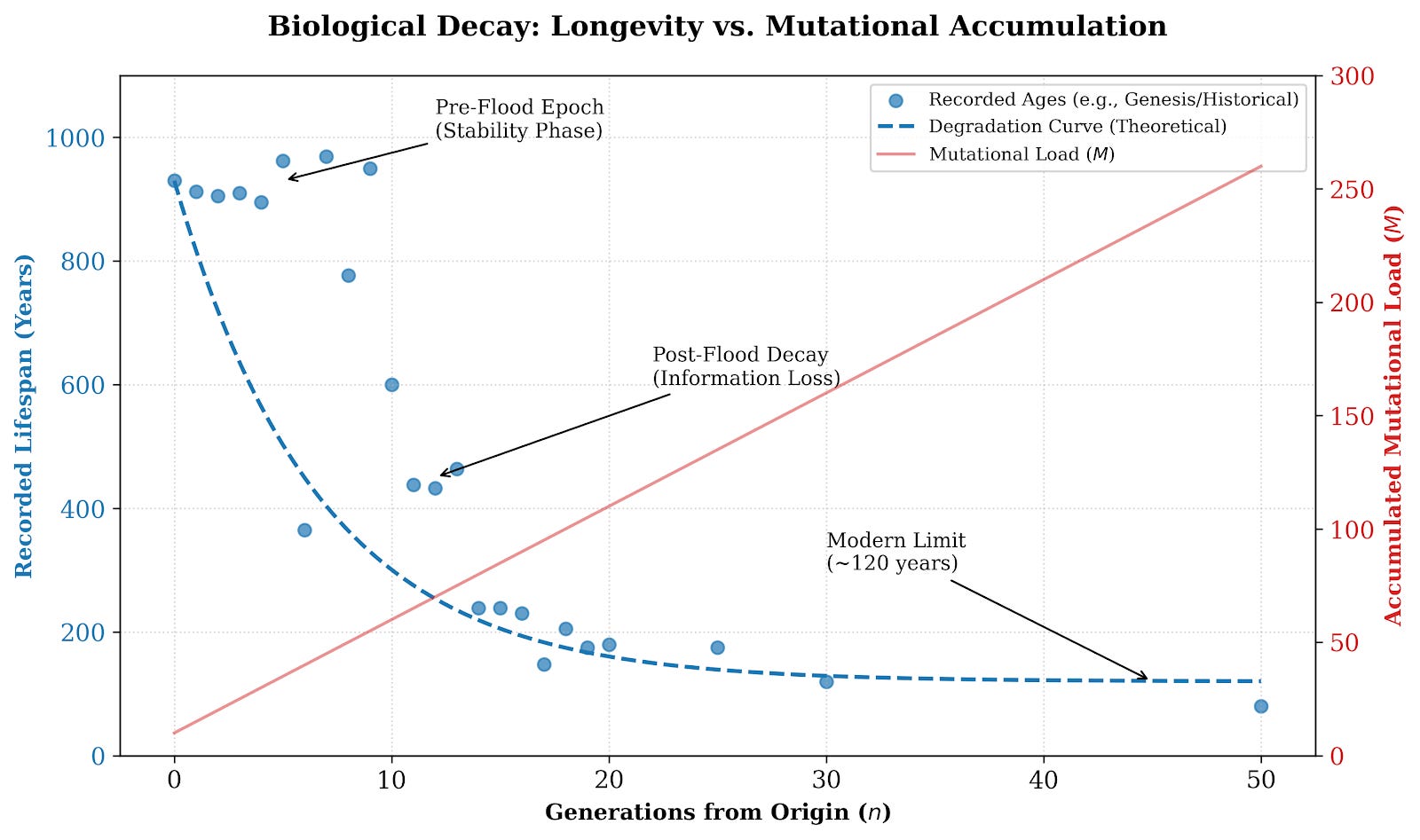
The modern genetic entropy argument is most closely associated with geneticist John Sanford, a former Cornell researcher, who argues that slightly harmful mutations accumulate faster than natural selection can eliminate them, gradually degrading the human genome over time.9 However, this view is strongly disputed within mainstream genetics. Most evolutionary biologists argue that natural selection, recombination, and large population sizes work together to remove harmful mutations. In large populations, individuals carrying severely damaging mutations are less likely to reproduce, preventing long-term genetic decline.10
Within the genetic entropy perspective, the shortening of human lifespan is not the loss of supernatural longevity, but the slow biological consequence of a fallen world. One where humanity was bottlenecked and lost the genetic strength it once possessed.
2. The Environmental Theory (The “Vapor Canopy” View)
This theory shifts the focus from DNA to environment. Instead of asking whether early humans were genetically different, it asks whether the world itself was different.
Some interpreters, especially within young-earth creation models, point to Genesis 1:7 and its reference to “the waters above the expanse.” They suggest that the pre-Flood Earth may have been surrounded by a dense layer of water vapor; a so-called vapor canopy.11
In this model, the early world functioned like a natural hyperbaric chamber. A thicker atmosphere could have produced more stable global temperatures, higher atmospheric pressure, and potentially greater oxygen availability. Most importantly, the canopy is proposed to have acted as a shield against ultraviolet and other forms of radiation, which are known contributors to cellular damage, mutation, and aging.
If early humans lived in a world with reduced radiation exposure and more stable environmental conditions, their bodies may have experienced slower biological degradation. The dramatic decline in lifespan after the Flood is then explained by environmental collapse. When Genesis describes the “windows of heaven” opening, supporters of this view interpret it as the release or destruction of the canopy. Humanity would then have been exposed to increased radiation, climate instability, and harsher living conditions. These factors could accelerate aging and reduce longevity.
However, the vapor canopy model is highly debated. Most atmospheric scientists argue that a water layer dense enough to produce these effects would have created extreme heat and pressure conditions incompatible with life.12 As a result, the theory is not widely accepted within mainstream geology or climate science.
Under the canopy framework, the central message is that the long lifespans of Genesis reflect not a different kind of human, but a different kind of world. A planet that was more stable, protected, and life-sustaining than the environment we inhabit today.
3. The Literary/Symbolic Theory (The “Honorific” View)
A third approach shifts the focus from science to the cultural world of the Ancient Near East. The Bible wasn’t the only ancient text with high numbers. The Sumerian King List13 records kings who supposedly reigned for 28,000 years. Extremely long lifespans appear in several ancient Near Eastern traditions and genealogies. In these cultures, numbers were often honorific, a way of signaling that a person was incredibly wise, godly, or important.14
In our modern world, we use numbers like a stopwatch click: precise and literal. But for ancient writers, numbers were also used as honorary titles.
When the Bible says a patriarch lived to be 900 years old, it may not have meant their actual age, but a borrowed cultural expression from the Ancient Near East. A way of using “Great Numbers” to describe “Great Men.” This is similar to how we say today someone is “one in a million” or they “gave 110%.” We know those figures aren’t literal, but they communicate the magnitude of the person’s character in an honorific way.15
Then there is the Base-60 measurement. While we count in tens (Base-10), ancient Mesopotamia used Base-60 (Sexagesimal). We still see this today in how we measure time: 60 seconds in a minute, 60 minutes in an hour.16
In this system, certain numbers are “perfect” or “round.” By using these mathematical patterns, the authors could be signaling to the reader that these lives were divinely ordered and significant, rather than just lucky enough to avoid a saber-toothed tiger or dysentery for nine centuries.
There is also the symbolic ending of digits. The ages in Genesis rarely look random. In a truly random set of ages, you’d expect an equal mix of 1s, 3s, 4s, 6s, and 8s. Instead, they cluster around a few different numbers (see chart below).

Think of these long ages as a monument. Just as a sculptor might make a king 20 feet tall to show he was powerful, the ancient scribe gave the patriarch a 900-year lifespan to show he was a giant of the faith. It was a numerical cipher meant to evoke awe and intrigue, not an invitation to open excel and create a spreadsheet.
To the ancient mind, a literal age like 43 would have been less true than a symbolic age like 500, because 500 tells you something about the man’s soul, not just his birthday.17
Conclusion
It’s easy to dismiss the long lifespans of Genesis because they don’t fit modern biology. But the deeper question isn’t how long the patriarchs lived, but what the text is trying to show.
Whether one reads the numbers as biological, environmental, or literary, the direction is the same. Humanity is not ascending. It is declining. Genesis isn’t trying to impress us with people who lived longer. It’s showing us a world that is slowly dying and needs to be rescued.

Enjoy the Bible’s “wait… what?” moments?
Here are three more puzzles to put together:
John C. Sanford, Genetic Entropy & the Mystery of the Genome (Waterloo, NY: Ivan Press, 2005).
Lynch, M. (2010). Rate, molecular spectrum, and consequences of human mutation. PNAS.
Lynch, M.
H. J. Muller, “Our Load of Mutations,” American Journal of Human Genetics 2, no. 2 (1950)
Motoo Kimura, The Neutral Theory of Molecular Evolution (Cambridge: Cambridge University Press, 1983).
G. Richard Scott and Christy G. Turner II, The Anthropology of Modern Human Teeth: Dental Morphology and Its Variation in Recent Human Populations (Cambridge: Cambridge University Press, 1997).
Montgomery Slatkin, “Bottlenecks and Founder Effects in Population Genetics,” Evolution 52, no. 3 (1998): 587–596.
Francomano, Clair (August 15, 2003). “Medical Genetic Studies in the Amish: Historical Perspective”. American Journal of Medical Genetics.
John C. Sanford, Genetic Entropy & the Mystery of the Genome (Waterloo, NY: Ivan Press, 2005)
See Richard Dawkins, The Selfish Gene, 40th Anniversary ed. (Oxford: Oxford University Press, 2016); Jerry A. Coyne, Why Evolution Is True (New York: Viking, 2009); Douglas J. Futuyma and Mark Kirkpatrick, Evolution, 4th ed. (Sunderland, MA: Sinauer Associates, 2017); Michael Lynch, The Origins of Genome Architecture (Sunderland, MA: Sinauer Associates, 2007); and Motoo Kimura, The Neutral Theory of Molecular Evolution (Cambridge: Cambridge University Press, 1983).
John C. Whitcomb and Henry M. Morris, The Genesis Flood: The Biblical Record and Its Scientific Implications (Phillipsburg, NJ: Presbyterian and Reformed Publishing, 1961).
See James F. Kasting, How to Find a Habitable Planet (Princeton: Princeton University Press, 2010); Raymond T. Pierrehumbert, Principles of Planetary Climate (Cambridge: Cambridge University Press, 2010); and Larry Vardiman, Andrew Snelling, and Eugene Chaffin, eds., Radioisotopes and the Age of the Earth (El Cajon, CA: Institute for Creation Research, 2005).
Thorkild Jacobsen, The Sumerian King List (Chicago: University of Chicago Press, 1939).
K. A. Kitchen, On the Reliability of the Old Testament (Grand Rapids: Eerdmans, 2003).
John J. Davis, Biblical Numerology: A Basic Study of the Use of Numbers in the Bible (Grand Rapids: Baker Book House, 1968).
Eleanor Robson, Mathematics in Ancient Iraq: A Social History (Princeton: Princeton University Press, 2008).
However, the idea that the ages in Genesis are purely honorific metaphors, is contested, particularly regarding whether the numbers are non-literal or directly base-60 conversions.
A good overview of some views on this.
To say genetic entropy is disputed in mainstream science is probably giving too much credit for it. As a biologist, I had never heard people talk about this other than among YEC "scientists".
The first two views would have been be possible if the earth was young, but it isn't.
From an apologetics point of view I found this really interesting. I always try to avoid allegorical interpretations when they aren’t clear, but there is an argument to be made for legitimacy here well done.
I do believe we can maintain a literal interpretation, however, without needing to invoke a naturalistic explanation. We must remember it is our separation from God in our sin that brings death, not a purely naturalistic cause.
If Adam and Eve were literal (and I think the biblical evidence shows they were), then they went from being immortal to being able to die in an instant. That is a dramatic shift in the human condition, and I do not think a purely natural explanation is either sufficient or necessary to explain it. For that reason, a natural explanation would not necessarily be required for those whom God allowed to live longer. We also see clear examples in Scripture of God extending life, so the explanation may simply be supernatural.
That said, I do think is wise to understand the various naturalistic views as they are also very possible explanations to a mystery that likely won’t be solved in this life.
Good break down of the naturalistic theories!