
Did Paul Contradict Jesus?

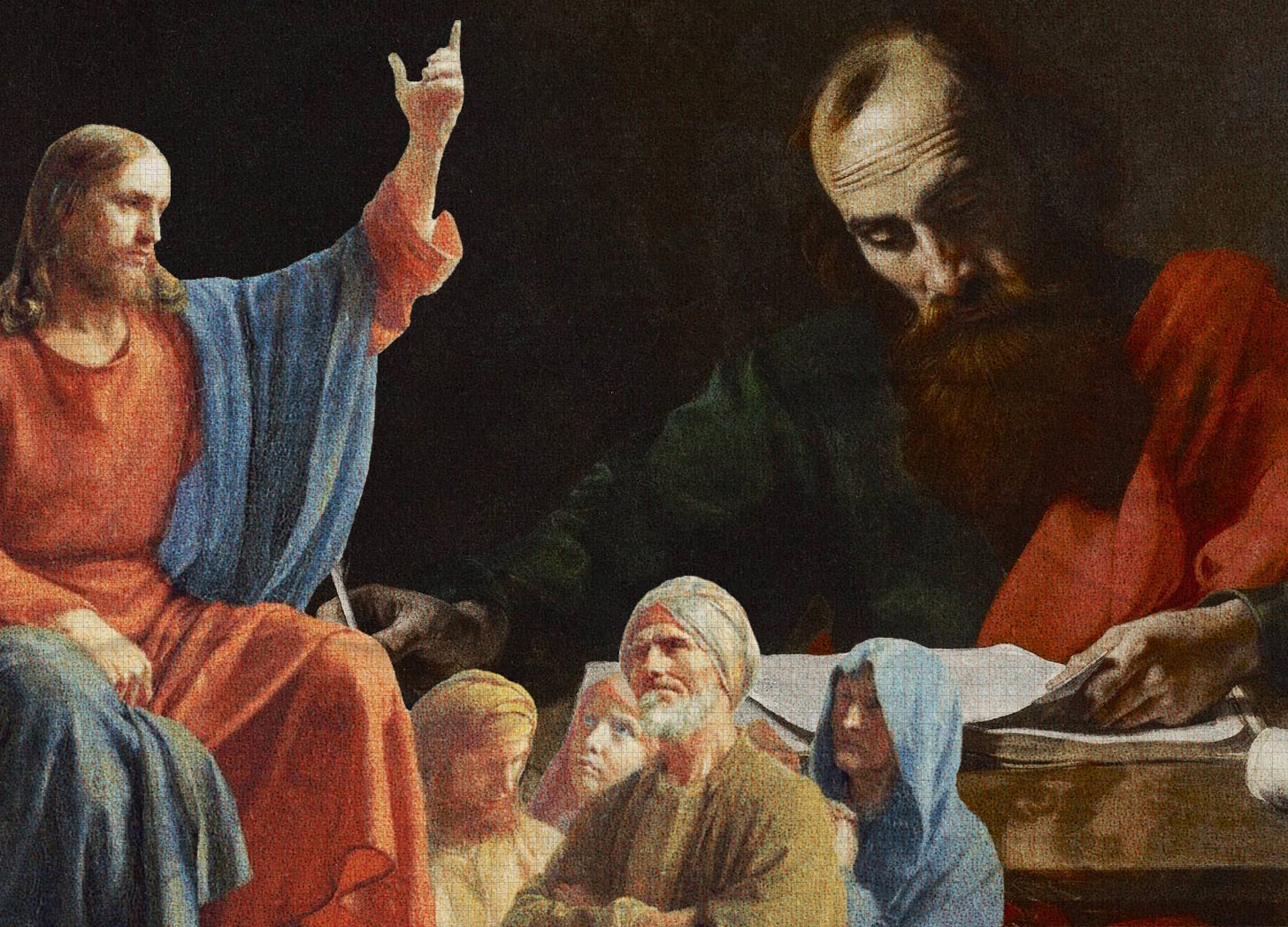
The Bible and the Razor Blade
In 1820, Thomas Jefferson sat at his desk with a razor blade and a Bible and started cutting. He removed the miracles. He removed the resurrection. He removed most of the Epistles. What he was left with, he called The Life and Morals of Jesus of Nazareth,1 and he considered it in his most astute and demure opinion a more beautiful or precious morsel of ethics I do not know. Jefferson was cutting Paul out on purpose.2 His argument was that Jesus taught ethics and Paul invented a religion about Jesus that Jesus himself never authorized.
Did Jefferson have a point?

Before the struggle is real became a slogan for the drone of corporate cubicle culture the struggle was real in interpreting Jesus and Paul. Jesus preached the Kingdom of God. Paul preached the cross. Jesus kept the Torah. Paul argued that the Law, while holy and good, became a curse for sinners, because nobody fulfills it perfectly.3 Jesus emphasized the arrival of the Kingdom of God; Paul spent more time unpacking the meaning of Jesus’s death and resurrection. It’s true that the difference in emphasis between Jesus and Paul is real; even if the categories overlap more than critics sometimes admit. In the Sermon on the Mount, Jesus says live this way. In Romans 7, Paul says I cannot live that way. Friedrich Nietzsche’s (never one for diplomacy) most provocative line about Christianity isn’t the God-is-dead one. It’s from The Antichrist: “the only real Christian died on the cross.”4 He meant it as an insult. Scholars took it as a question. The question of whether Paul invented something Jesus never intended, has driven serious historical research for nearly two centuries.
So which is it? Here are three serious answers to the tension of Jesus and Paul. The struggle is real.
The Hijacking Thesis: Paul Made It Up
This is not to be dismissed as a fringe position. In the nineteenth century, F.C. Baur and the Tübingen school of German scholarship argued that the New Testament itself records a doctrinal fracture.5 Paul’s law-free Gentile gospel versus the Jerusalem church under James and Peter, who stayed Torah-observant. The smoking gun6 for this position is found in Galatians 2. Paul confronts Peter to his face in Antioch because Peter stopped eating with Gentiles when Jewish Christians arrived from Jerusalem. That is not a minor disagreement about who sits at the cool table at lunch.

That is a split over the fundamental question of who belongs to the people of God. Baur read it as evidence that early Christianity was two movements both bearing the same name.
In the twentieth century, Hyam Maccoby pushed further. Paul, he argued, was not a trained Pharisee at all, and that the Acts account was an invention.7 The work of a Gentile convert importing pagan categories into a Jewish movement and calling the result Christianity. The dying-and-rising savior, the blood atonement, the cosmic Christ; none of that is in the Gospels. Jesus says follow me, repent, the Kingdom is near. Paul says, “if you confess with your mouth that Jesus is Lord and believe in your heart that God raised him from the dead, you will be saved.”8 One is a way of life. The other is a claim about what happened on a single weekend in Jerusalem, and what that death and resurrection bought for humanity.
Theologically we would say Paul is showing us where the front door to the kingdom Jesus offers is. But in Maccoby’s reading, that door opens into a different house entirely: a religion of largely Gentile making, with Jesus’s name set over the foyer, like a live, laugh, love sign.
The fair pushback against the hijacking thesis is the issue with timing. Paul wrote his letters within twenty years of the crucifixion.9 He met Peter. He met James, the brother of Jesus. He explicitly claims to have received his gospel from the risen Christ directly and then cross-checked it with the Jerusalem apostles. If Paul invented it, he did so while eyewitnesses were still alive. The book of Acts records the crisis openly. In Acts 15, the Jerusalem Council debates whether Gentile converts must fully adopt Torah observance. The fact that such a council happened at all shows the tension was real. But the outcome matters just as much: Peter, James, and the Jerusalem leadership ultimately affirm Paul’s Gentile mission, even while important disagreements and cultural tensions remained. Christianity did not erase the conflict. It worked through it. That is a significant problem for the hijacking theory.
More importantly, the resurrection itself appears to be the moment the earliest disciples began interpreting Jesus in ways that already sounded Pauline. The Gospels do not end with Jesus saying “be nice to each other.” They end with the risen Christ explaining how the Scriptures pointed to his suffering and vindication all along. At the Last Supper, Jesus speaks of his blood as covenantal. In John’s Gospel, He is already the Lamb of God and the eternal Word made flesh. Whatever one thinks of Paul, the movement toward a theological reading of Jesus begins early, inside the apostolic community itself.10
The Translation View: Same Gospel, Different Audience
Here the argument is that Paul is not contradicting Jesus. He is translating him. Jesus was a Jewish rabbi speaking to Jewish peasants in Galilee about a Jewish God keeping Jewish covenant promises. Paul was primarily writing letters to Gentiles in Corinth, Rome, and Ephesus who had little to no Torah background, no temple, no covenant history. In this reading, the Sermon on the Mount and Romans are not doing the same thing. One is kingdom ethics for disciples in first-century Galilee. The other is a forensic argument about how people with no covenant standing can become part of this covenant.11 You cannot fault a French-to-English translator for not sounding exactly like the French original (but they better pronounce croissant correctly).
N.T. Wright has made this case at length.12 Paul’s justification language, Wright argues, is not about individual sinners getting right with God in a private transaction. It is covenant language. Justified means declared a member of God’s people, which is exactly what Jesus was arguing about with the Pharisees. Who belongs? Whose sins get forgiven? Whose dead get raised? Same fight, just a different vocabulary being used. To further support this, Paul also quotes Jesus more than he is usually credited for. In 1 Corinthians 7, on divorce, he writes “not I but the Lord.” In 1 Corinthians 11, on the Eucharist, “I received from the Lord what I also delivered to you.” He knew the tradition, and saw himself as a translator for the Gentiles, putting it in the language they would understand. In his letters, Paul deliberately flagged when he was adding his own voice to it.
The fair pushback on this view is Paul’s silence. The parables get almost no treatment in his letters. The Lord’s Prayer, nowhere. The healings, the Beatitudes, the rich young ruler: Paul mentions almost none of the concrete content of Jesus’s ministry. That is a strange gap for someone who is supposedly translating rather than creating. A translator leaves the meaning intact but changes the language so that the hearer/reader can understand. At this point, it is necessary to remember what Paul’s letters actually are. They are not biographies of Jesus. They are occasional letters written to churches already formed by oral teaching and apostolic preaching. Paul may not repeat many sayings of Jesus precisely because his audiences likely already knew them. His letters are addressing crises, not attempting to retell the story from the beginning each time. Which means he wasn’t purposely leaving out key aspects of the kingdom but was zeroed in on addressing local issues.
The Canonical Answer: The Tension Was the Point
Every tradition that has tried to resolve the Paul-Jesus tension in one direction has produced a known distortion. Push too hard toward Paul, you minimize the Gospels, and end up with antinomianism: the idea that grace makes ethics, meh, not that important. Marcion went exactly there in the second century. He dropped the Old Testament, kept a stripped-down Paul, and built a Christianity with no moral demand and no earthly stakes.13 The church spent a generation refuting him. Push too hard the other way, toward Jesus’s reframed Judaism with no Pauline theology underneath and you get moralism. A religion that is essentially the Sermon on the Mount with the resurrection removed, which is what Jefferson ended up with. It is admirable but insufficient. You get the teacher but not the gospel. The early church saw the failure when you begin to lean so hard in one direction, the other is no longer in view. Its response was to canonize the tension.
James 2:24 says, “a person is justified by works and not by faith alone.” Paul says in Galatians 2:16, “a person is not justified by works of the law but through faith in Jesus Christ.” At the surface level, those statements pull in genuinely different directions. Martin Luther called James “an epistle of straw” in 1522 and tried to push it to the back of his New Testament.14 He never formally removed it. The reason is that by Luther’s own era, the church had spent over a thousand years treating both texts as Scripture, and removing one would have required admitting that the canon was wrong. So, Luther held it in by doing that slow blinking thing folks do, when they can’t actually do or say what they feel.
This is what Brevard Childs argued across his career: the shape of the canon is itself a theological act. The early church was not simply collecting whatever manuscripts survived. It was making a claim about how these texts should be read: in conversation with each other, each one qualifying and sharpening the others.15 On that reading, the Jesus of Matthew 5 and the Christ of Romans 8 are not two competing portraits that someone failed to reconcile. They are two panels of the same image that only resolves when you hold both in view.
Most traditions have tested this by picking a center text or texts and reading everything else through them. Catholics tend to lean towards James and the synoptics. Lutherans tend to lean towards Romans and Galatians. Calvinists tend to lean towards Romans 9. Pentecostals we run (pun intended) to Acts. In each case, the tradition has to do interpretive work on the texts it de-emphasized. That work never fully succeeds. The de-emphasized texts keep pushing back. Which is precisely what the canonical argument tells us: the tension is not a problem waiting for a solution. It is the purposeful structure.
The fair pushback is that this can become a way of avoiding hard questions. Meaning it is a satisfying answer until Thursday, when someone has to make an actual decision and needs to know what Christianity requires of them, not what it holds in tension. And it still does not explain why Paul never mentions the prodigal son and a number of other core elements in the Gospels.
So Which Question Are You Actually Asking?
The hijacking view is asking a source question: did Paul have legitimate access to Jesus, or did he build a religion in his name? The translation view is asking a context question: does the same truth look different when spoken to different audiences in different centuries? The canonical approach is asking a hermeneutical question: what does it mean that both voices ended up in the same book?
What you make of Paul depends a lot on which of those questions you think is primary. The irony is that the New Testament itself seems aware of the danger from the beginning. In 1 Corinthians 1, Paul is already frustrated that Christians are splitting into camps: “I follow Paul,” “I follow Apollos,” “I follow Cephas,” “I follow Christ.” His response is that the cross reframes all of them. Christianity did not preserve the Gospels and Paul’s letters because the early church failed to notice the tension. It preserved them because it believed the tension revealed something true: that the Kingdom Jesus announced and the cross Paul preached were not rival messages but inseparable realities. The difficulty is not making them agree perfectly. The difficulty is that both refuse to let the other become simplistic.

Thomas Jefferson, The Life and Morals of Jesus of Nazareth (1820; repr., Washington, DC: Smithsonian Institution Press, 2011).
Thomas Jefferson to Charles Thomson, January 9, 1816, in The Works of Thomas Jefferson, ed. Paul Leicester Ford, vol. 11 (New York: G. P. Putnam’s Sons, 1905).
See the third chapter of Galatians.
Friedrich Nietzsche, Twilight of the Idols and The Anti-Christ, trans. R. J. Hollingdale (London: Penguin, 1968).
F. C. Baur, Paul the Apostle of Jesus Christ: His Life and Works, His Epistles and Teachings, trans. Allan Menzies, 2 vols. (London: Williams and Norgate, 1873–1875).
This idiom comes from the image of a detective who arrives at the scene of a crime and the suspect is holding a gun with smoke coming from the barrel, thus providing proof that the person just fired it. Fun fact: the phrase was popularized in the 1970s during the Watergate scandal. “Well, when the president does it, that it means that it is not illegal.” - Nixon
Hyam Maccoby, The Mythmaker: Paul and the Invention of Christianity (New York: Harper & Row, 1986).
Romans 10:9.
Raymond E. Brown, An Introduction to the New Testament (New York: Doubleday, 1997).
Larry W. Hurtado, Lord Jesus Christ: Devotion to Jesus in Earliest Christianity (Grand Rapids: Eerdmans, 2003)
For the historical context of Jesus operating within Second Temple Jewish categories, see E.P. Sanders, Jesus and Judaism; N.T. Wright, Jesus and the Victory of God.
N. T. Wright, Paul and the Faithfulness of God, 2 vols. (Minneapolis: Fortress Press, 2013)
Tertullian, Against Marcion, trans. Ernest Evans, 2 vols. (Oxford: Oxford University Press, 1972)
Martin Luther, “Preface to the Epistles of St. James and St. Jude” (1522), in Luther’s Works, ed. E. Theodore Bachmann, vol. 35 (Philadelphia: Muhlenberg Press, 1960)
Brevard S. Childs, Biblical Theology of the Old and New Testaments: Theological Reflection on the Christian Bible (Minneapolis: Fortress Press, 1992)
This is a fantastic essay, brother!
Your writings always look at alternatives and make us think 👍
My view is Paul reinterpreted Jesus for his audience which included Gentiles.
The reality is Paul never knew Jesus or saw his bodily resurrection. Paul had a post-resurrection vision of Jesus and other heavenly visions from God. Paul is led by the Spirit of God but that does not make him infallible.
He refused to give John Mark a second chance and he opposed Peter to his face like he knew better than him.
Paul would have never thought his writings were Scripture and Paul was thoroughly Jewish to the very end.
I really don’t like views that set Paul above the gospels or Paul started Christianity, or worse, distorted Jesus teachings.
There are no black and white answers to the messiness of church history nor the complexities that went on during the infancy of this new Messianic movement called “the Way.”