
Crammed with Heaven: Finding God in the World’s Hard Edges

Earth’s crammed with heaven,
And every common bush afire with God,
But only he who sees, takes off his shoes,
The rest sit round it and pluck blackberries,
And daub their natural faces unaware.
Elizabeth Barrett Browning
Skeleton Coast, Namibia

The Skeleton Coast of Namibia is a scientific marvel to behold. It is defined by the dramatic collision of the extremely dry Namib Desert (the oldest desert on Earth1) and the frigid Benguela Current of the Atlantic Ocean. This interaction of one extreme crashing into another creates a “fog desert” ecosystem where life is sustained not by rain, which is almost non-existent, but by a thick mist that rolls inland for miles. And somehow in the words of Ian Malcolm, “Life finds a way.”
The fog-basking beetle collects water by titling its shell to catch condensation, desert lions hunt marine seals, and the Palmato Gecko licks the morning dew directly off its own lidless eyeballs to stay hydrated2. Despite the extreme environmental stress, living things still find a way to thrive.
Danakil Depression, Ethiopia

The Danakil Depression in Ethiopia is a geochemical marvel described as “the cruelest place on Earth3.” Located at the junction of three tectonic plates, it is a volcanic basin sitting 410 feet below sea level, where temperatures regularly exceed 122 degrees and the air is thick with toxic sulfur and chlorine vapors. While the Skeleton Coast is defined by life adapting to a lack of water, life in the Danakil has adapted to survive extreme conditions; acidity, salinity, and heat. This environment feels more at home with Mars than Earth4. The neon-yellow and green acid pools of Dallol were long thought to be sterile, but scientists recently discovered life thriving in water with a pH of 0 (equivalent to battery acid).
The Danakil is also one of the last strongholds for the critically endangered species; the African Wild Ass (put a dollar in the swear jar if you laughed). They are incredibly tough, capable of losing up to 30% of their body weight in water and recovering it in a single drink5.
Mount Erebus, Antarctica
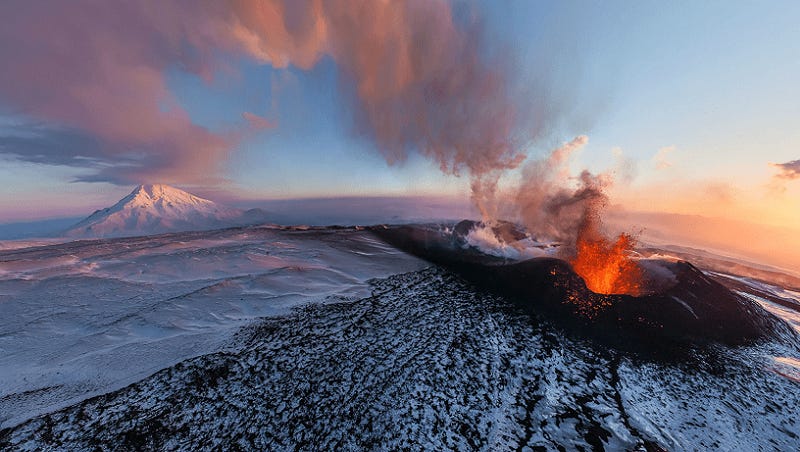
Mount Erebus is a scientific marvel: a towering, glaciated volcano that serves as the southernmost active volcano on Earth. While the surrounding Antarctic environment is a frozen wasteland of -22°F, Erebus hosts a persistent lava lake at its summit (one of only a few in the world). This internal furnace creates a surreal “fire and ice” ecosystem where volcanic gases carve out massive subglacial ice caves. These caves remain a “warm” 32°F and are filled with cathedral-like hoarfrost (the Sagrada Família of the arctic), providing a geothermal refuge for life that would otherwise perish in the Antarctic winter6.
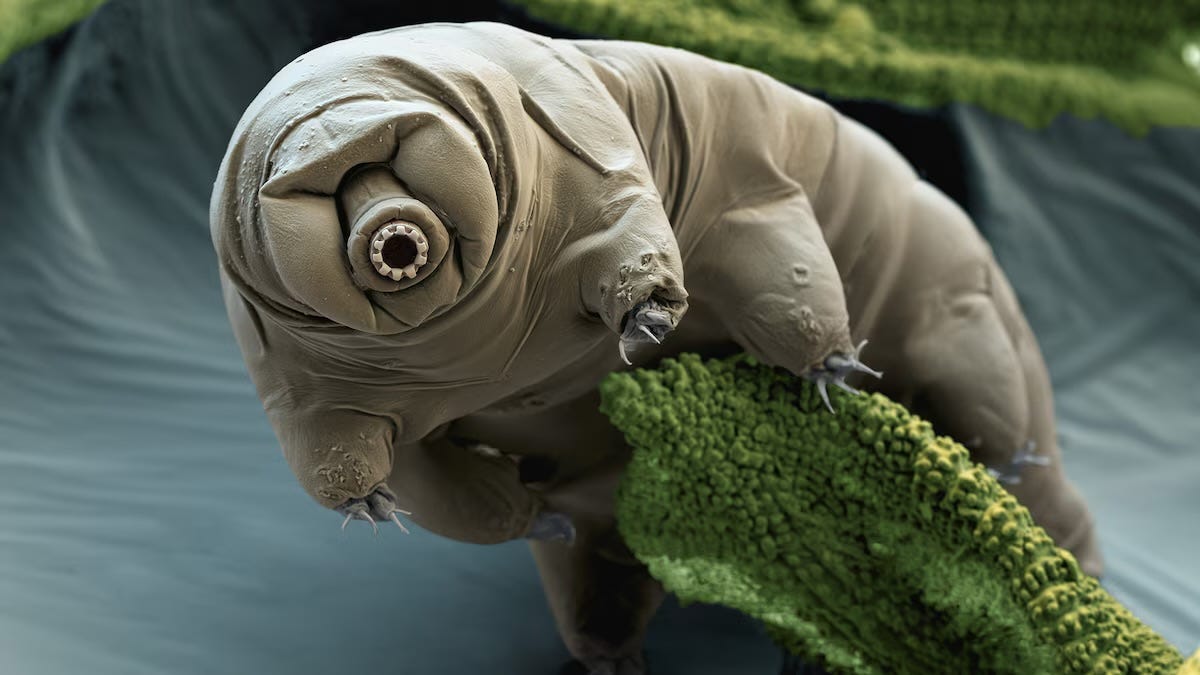
In a land where almost nothing grows, the steam-warmed soils of Erebus support vibrant, microscopic “forests”. At sites like Tramway Ridge, geothermal heat creates patches of moist, ice-free soil. Here, colonies of cyanobacteria and hardy mosses thrive, creating green and orange streaks against the volcanic rock. Living within these moss beds are Tardigrades (water bears7). These creatures can survive the extreme dehydration of the Antarctic by entering a state of dormancy, reanimating only when volcanic steam provides enough moisture8.
Seeing these landscapes, you can’t help but marvel, like a child grabbing your face, they demand without speaking, look at me. Yet beneath the marvel like the bummock of an iceberg lies an anxious undercurrent; when you encounter a paradox in logic it is confusing, but a paradox in nature is unsettling. Dry deserts shouldn’t touch oceans, fire shouldn’t erupt engulfed by ice, and frozen water shouldn’t be met with crashing waves.
In these extreme places, the “unaware” person may only see death or danger; but the “aware” person sees the Tardigrade clinging to the source, the Beetle tilting its shell to catch the grace of moisture, and the pools of Dallol pulsing with life, where there shouldn’t be life.
Perhaps the hard edges are the default of the Christian life.
Not the hope for smooth paths, but to embrace the narrow line. To follow the route when it makes no sense, and to embrace the tension between what is and what could be.
So take off your shoes and make the leap of faith.

Seely, M. (2004). The Namib: Natural history of an ancient desert (3rd ed.). Desert Research Foundation of Namibia.
Henschel, J. R., & Seely, M. K. (2008). Ecophysiology of Namib Desert animals. Journal of the Royal Society of South Africa, 63(2), 109–120.
Morell, V. (2012, January). Africa’s Danakil Desert. National Geographic Magazine, 221(1), 116–137.
Belilla, J., et al. (2019). Hyperdiverse archaea near life limits at the polyextreme geothermal Dallol area. Nature Ecology & Evolution, 3(11), 1552–1561.
Moehlman, P. D., et al. (2017). Road Map for the Conservation of the African Wild Ass (Equus africanus) 2017–2027. IUCN Species Survival Commission.
Kyle, P. R. (Ed.). (1994). Volcanological and environmental studies of Mount Erebus, Antarctica. American Geophysical Union.
Yes, these creepy guys.
Science Learning Hub. (2025, October 22). Mount Erebus – extreme habitats. University of Waikato.