
A Theology of Walking

A Walk in the Park
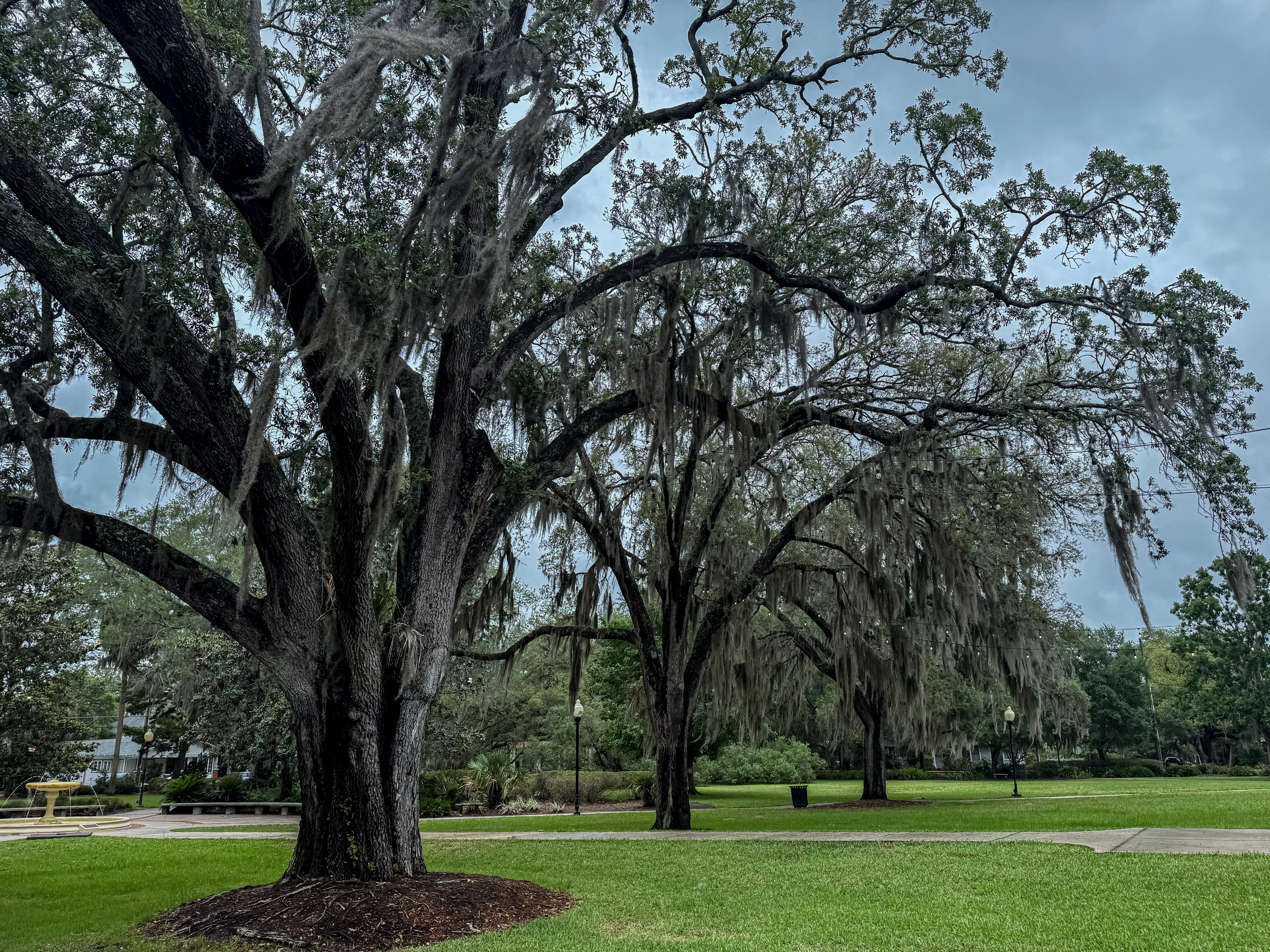
I’m walking thinking about what to write when I come upon this tree and pause to admire the Spanish moss as it sways in the breeze. If you are not from Florida, don’t touch it, that’s a tale for another day. As a young pastor, whenever I was stuck in a sermon, not sure how to land the plane or how to decipher a bewildering part of the text, I would go on a walk, and within 10 minutes the answer normally emerged as clear as a Magic Eye image where you pause just long enough to wait for the reveal.

Walks have created space for my creative, thinking, and writing process to breathe. They have set the pace of my spiritual formation. In this article, let’s trek together through a theology of walking.
A Brief History
In 1 Kings 19, Elijah is done, he is scared and burnt out. He called fire from heaven, slaughtered 450 prophets of Baal, and outran a chariot in a rainstorm. Then Jezebel sends a single threatening message and he falls apart. He flees to the wilderness, sits under a broom tree, and asks God to let him die. What does God do? He sends an angel with bread and water. Then God says, “get up and eat, for the journey is too great for you.” God’s prescription for a broken prophet was food and a long walk.
We’ve largely forgotten how to walk (at least in the US). Consider the numbers; Americans average about 2.5 miles a day, roughly 5,000 steps. That’s technically the threshold for “sedentary.”1 The Hadza of Tanzania, one of the last hunter-gatherer populations on earth, walk 6 to 9 miles daily, just to eat.2 Even our modern obsession with 10,000 steps goal isn’t science.3 A Japanese company invented it as a marketing slogan for a pedometer they were selling before the 1964 Tokyo Olympics. The device was called the Manpo-kei: “10,000 steps meter.” We’ve been running after a number a copywriter invented 60 years ago (the power of manufactured consensus).

At a spiritual level we’ve forgotten walking as a practice, as a theology. It’s been reduced to exercise and commuting, the thing you do to get somewhere before the real activity begins. We’ve loaded it with podcasts, audiobooks, and step-counters. Walking sacrificed on the altar of the wellnessmaxxing protocol.
A Long Obedience in the Same Direction
Eugene Peterson spent the last decade of his life writing and revising what became his memoir, The Pastor.4 He describes walking the trails around Flathead Lake in Montana. He walked to pray. He walked to think. He’d come to believe pastoral life required a particular pace, and that speed was approximately 3 miles an hour. Peterson was drawing on ancient tradition as he walked his glacial till trails.
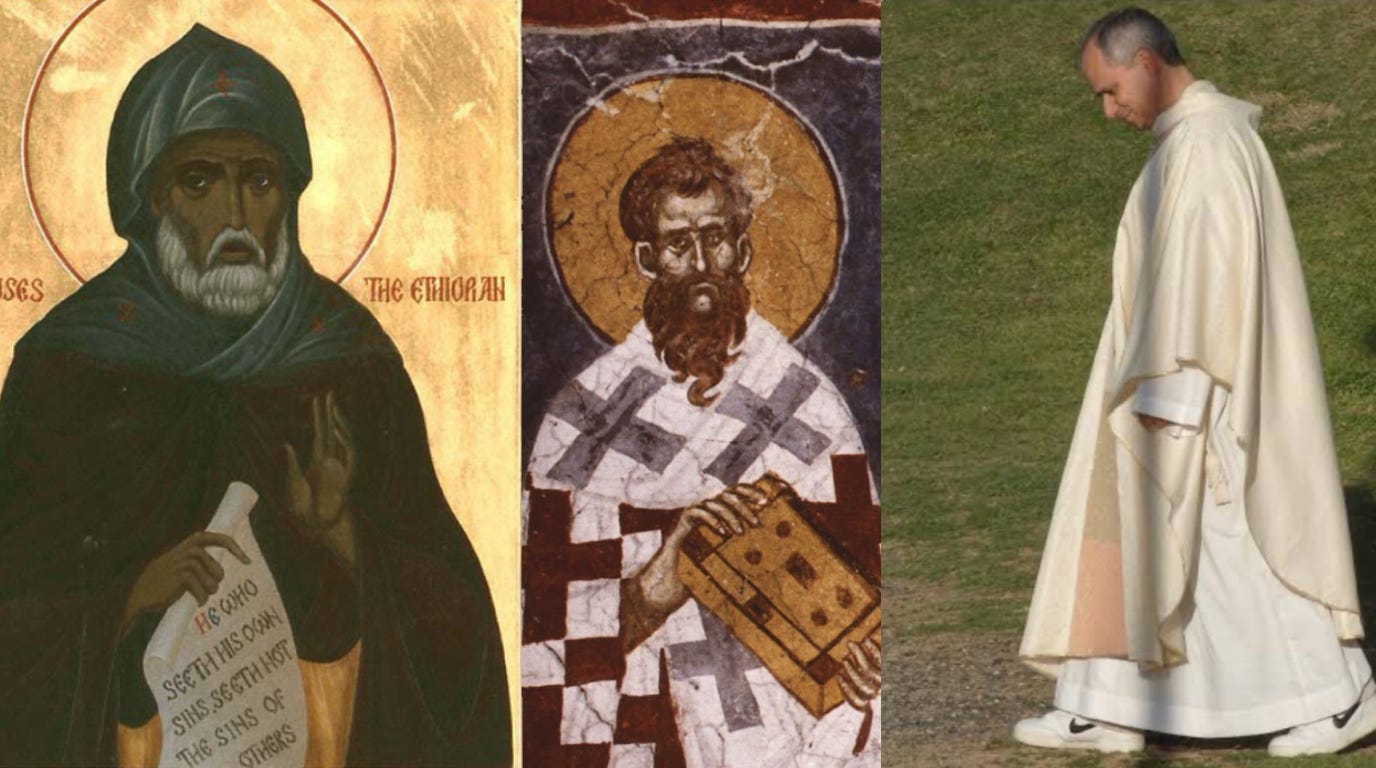
The desert fathers and mothers of 4th-century Egypt walked constantly. Their days were built around manual labor, Scripture, prayer, and walking. Abba Moses, one of the most celebrated of the desert teachers, was known for long predawn walks in the dark. Abba Bessarion was described as wandering the desert “like a bird” with no fixed cell or settled place.5 He walked through the desert for weeks on end with no destination. When asked why he had no cell, he essentially said the cell would be a kind of grasping. The wandering was the release and the walk was the prayer.
Throughout the redemptive story of the people of God you find walking. Enoch walked with God, and was not, for God took him. That’s the entire biography. Just a man who walked with God so intimately that the distance between earth and heaven eventually faded away. Abraham walked out of Ur without knowing where he was going. One of the remarkable statements in Genesis, easily read past, but the implications of this walk would affect all of humanity. The life of faith began with a single step, on a walk, in an uncertain direction. Abraham walked the length of Canaan, north and south, and God kept saying: look, everything you can see, I’m giving to you. The seeing required the walking. Moses spent 40 years walking the backside of a desert before he was ready to lead anyone anywhere. David walked the hills of Judea as a shepherd and learned something about vulnerability and provision that became the theological marrow in the bones of the Psalms. Jeremiah walked through the rubble of a crushed Jerusalem and wept what he saw onto ink and papyrus.
On the Emmaus road, two disciples were depleted, distraught, and devastated. They were walking away from Jerusalem on resurrection day. They were processing grief at 3 miles an hour. Jesus fallen into step beside them. He walked with them, asked questions, He listened to what stirs within them. He opened the Scripture slowly, over the course of seven miles, and something started burning in their chest, mile by mile. By the time they reached Emmaus they were different people than when they had left Jerusalem. The road created the opportunity for encounter.
The Science
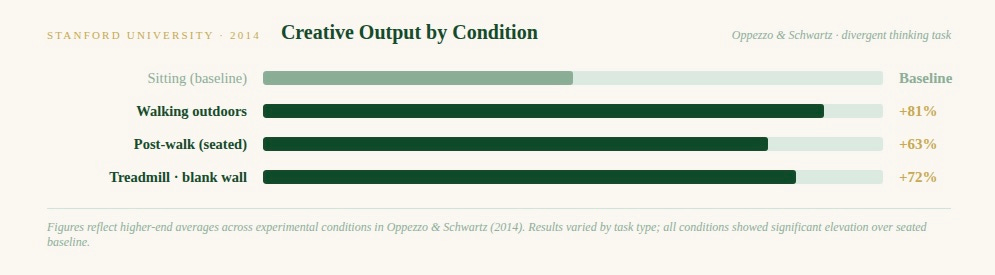
It turns out the desert fathers were doing neuroscience. They just didn’t have the vocabulary for it. Walking, specifically bilateral rhythmic movement, does something unique to the brain. Andrew Huberman’s research shows that the optic flow generated by walking directly suppresses amygdala activity.6 Meaning we are less anxious when we move. A walk allows the nervous system to exhale. Walking generates a similar bilateral rhythm that underlies EMDR therapy.7 It’s why a long walk after a hard conversation does more than an hour of sitting still. The body processes what the mind can’t hold. A Stanford study from 2014 found that creative output increased by 60% or more while walking and stayed elevated afterward. The effect held even on treadmills facing blank walls. The movement opens the mind to new possibilities.
Recovery of the Slow
Peterson had a distrust for any spirituality that wasn’t physical, local, and slow. That the spiritual life was meant to be like farming not managing. Showing up in the same place, in the same body, in all types of weather, over long stretches of time, without much visible result. That’s what walking is. It places you in a specific stretch of ground, under a specific patch of sky, in a specific season of weather. It forces you to move slow enough that you can’t help but notice things. The way light falls between Live Oak branches in the late afternoon. The smell of rain on asphalt. The neighbor who waves from the same porch every Tuesday. You can’t catch any of this at driving speed.
The recovery of walking as a spiritual practice is a form of resistance. We live inside an attention economy designed to capture and monetize every available second we own. The scroll, the autoplay are labyrinths of distraction, designed to keep us simultaneously stimulated and sedentary. Walking is the body asserting its creatureliness against the machine. Not everything can be downloaded and formation happens in the body, on the road, at 3 miles an hour.
Enoch walked with God. Jesus walked with his disciples. The disciples walked to Emmaus and met the risen Christ on the road. The Christian life has always been called the Way: a path walked together, in a body, over time.
So here’s my prescription: walk somewhere this week without your phone (or silenced and in your pocket if you need it for safety). Walk slowly enough to notice things. Walk long enough for the first wave of boredom to pass and watch as you come out from the breaker to the other side into something quieter, clearer, and unexpected. Pray if you know how. If you don’t, just walk and pay attention, which is, as the desert fathers would tell you, more or less the same thing. Elijah walked 40 days to Horeb and heard God in the still small voice. The walking prepared him for the silence. You can’t rush to that kind of quiet.

At 18 I decided I wanted to be a pastor. There was one problem. While I grew up in church, I didn’t have a clear understanding of how I thought about God. So, I spent 20 years pursuing that. This framework is the result of those 20 years.
You can get it in 40 minutes. The Theology Made Workshop
Tudor-Locke, C., et al. “How Many Steps/Day Are Enough? For Adults.” International Journal of Behavioral Nutrition and Physical Activity 8, no. 79 (2011).
Pontzer, H., Raichlen, D.A., Wood, B.M., et al. “Energy Expenditure and Activity Among Hadza Hunter-Gatherers.” American Journal of Human Biology 27, no. 5 (2015). It’s an interesting research paper if you want to read it: Read Here
See Harvard Health Publishing, “Why 10,000 Steps a Day?” (updated 2023).
Eugene Peterson, The Pastor: A Memoir (HarperOne, 2011).
Benedicta Ward, SLG, trans., The Sayings of the Desert Fathers: The Alphabetical Collection (Kalamazoo: Cistercian Publications, 1975).
Huberman, A. “Maximizing Productivity, Physical & Mental Health with Daily Tools.” Huberman Lab Podcast, Episode 28.
de Voogd, L.D., et al. “Eye-Movement Intervention Enhances Extinction via Amygdala Deactivation.” Journal of Neuroscience 38, no. 40 (2018).
Yep, definitely needed to read this today. Thank you for the richness in your writing, Jordan. Blessings!