
A 3,000-Year-Old Prayer Structure Changed How I Pray

One of the earliest ministries I worked for was a Presbyterian church overlooking a serene lake, full of swans and the occasional alligator—the swans a gift from Queen Elizabeth in the 50s.1 It was the quintessential chapel to get married in; before barn weddings became all the rage. The church was full of local dignitaries and wonderful salt of the earth Polk county folks. Whenever the service was about to start for the missional gathering (listen, it was 2007), they always wanted the Pentecostal to pray.
BTW: I was the Pentecostal.
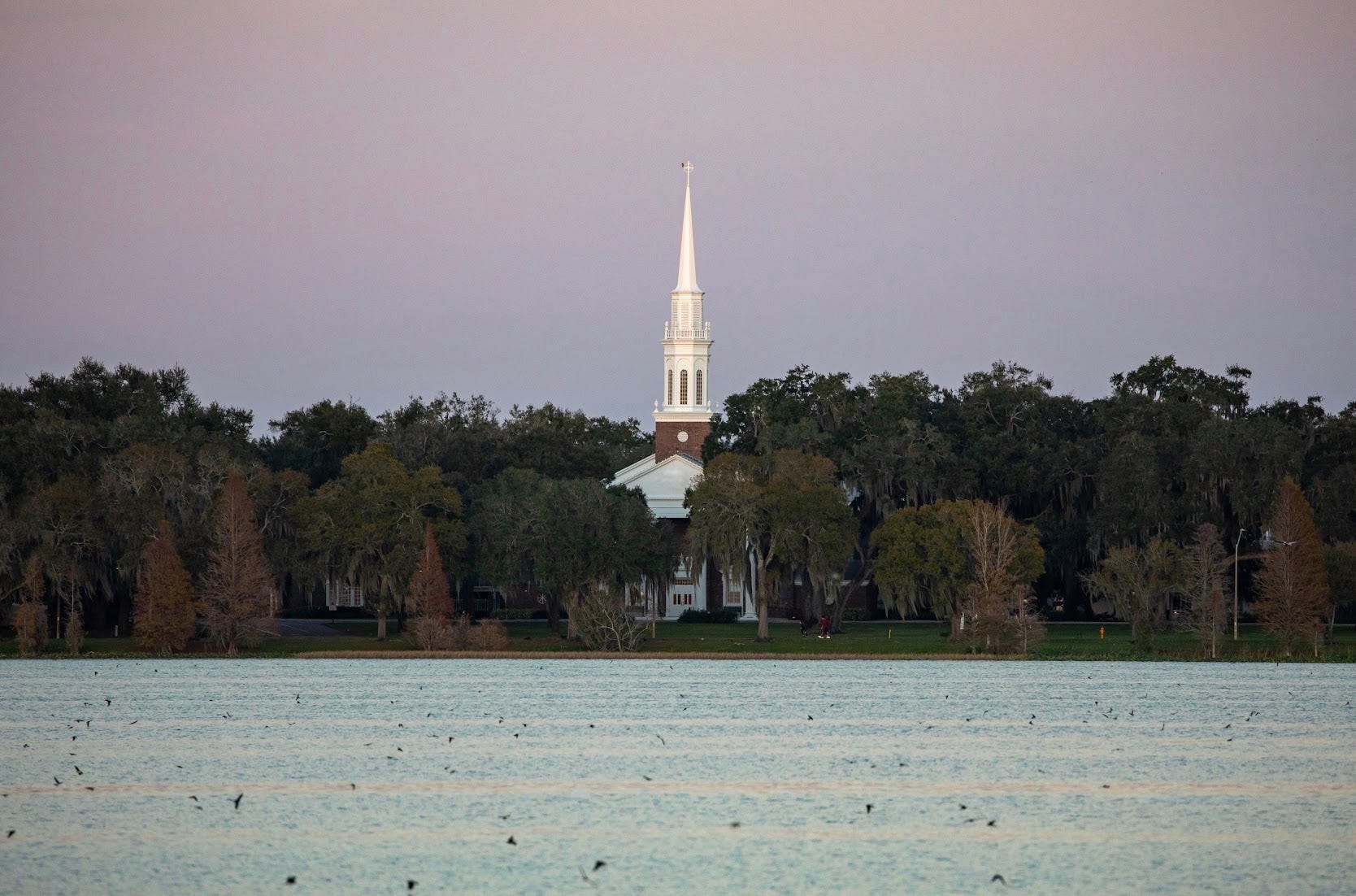
At the time I am a young guy on staff, still finishing up my undergrad degree in practical theology, opening the service in prayer. This is before I knew the difference between the PCA and PCUSA and thought infralapsarianism was a System of a Down lyric.
I was raised in and around church. As a child, we went up and down Pacific Coast highway attending charismatic church after charismatic church with revivals in between (the amount of church ceiling tiles I have counted). Because we were in so many churches as a kid, I experienced a wide variety in the way people prayed. From the men who would clear their throat, start praying and suddenly turn into a founding father. The Pentecostal who when they spoke in tongues raised their voice as if louder made it clearer. The prayer circle where every other word was, “Father God, thank you Father God, Father God, Father God…” Imagine doing that in normal conversation? “Steve, how you doing Steve? Steve, good to see you Steve.”
You’re not a barker. What are you doing?
Here’s what I’ve found: a lot of people find prayer hard. I often find prayer hard. One of the reasons we find it difficult is the tendency to overemphasize the model of prayer as a conversation with God. Impromptu prayer is good, conversational prayer is important. But when it’s all we have, at times it can feel like a conversation with ourselves. If I ask you a question, you respond. There’s a back and forth. With God there is too, but it’s categorically different. It’s impressions. Feelings. A sense of His presence. When impromptu conversational prayer is all we practice, it’s easy to get stuck.
The Bible presents us with another alternative. Within the architecture of scripture, there are different prayer tracks. They are like rails that you can put your prayer train on and ride. One of those tracks is the Tabernacle Prayer.2
Seven Stations
At the center of the Old Testament was the Tabernacle. The dwelling place of God, built to exact specifications. When the Israelites entered, they walked through seven stations, that followed God’s instructions to experience His presence.
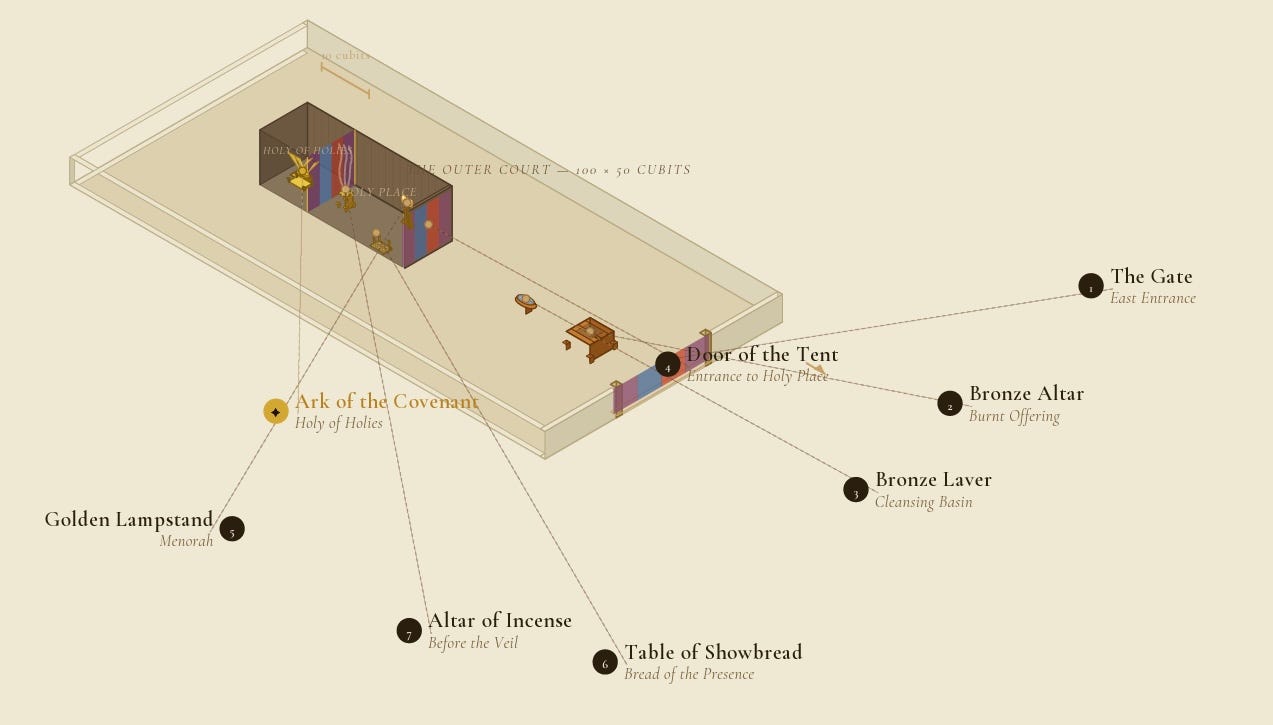
We don’t need a physical tabernacle anymore. But these same seven steps form a helpful prayer model. It’s not meant to be a script. It’s a track that teaches you how to move from gratitude to petition, in a way that isn’t forced but meaningful.
1. The Outer Court (Thanksgiving and Praise)
When the Israelites entered the tabernacle, they would enter through the gate into the outer court with singing and thanks. Psalm 100:4 says, “Enter His gates with thanksgiving and His courts with praise.”
As a model for prayer, here’s what I’ve found helpful: I will begin in prayer by taking my thanks as high as it can go. Before I thank God for my wife, my daughters, or that the Dodgers are not the Mets, before any of that, I start thanking at a cosmic level. Throughout this post are examples of how I pray like the one below.
God, thank you that you’re the creator of the universe. You’re the God of constellations. Thank you that your Spirit has been present from before creation. Thank you that your work extends before me and beyond me. May I sit with the reality that love came first, that in the Trinity you had perfect community and yet you still made me.
I take my praise and gratitude as high as it can go. As I am praying I’m asking myself: where at the cosmic level have I not really thanked God? Where do I need to behold his glory anew? Once I have gone as high as I can go, I start to bring my thanks down, for my family, friends, my church, community, and so on.
I don’t have a natural bent towards gratitude, I can be very impatient with myself, others and God, in my spiritual formation this is a place my desires need to be reordered. One of the practices towards that takes places in this prayer. When I pray through this model and I start at the outer court, I will look to thank God for something I’ve never thanked Him for before. Something that I have never expressed appreciation for. It doesn’t matter how small or off the wall it may be.
As an example, I love Mexican food. I grew up in California. I don’t look it, but I’m a quarter Mexican, my last name would have been Valdez but the name was changed a number of years before I was born.
Which means yes, I appreciate good Mexican food but occasionally I want to live más.
And you don’t go to Taco Bell because you want Mexican food. You go to Taco Bell because you want Taco Bell. Same thing can be said about coffee. I’m a bit of a snob.

But sometimes I just want a little Dunkin. I don’t go to Dunkin because I want a good cup of coffee. I go to Dunkin because I want Dunkin.
What does that have to do with thanks?
When I am praying through this model, I want to end this portion by finding something I have never thanked God for.
God, thank you for my Dunkin with the blueberry syrup this morning. Thank you for this coffee that most people would find gross but for whatever reason, I’m just enjoying.
When I dropped my girls off at school last week, the jasmine by their walkway was blooming and smelled idyllic.
God, thank you there is the wonderful scent of jasmine growing on that rusted school fence, I was not expecting that surprise when I dropped off the girls.
When we start with thanks in prayer our heart grows three sizes that day. We will realize that perhaps our lives are better than we think. Maybe we (certainly me) need to complain less and stop being like Job. Take notice, as we begin to pray this model we don’t start with “God, help me.” We start with “God, let me glorify you for all you’ve done.” Let me begin in thanks.
2. The Brazen Altar (The Cross)
The brazen altar was where Israelites sacrificed animals for the atonement of sins. It was the first thing they’d see walking in. We don’t sacrifice animals anymore; our sins have been paid once and for all on the cross. In this prayer model the brazen altar becomes the cross. Psalm 103 says, “Praise the Lord, my soul, and forget not all his benefits, who forgives all your sins, heals all your diseases, redeems your life from the pit, crowns you with love and compassion.” At this station, I’m not offering a sacrifice, but I am thanking God for the gift of Jesus. For His sacrifice. For His love. I’m opening myself to receive the power of the cross. Here are the five aspects of the cross I pray through.
(1) Salvation. Thank you that you’ve forgiven me; you brought me into Your family. I was lost and You gave me a home, because of the work of the cross, I am accepted in Jesus.
(2) Healing. God, you heal all my diseases. You see me in my anxiety, I am not alone. Thank you that I haven’t had a panic attack in six months. I rest knowing that because of Jesus I can experience eternal life. I hold onto the promise that one day my anxiety will be gone forever.
(3) Redemption. You didn’t just rescue me. You redeemed me, I take a moment to sit in that, to not rush past, to reflect on your redeeming love.
(4) Transformation. You’re making me into the image of Christ. Thank you Holy Spirit, form me towards the image of Jesus, I don’t want to stand in the way of your work.
(5) Blessing. Whether I see it or not, you’re providing everything I need. I am a child of God. I am experiencing Eternal Life now.
At this stage of the prayer I am reminding myself that I am not a victim of my circumstances, and I return my mind, my heart, and my posture to the finished work of Jesus.
3. The Laver (Cleansing)
The laver was a bowl of water where people were reminded of their sinfulness and the need to be cleansed. Take notice where this comes in the prayer: it is not first. We didn’t jump right away into confession. We first made our thanks big and wide, then we focused on the cross; returning our gaze to the finished work of Christ, and now we come to the laver. Romans 12:1 says, “Present your bodies as a living sacrifice, holy and acceptable to God.” At the third station I’m humbly praying, God, search me, know me. During this part of the prayer, I will bring to God things I am aware of that I need to repent.
Lately Father, I’ve not been very present with gratitude for the good you’ve been doing. I’ve been distracted by things in my life that aren’t moving at the pace I want. I have been greedy in my expectations of you and others. Search me and know my heart, and if there’s anything in me not of you, bring it to the surface now.
And I will stay in silence for a couple of minutes. A lot of times God brings things to my attention, things I stuffed down or things I wasn’t aware of. Sometimes He is quiet and I don’t hear anything. I have found to not worry about the silence, sometimes He leads through impressions of things that must be surrendered and other times He doesn’t. And when God does feel silent to me in that moment, it doesn’t mean He’s gone. After sitting in silence and allowing the Spirit to reveal what needs to change in my heart. I then offer myself up to Him by offering each part of my body.
God, I give you my tongue today, that I would speak good and not evil. My eyes, that I’d focus on the needs of others. My ears, that I’d be sensitive to your voice. My hands, that they’d do good. My feet, that I’d follow your way. My mind, that it’d be transformed by the renewal of your work.
I will end this portion by praying through the fruit of the Spirit, specifically walking through each aspect.
Father will you show me today how I am meant to be loving to my two girls. Make me aware of the joy of simple things (like Dunkin coffee). Bring me peace. Reveal where I lack patience in my marriage. How can I show kindness in my friendships? I want to taste your goodness and faithfulness in my life. Show me Lord where I have not been gentle.
4. The Candlestick (The Holy Spirit)
Now we come to the fourth station, a seven-branched candlestick, that burned continuously in the temple as a sacred light symbolizing Gods presence. The fire today represents the Holy Spirit. In the book of John, Jesus says something Savannah Bananas wild, “I have to go, because greater things you’ll do.”
Greater. Things.
If we really believed what Jesus said in His farewell discourse how differently would we live? How differently would we pray? How differently would we show up in our marriages, our jobs, in our relationships? At this stage in the prayer, I’m asking the Holy Spirit for more of His presence and work in my life. In Isaiah 11:2 there is a prophecy describing Jesus, it says, “The Spirit of the Lord will rest on him—the Spirit of wisdom and of understanding, the Spirit of counsel and of might, the Spirit of the knowledge and fear of the Lord.” Isaiah expands the work of the Holy Spirit into seven expressions (they are in bold above), the number symbolizing completeness in Hebrew thought. Here I am welcoming the Holy Spirit and praying these seven expressions over myself.
Spirit of the LORD, Holy Spirit I welcome you into this space, I know you are already here, I know I can be quick to forget your presence, I remind myself right now that you are for my good. I ask for the spirit of wisdom in the decisions I make today, I ask for the spirit of understanding, particularly related to leading my family, I ask for the spirit of counsel in the areas I tend to be blind. Holy Spirit I ask that you pour upon me your might and knowledge. As I live out today I want to walk in the fear of the LORD.
As a quick aside, “let go and let God” is not good theology. Surrender matters, yes, but God isn’t asking us to go limp. He’s asking us to participate. To walk with Him. To be transformed into the likeness of Jesus. There’s a difference between giving up and showing up. This stage of the prayer is critical, we need the empowering presence and work of the Holy Spirit to guide us. To be reminded of what Jesus said in John 14.
5. The Table of Showbread (The Word)
In the tabernacle there was a table with twelve loaves of bread, representing the importance of God’s Word as daily sustenance. Joshua 1:8 tells us, “Keep this book of law always on your lips. Meditate on it day and night.”
Here’s what I’ve found: the more I’m saturated in the Word, the more the Word shows up in my prayers. I don’t have to force it. It just comes out. It becomes the language I think and pray in.
God, give me fresh revelation in your Word. Not just as I read it, but as I live my day. Help me apply the relevance of a book written 2,000 years ago to my part of the world around me. Show me something today in Your Word that you want me to share. Maybe in a conversation with a stranger. Maybe with a friend. I want to anticipate you’re going to do something through your Word and through me, today.
6. The Altar of Incense (Worship)
A small altar of burning incense stood at the entrance of the Holy of Holies. The people entered God’s presence by worshiping His name. Proverbs 18:10, “The name of the Lord is a strong tower. The righteous run into it and are safe.” (If you grew up in church in the ‘90s, you just started singing that song. IYKYK)
At the altar, I’m thanking God that His presence is available and I’m praising His names. In Ancient Near Eastern culture, to have someone’s name meant to have a level of access and control.3 We see this when God first reveals His name at the burning bush: I am who I am. Throughout the Old Testament we learn more names of God. These names don’t mean we control God. Rather God has chosen to reveal himself to us and I can declare His names over my life. Over my situation. Bringing myself under His good reign.
God, you are my righteousness. My righteousness isn’t found in how good or bad I am today. It’s found in who you are and what Jesus accomplished on the cross. You are my sanctifier. As much as I want to grow and become holy, the Holy Spirit wants that more for me than I do. You are my healer. My peace. My provider. My shepherd.
7. The Ark of the Covenant (Petition)
The final place in the tabernacle was the Holy of Holies; where God’s presence dwelt. The priest would intercede there, praying on behalf of the people. And at His ascension, Jesus went to the right hand of the Father to pray and intercede for us.
In 1 Timothy 2 we find this, “I urge you, first of all, that petitions, prayers, and intercession be made for all people, for kings and all those in authority.” Here I’m joining with Jesus and the Holy Spirit, in petitioning for others. At this part of the prayer I will start broad and then move in more narrow as I go.
Authority. World governments. The United States. Other countries. Then I move local to my mayor, my county, my city. What principalities and powers are over these cities? God, I want to be aware, I want see darkness pushed back in my city, I want to participate in your light shining forth, Jesus you are the king.
The marginalized. Who around me is suffering injustice? Who are the poor, widowed, and weak? Where am I missing an opportunity to be the Good Samaritan because I’m too busy? I am asking God to reveal that to my heart.
My family. Immediate and extended. Praying blessings over my wife, over my children; that they’d dwell in the house of the Lord forever. That their future husbands would be men of God who would walk with Him all the days of their lives.
My church. That we’d have boldness. Be a house of encouragement and love. That God would be exalted.
My adversaries. And listen the adversaries that take space in our thoughts probably aren’t trying to kill us. It’s Sharon at work or the neighbor who doesn’t mow their lawn as often as we want.
Why This Works
Notice how we move through six stations before we ask for anything, before we make a request; we stir up our hearts. We are positioning our desires towards God. This is a prayer model you can pray in three minutes or thirty and it’s not about the time, it’s about having a track. And if you pray it today, then pray it tomorrow, and pray it in three weeks, you will find it’s not the same prayer. You’re not repeating something rote, but bringing God in, following a model in Scripture, saying: Lord guide me through this.
Outer Court. Brazen Altar. Laver. Candlestick. Table. Altar of Incense. Ark.
Thanks. Cross. Cleansing. Spirit. Word. Worship. Petition.
Try the track. See what happens.

This post is what theological thinking actually looks like in practice. I built a workshop that teaches you how to do it yourself, so you’re not dependent on someone else to hand you the framework. → Faith Without Fear
This model of prayer was developed in 20th century Pentecostal and Charismatic Christianity. It was made popular by pastors like David Yonggi Cho the founder of Full Gospel Church and more recently by Church of the Highlands.
One of my professors from seminary, John Frame has a wonderful treatment on this.
Thank you, very comprehensive. One of my favorite "structures" of prayer is ACTS...Adoration, Confession, Thanksgiving and Supplication.
Bro this is incredibly well-written and greatly appreciated 💐 I am excited to start implementing this into my prayer life! Thanks for sharing; what a gift