
A 1,700-Year-Old Reading Habit Changed How I Open My Bible

An Origin Story
It started a long, long, time ago in a galaxy far, far away… Okay, maybe not a different galaxy, but there was a desert and one possessing something more intriguing than Jawas and sand people. Around the year 270, a young man in Egypt slipped into the back of a church service after it had started. He was around twenty and his parents had recently died; leaving him a large piece of farmland and a younger sister to raise. As he sat down the Gospel was being read aloud, and a line surged to the back and grabbed him by the tunic, “If you want to be perfect, go, sell what you have, and give to the poor, and you will have treasure in heaven.”1
His name was Antony. We know the story because Athanasius, the bishop of Alexandria, wrote it down not long after Antony died, in a short book called the Life of Antony.2 The story unfolded like a movie scene, instead of going home to mull it over, he walked out of that service, gave the farmland to his neighbors, found a home for his sister with a community of Christian women, and kept a small portion of the money back. Then a few days later he heard another verse read, this one about not worrying over tomorrow,3 and he gave the money he kept back away too. He went to live in the desert dunes and stayed there, more or less, until he died at over a hundred. That is the famous part of the story, the one who gave everything away, and went off in infamy to become one of the great desert fathers. But there is something else in the story of equal interest—the act that made it all happen.
When Antony walked into that church in 270, he had no CSB study Bible on his knee, no YouVersion app open, no Moleskin journal and a pen. All he had were the few lines of Scripture spoken in a small room. He heard those words like they were spoken directly to him, for that particular morning, meant to be received in the present tense. 240 years earlier, on the road to Emmaus, two disciples turned to one another after a seven mile walk and said, “Were not our hearts burning within us while He talked with us on the road and opened the Scriptures to us?”4 This was how the desert Christians approached the Scriptures and it’s not the way many of us were taught to read the Bible.
The Practice of Lectio Divina
I grew up in church, did the Bible drills, knew the catchy songs, and was trained to read Scripture the way you are taught to prep for an exam. Find the main idea, note who wrote it and why. Then get the interpretation right so you do not embarrass yourself in front of people who know more than you do. And you have to keep moving, because there is a reading plan to complete and you are two days behind—bless your heart. Now, that is not necessarily wrong, I have to confess in my hermeneutics course I teach some of it for a living. But reading the Bible this way does put you in a particular posture. You sit above the text with a highlighter and the Scriptures sits below you, like a puzzle needing to be solved. In the Egyptian desert, folks like St. Antony had the posture turned upside down. The monks sat under the text and waited and waited, allowing it to work on them.
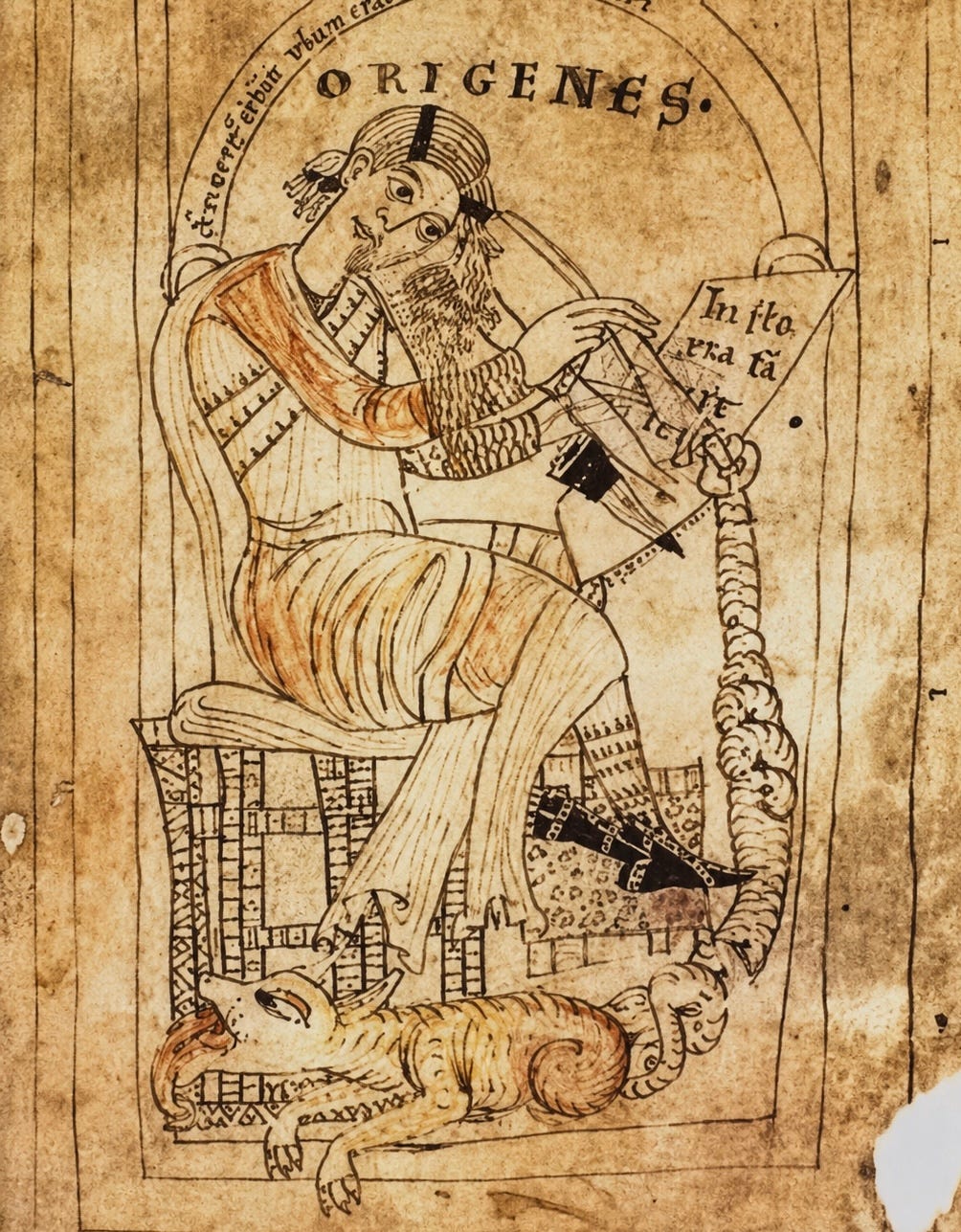
30 years before Antony’s experience, Origen of Alexandria had written to a former student named Gregory and urged him to give himself to what he called divine reading, attending to Scripture with prayer and the expectation that God would meet him there.5 The desert father took this as their modus operandi. The monks memorized enormous stretches of the Bible, often the entire book of Psalms, and spoke it under their breath, slowly, while they wove rope and baskets through the long hours of manual labor.6 They would read a short passage aloud, slowly, then read it again. The Latin word associated around this was meditatio, which comes from meditari (to rehearse, turn over), the monks paired this with ruminatio which is where we get the image for what a cow does when it chews the cud.7 You take a small amount in, you keep working it over, and you do that until it becomes a part of you.
Evagrius, a brilliant monk who died in 399, taught the brothers to answer their worst thoughts with specific lines of Scripture, the way Jesus answered the tempter in the wilderness.8 A sand storm of despair would roll in and the monks would have a verse ready, learned by heart, fixed in their mind to say back. Scripture was food, it was life, and when needed a spiritual weapon kept within tongues reach.
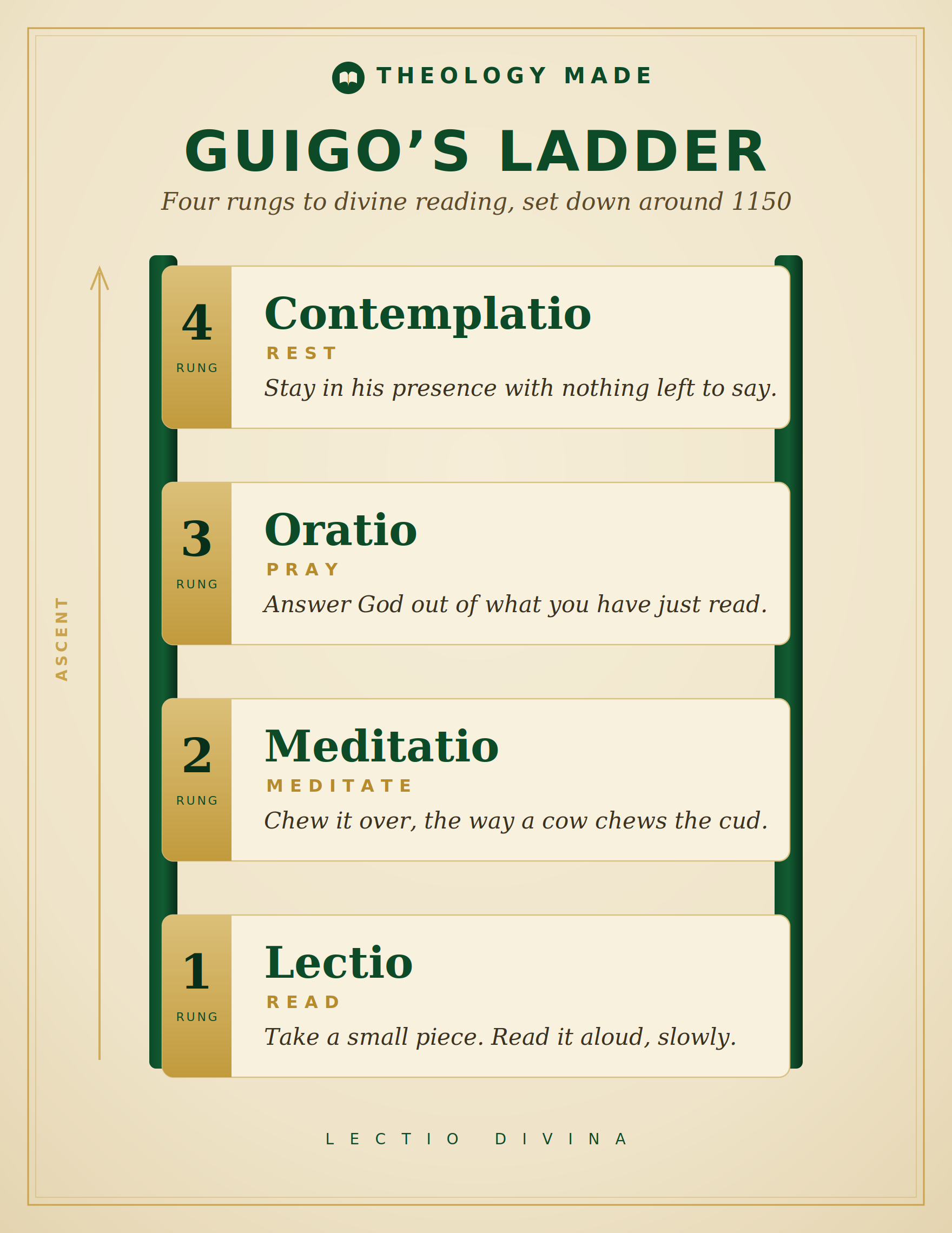
Centuries later, around 1150, a Carthusian prior named Guigo II wrote a brief letter that gave this approach to reading the Bible a process anyone could follow. He pictured it as a ladder with four rungs. (1) You read a passage of Scripture. (2) You meditate on it, chewing it the way the monks in the desert did. (3) You pray and listen, answering God out of what you have just read. (4) Then you rest, staying in his presence with nothing left to say, no agenda; attuning your presence to God’s presence.9 Reading, meditation, prayer, rest, four rungs on a ladder. Guigo gave us a process and shape to what the desert monks had been practicing eight centuries earlier.
This method goes by a Latin name that we still use today: Lectio Divina (pronounced: lex-see-oh dih-vee-nah). It is simple and beautiful; you take a small (at most one chapter, but normally a pericope10) piece of the Scriptures and you move through it slowly. No rush, no goal, no completion waiting for you at the end with a check off list. You take that one piece of scripture and turn it over and over in your mind with the belief that God intends to say something to you through his Word today.
Here is what it changed for me, I am a type A, D on the DiSC, Enneagram 3, I eat goals for breakfast and tasks for lunch, type of achiever. I used to measure a morning by how much ground I covered in the Bible. Three chapters was the minimum acceptable amount. But today, I will take four or five verses and stay put. I will normally read them out loud, because when you read it out loud you hear things that reading in your mind will miss. Then I wait to notice which word or turn of phrase grabs me by the collar, and I have learned to trust the snag instead of hurrying past it, worrying I am going to miss something else. Then I talk to God about what pulled me, usually I say something short, I am not trying to impress Him, I just want to sit and receive from my Father, “God I don’t know what it is about this phrase here, but I think you want it to say something to me today.” After I talk to God about the word, phrase, or verse that arrested me, I just sit still. What I have learned, is the sitting still is the most meaningful part, the minutes I used to treat as a turning toward my day and moving on, have now become the point. Sitting and waiting, I place no expectations on myself, no set agenda, I wait in stillness and silence for God as I turn what grabbed me in the Scriptures over and over again in mind.
I get through far less of the Bible now, but there is more of it in me.
A note for those of us on the Protestant side of the family, since this practice grew up through the desert and monasteries and has been carried mostly by Catholic and Orthodox hands. Antony walked into the desert two full centuries before anything resembling our current divisions existed. Origen wrote his letter to Gregory more than twelve hundred years before Luther was born. This way of reading was held in common long before anyone thought to split up. Recovering this way of reading the Bible is closer to coming home than trying something new.
Moving Forward
The desert fathers did not leave us much of a method. They left something better: an expectation. They saw the opening of scripture as the opening of a door to an expected guest waiting to come in and speak their name. Practicing Lectio Divina is learning to see the Word like Antony experienced it 1,700 years ago. Were not our hearts burning within us while he talked with us.
Matt. 19:21.
Athansius, The life of Antony and the Letter to Marcellinus, trans. Robert C. Gregg, Classics of Western Spirituality (New York: Paulist Press, 1980).
Matt. 6:34.
Luke 24:32.
Origen, “Letter to Gregory” 3–4, in The Ante-Nicene Fathers, vol. 4, ed. Alexander Roberts and James Donaldson (1885; repr. Peabody, MA: Hendrickson, 1994).
Douglas Burton-Christie, The Word in the Desert: Scripture and the Quest for Holiness in Early Christian Monasticism (New York: Oxford University Press, 1993)
Jean Leclercq, The Love of Learning and the Desire for God: A Study of Monastic Culture, trans. Catharine Misrahi, 3rd ed. (New York: Fordham University Press, 1982)
Evagrius of Pontus, Talking Back: A Monastic Handbook for Combating Demons (Antirrhêtikos), trans. David Brakke, Cistercian Studies 229 (Collegeville, MN: Liturgical Press, 2009)
Guigo II, The Ladder of Monks: A Letter on the Contemplative Life, and Twelve Meditations, trans. Edmund Colledge and James Walsh (Kalamazoo, MI: Cistercian Publications, 1981).
A pericope is one unit of thought in the Scriptures, think like a set of scriptures that go together. Most modern Bibles provide this division for you. I find it makes the meditation more focused as the parameters have been set.