

666: The Bible's Most Misunderstood Number


In 1989, Ronald and Nancy Reagan bought a retirement home in the Bel Air neighborhood of Los Angeles. Before moving in, they had one odd renovation request that made national news. It had nothing to do with remodeling the kitchen or wanting to remove a Joshua tree. The address was 666 St. Cloud Road, and the former President of the United States had it officially changed to 668.1 Apparently, he would have preferred a house where the streets have no name.2
A Hollywood actor, the 40th president, the man who wasn’t afraid of the Cold War, was spooked by three numbers from the Book of Revelation. Whatever else you can say about the Bible’s influence on Western culture, no other verse has produced a certified phobia (hexakosioihexekontahexaphobia, if you want to lose a spelling bee), a horror franchise, an Iron Maiden album, and a real-estate issue in Bel Air. The verse behind all the fear: “This calls for wisdom: let the one who has understanding calculate the number of the beast, for it is the number of a man, and his number is 666.”3
However, the verse in question has less do with Stephen King and more to do with Ada Lovelace; meaning it’s a math problem. This is the only time in Scripture where the author stops the story, looks at the reader, and says: get out a pen, this isn’t your Wordle, or NYT crossword puzzle, but something that calls for wisdom. Yet, for some reason twenty centuries later, we still don’t seem to know the answer. And it gets a whole lot more interesting, because some of the oldest Bibles in existence say the number is actually 616.
Wait... what?
How Ancient People Did Math With Names
Before we get to the three views, a piece of background. The ancient world didn’t have separate symbols for numbers. Letters had a dual usage, Alpha was 1, Beta was 2, and so on up the alphabet, this was true of Greek and Hebrew alike. Which meant every name had a numerical value, and turning names into numbers became a game and, eventually, a rabbinic discipline called gematria.4
On a wall in Pompeii, buried by Vesuvius in 79 AD, an admirer scratched: “I love her whose number is 545.”5 First-century flirting involved a little encrypted texting, which is also how I feel trying to flirt with my wife via text (did I send the right emoji 🤔). John’s original readers would have recognized what was going on in Revelation 13, the number of the beast was a name, hidden in the code, waiting for someone with “understanding” to figure it out. So, whose name is it? Here are three frameworks readers have used to solve it.
View One: The Emperor’s Name
The first views answer is the name that would have popped in the heads of many of John’s first readers: Nero.
Take the Greek form of his name and title, Neron Kaisar, transliterate it into Hebrew letters (נרון קסר), and add up the values: nun (50) + resh (200) + waw (6) + nun (50) + qof (100) + samek (60) + resh (200). The total is 666.6
If this were the whole argument, you could call it a coincidence hunt. Enough fiddling with spellings can make almost any name hit almost any number, which is what we’ll address in view three. But the Nero solution has a piece of evidence no other candidate can touch and it comes from the manuscripts themselves.
Not every early copy of Revelation reads 666. Papyrus 115, a late third-century codex pulled from the sand at Oxyrhynchus and not identified until 1999, gives 616. So does Codex Ephraemi.7 And around 180, Irenaeus of Lyons was already complaining about the 616 copies, which puts the variant in circulation earlier than any manuscript we still hold.8
To add to the suspense, Nero’s name had two common spellings. The Greek form, Neron, ends with a final nun, worth 50. The Latin form, Nero, drops it. Which means if we run the Latin spelling through the same math the total falls by 50, from 666 to 616.9 Both numbers point at the same man 😱 (am I doing this emoji thing right?).
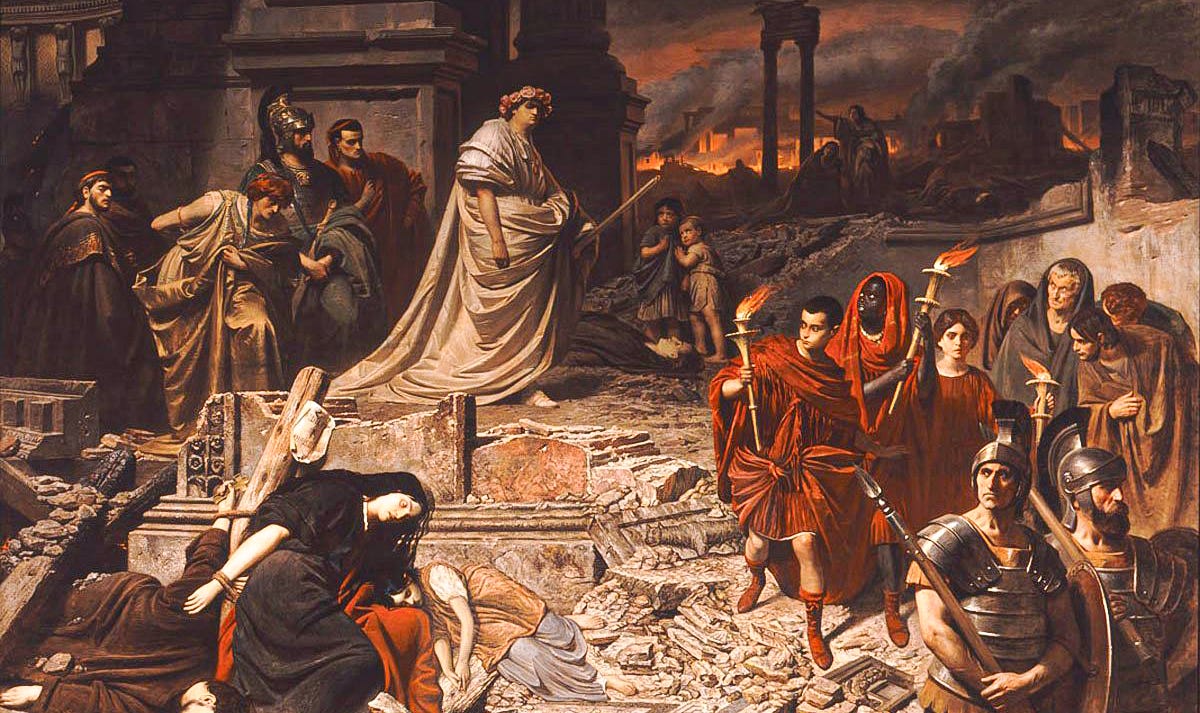
And the man fits the description. Nero was the first emperor to make war on the church, he executed Christians in the aftermath of the Great Fire of Rome in 64 AD, and the historian Tacitus records believers being burned as torches to light Nero’s gardens.10 After his suicide in 68 AD, a rumor spread across the empire that Nero would return from the dead, a legend serious enough that at least three imposters claimed to be the raised Nero.11
The strength of this view is that it lets Revelation mean something to the people it was originally mailed to; seven churches in first-century Asia Minor. Its weakness is the sense that a code this localized seems odd for a book that ends with the renewal of all creation.
View Two: The Number That Falls Short
The second view says we’ve been counting when we should have been reading. In Revelation, numbers carry meaning before they carry math. The book is built around sevens. Seven churches, seven seals, seven trumpets, and seven bowls. Seven is the number of completion, stamped into the creation week itself. Six is seven minus one (impressive math, I know, you should see me try and calculate a tip). Six is the almost-number, the day humanity was created, greatness one step short of rest. In this reading, 666 is failure but crank up the volume in your Camry like it’s 2005 and you are blasting Panic! at the Disco12: falling short, then falling short again, and then again.13
The structure of Revelation supports the idea, because the beast is a counterfeit. A dragon who empowers a beast, who is promoted by a second beast: an unholy imitation of Father, Son, and Spirit. The beast even mimics the resurrection with its healed death-wound. And the mark itself is a forgery of something told early in the history of the people of God. In Deuteronomy, Israel was told to bind God’s words “as a sign on your hand” and “on your forehead.”14 Revelation’s faithful receive the seal of God on their foreheads two chapters before the beast starts stamping anyone.15 Everyone in Revelation ends up marked. The only question the book cares about is who marked you?
One more detail makes this reading attractive. Run the gematria on the Greek name Iēsous, Jesus, and the total is 888.16 Beyond completeness, the eighth day is resurrection morning. Where the beast falls short three times, Christ overflows three times. Whether John intended that pairing or later Christians discovered it, that’s for you to decide.
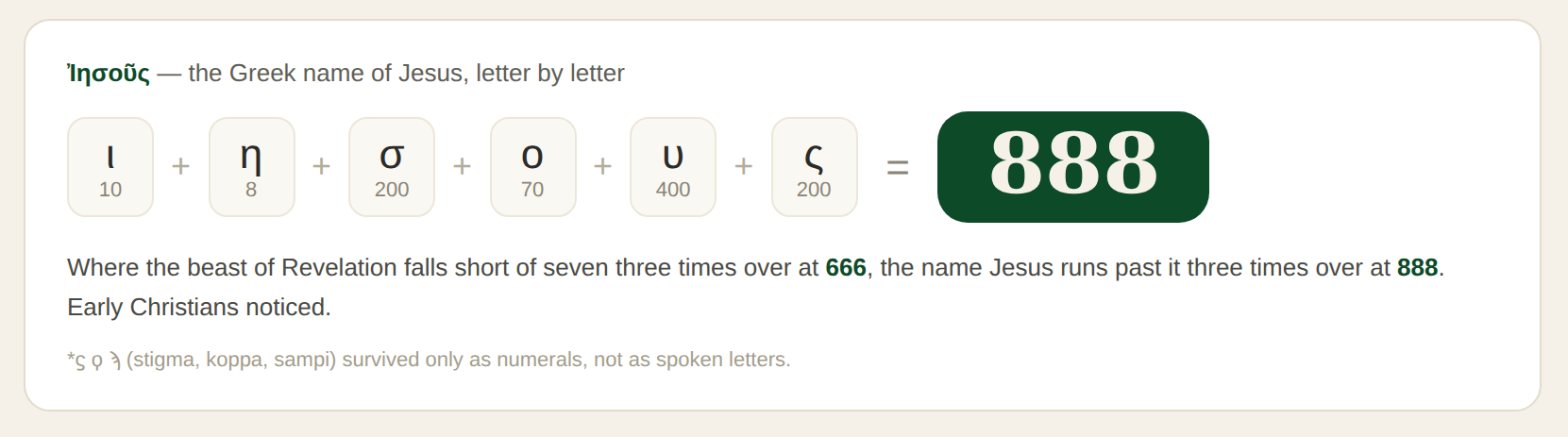
The strength of this view is that it works in every century, which is exactly what we would expect a letter that says to “the one who has understanding” to do. Its weakness is that Revelation 13:18 really does say to calculate, and does say the number belongs to a man.
View Three: The Beast Still to Come
The third view focuses on the future tense. Revelation calls itself a prophecy, and in this reading the beast is a figure history hasn’t met yet: a final world ruler, empowered by the dragon, who will demand worship and enforce it economically. No one buys or sells without the mark.17 For futurist interpreters spanning from the early church’s expectation of a personal Antichrist to the dispensationalist tradition that produced The Late Great Planet Earth and the Left Behind fictional novels, 666 is a name tag anxiously waiting for its owner.18
To be fair this view had support earlier than the 90s Left Behind books and anti-Pokemon rhetoric.19 Irenaeus himself, the earliest commentator we have on the verse, believed the beast was still coming. He toyed with a few candidate names (Teitan was his favorite, since it summed to 666), but then, he told his readers to stop guessing. If the Spirit had wanted us to know the name now, Irenaeus wrote, John would have said it.20
The church did not heed his advice.
What followed was a two-thousand-year calculator graveyard. Medieval Christians ran the numbers on Muhammad. Reformation-era Protestants made the papacy work by summing the Latin title Vicarius Filii Dei, a calculation later popularized by the Adventist writer Uriah Smith.21 Other generations convicted Napoleon, then Kaiser Wilhelm, then Hitler, then Stalin. In the 1980s, a bestselling paperback found the number hiding in the guard bars of the new UPC barcodes,22 and plenty of Americans noticed that Ronald Wilson Reagan carried six letters in each of his three names, which perhaps explains the presidents queasiness about his mailbox. Social Security numbers, credit cards, microchips, and vaccines have each taken a turn.
Every single identification came with an air of confidence, but now is a museum relic collecting dust. That track record should serve as a warning label for the futurist view, many have tried to predict what 666 was really carrying and so far no one has figured it out. Now, the strength of this approach is that it refuses to let Revelation shrink into an artifact or book from the past; evil organizes, and Scripture they believe says it will organize one last time.
This Calls for Wisdom
Put the three frameworks side by side and you’ll notice they are traveling different roads, but ending in a similar place. If the number is Nero, then John gave his churches a portrait of what beastliness looks like when it wears a crown. If the number is symbolic, that portrait becomes a pattern, stamped on every empire that demands what belongs to God. If the beast is still coming, the pattern has a final chapter and evil will be dealt with.
Which may be why the verse opens the way it does: the need for wisdom. First-century believers weren’t being asked to predict their beast; they were being asked to spot him, and to refuse him; at the cost of their livelihoods and often their lives. Maybe that’s the discomfort hiding under twenty centuries of failed math. Decoding the beast is the easy version of the assignment, because the beast is always somebody else. Revelation’s actual question the one underneath it all, has never expired, and it isn’t about an address in Bel Air or a crazy Roman Emperor. Everyone in that book bears a mark, God’s or the beast’s, and nobody gets to skip the choosing.

Enjoy the Bible’s “wait… what?” moments?
Here are three more puzzles to put together:
“St. Cloud Road: Reagans to Get New Address,” Los Angeles Times, 1989. The street number of the Bel Air home was changed from 666 to 668 at the Reagans’ request before they took residence.
Yes, that was a nod to U2, that I probably worked too hard to get in, unlike that time they put their album automatically on all our Iphones.
Revelation 13:18.
Adele Yarbro Collins, “Numerical Symbolism in Jewish and Early Christian Apocalyptic Literature,” ANRW II.21.2 (1984).
Adolf Deissmann, Light from the Ancient East, trans. Lionel R. M. Strachan (London: Hodder & Stoughton, 1910), 276–278.
On the Nero gematria, see Craig R. Koester, Revelation, Anchor Yale Bible 38A (New Haven: Yale University Press, 2014
Papyrus 115 (P.Oxy. LXVI 4499), published in The Oxyrhynchus Papyri, vol. 66 (London: Egypt Exploration Society, 1999); Codex Ephraemi Rescriptus (C).
Irenaeus, Against Heresies 5.30.1. Irenaeus affirmed 666 and attributed 616 to scribal error, which tells us both readings were in circulation within a century of Revelation’s composition.
Aune, Revelation 6–16, 770–771. The Latin form Nero Caesar rendered in Hebrew (נרו קסר) omits the final nun, reducing the sum by exactly 50.
Tacitus, Annals 15.44.
Suetonius, Nero 57; Sibylline Oracles 4.119–124; 5.361–370. On the Nero redivivus legend and its relationship to the beast, see Richard Bauckham, The Climax of Prophecy: Studies on the Book of Revelation (Edinburgh: T&T Clark, 1993)
Turns out they also enjoy pacing the pews in a church corridor. I will see myself out.
For the symbolic reading of 666 as consistent falling-short, see G. K. Beale, The Book of Revelation, New International Greek Testament Commentary (Grand Rapids: Eerdmans, 1999)
Deuteronomy 6:8; 11:18.
Revelation 7:3; 14:1.
Sibylline Oracles 1.324–330, where the name of the coming Savior is identified by the number 888.
Revelation 13:16–17.
Hal Lindsey, The Late Great Planet Earth (Grand Rapids: Zondervan, 1970); Tim LaHaye and Jerry B. Jenkins, Left Behind (Wheaton, IL: Tyndale House, 1995).
Some fundamentalist preachers believed Pokemon was an acronym for Anti-Christ Devil's Child. Poor little Pikachu.
Irenaeus, Against Heresies 5.30.3.
Uriah Smith, Thoughts, Critical and Practical, on the Book of Revelation (Battle Creek, MI: Seventh-day Adventist Publishing Association, 1865). The Vicarius Filii Dei calculation sums the Roman-numeral values of the letters in the title.
Mary Stewart Relfe, When Your Money Fails: The “666 System” Is Here (Montgomery, AL: Ministries, Inc., 1981).